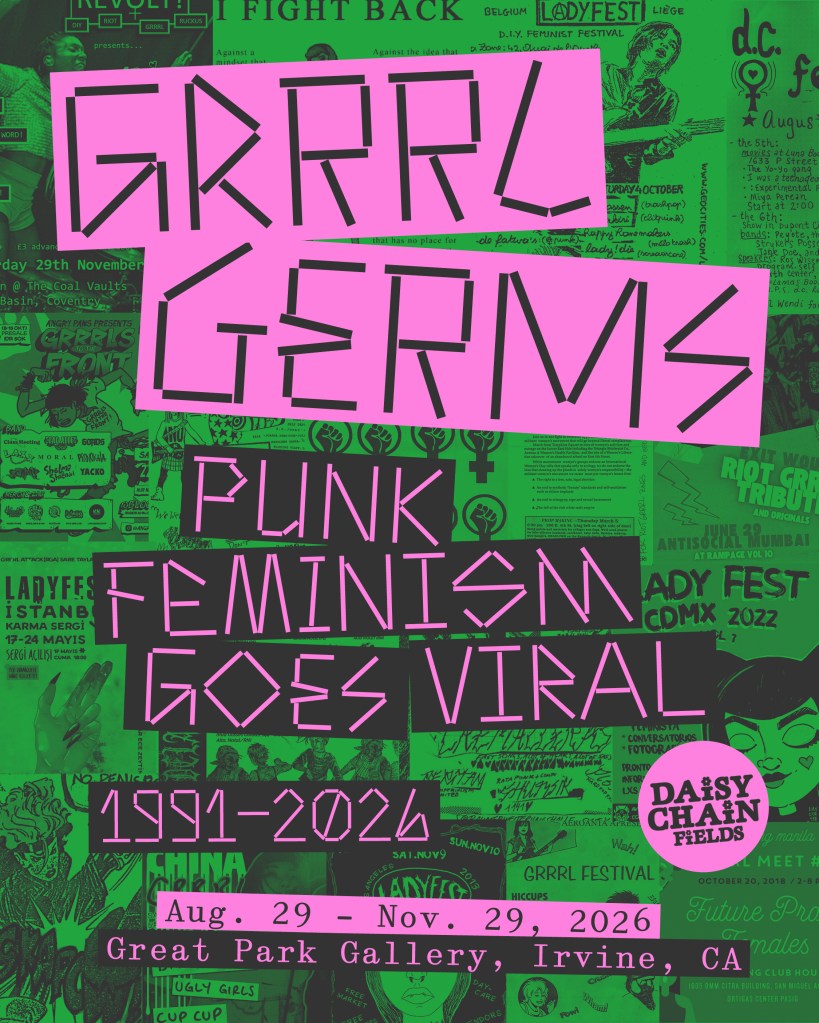
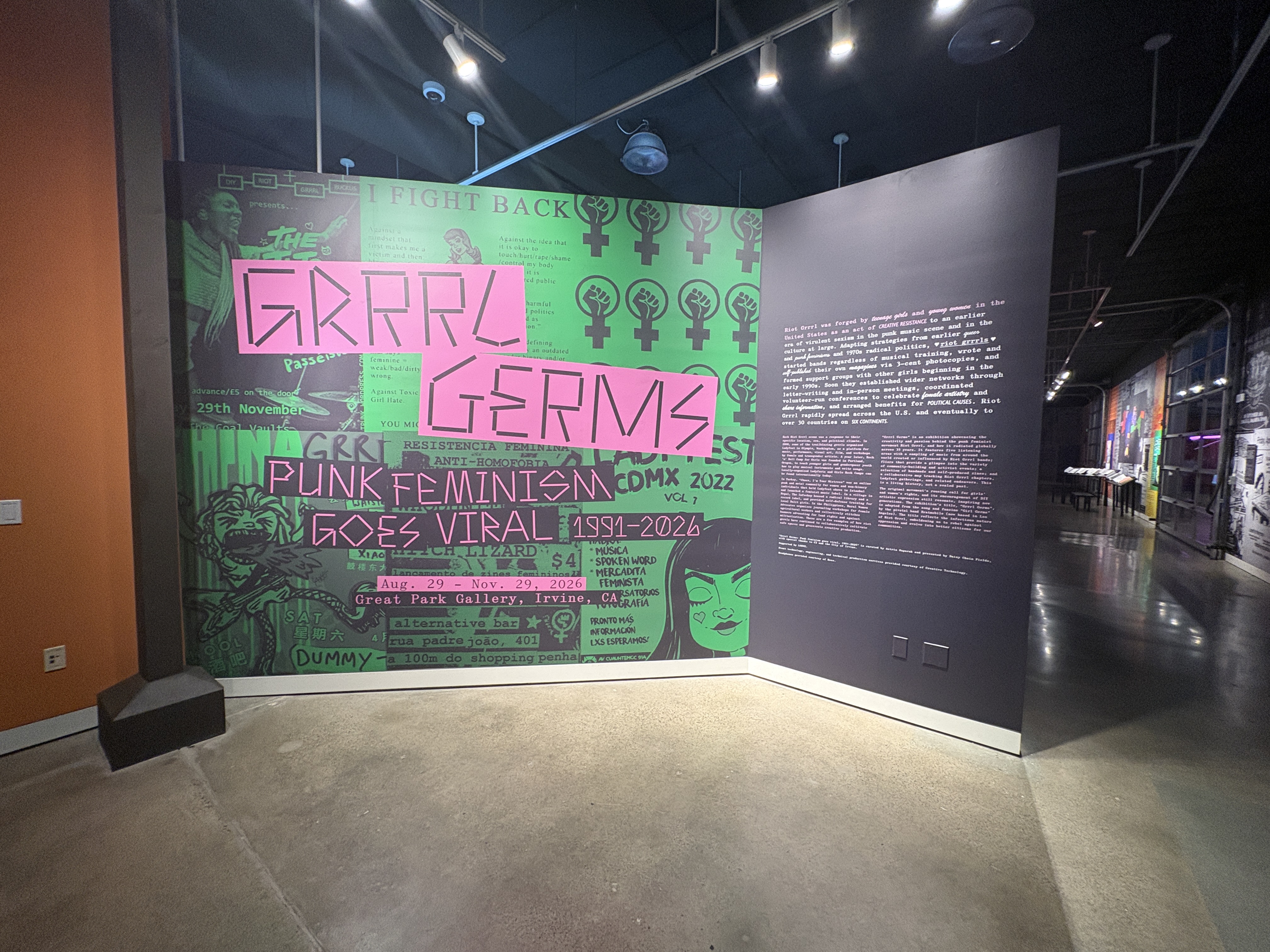
Grrrl Germs: Punk feminism goes viral, 1991–2026
Curated by Astria Suparak
Daisy Chain Fields, Great Park Gallery, Irvine, CA
Aug. 29 — Nov. 29, 2026
https://www.daisychainfields.com/page/grrrl-germs
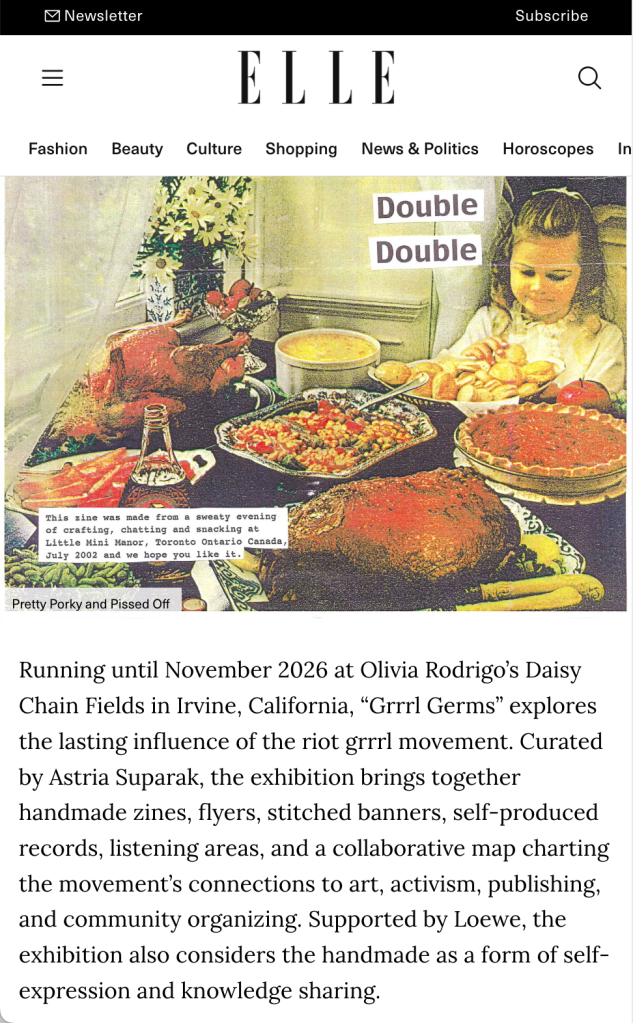
Grrrl Germs: Punk Feminism Goes Viral, 1991–2026 explores Riot Grrrl’s global legacy of DIY artistic expression, community-building, and resistance. Through music, zines, fliers, videos, and a collaborative map, the exhibition traces how a movement started by young women in the early 1990s grew internationally, inspiring new generations of artists and activists.
ABOUT THE FESTIVAL
Daisy Chain Fields is a music festival founded on the belief that joy, community, and creativity can inspire meaningful change. The festival celebrates the voices, artistry, and contributions of women in music, fostering an inclusive environment in which all are welcome. Net proceeds from the festival are directed toward nonprofit organizations dedicated to advancing and advocating for women and girls.
CURATORIAL TEXT
Riot Grrrl was forged by teenage girls and young women in the United States as an act of creative resistance to an earlier era of virulent sexism in the punk music scene and in the culture at large. Adapting strategies from earlier queer and punk feminisms and 1970s radical politics, riot grrrls started bands regardless of musical training, wrote and self-published their own magazines via 3-cent photocopies, and formed support groups with other girls beginning in the early 1990s. Soon they established wider networks through letter-writing and in-person meetings, coordinated volunteer-run conferences to celebrate female artistry and share information, and arranged benefits for political causes. Riot Grrrl rapidly spread across the U.S. and eventually to over 30 countries on six continents.
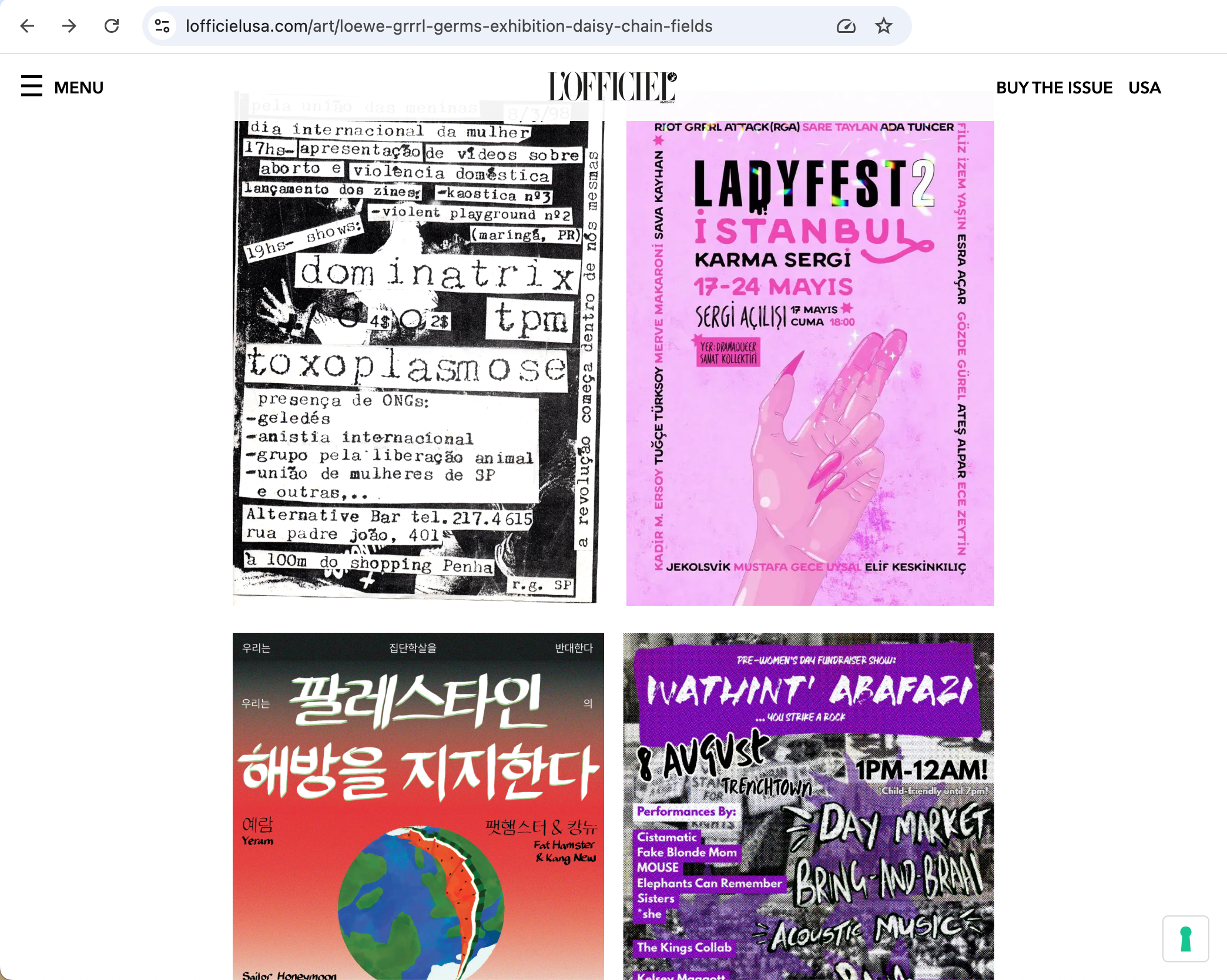
Each Riot Grrrl scene was a response to their specific location, era, and political climate. In 2000, some of the trailblazing grrrls organized Ladyfest in Olympia, Washington, as a platform for music, performance, visual art, film, and workshops by female and transgender artists. A year later, Rock ‘n’ Roll Camp for Girls was founded in Portland, Oregon, to teach younger girls and genderqueer youth how to play musical instruments and write songs. Locally-organized Ladyfests and Girls Rock Camps can be found internationally today.
In Turkey, Chaos, I’m Your Mistress was an online punk and metal community for women and non-binary individuals that held Ladyfest shows in Istanbul and launched a feminist music label. In a village in Nepal, The Infoshop housed a radical library and a record label, and provided self-defense training for local Dalit girls. In the Philippines, Rural Women Advocates organizes journaling workshops for female agricultural workers and collectively stitches banners advocating for land rights and against militarization. These are a few examples of how riot grrrls have continued to collaboratively cultivate safe spaces and grassroots creative production.
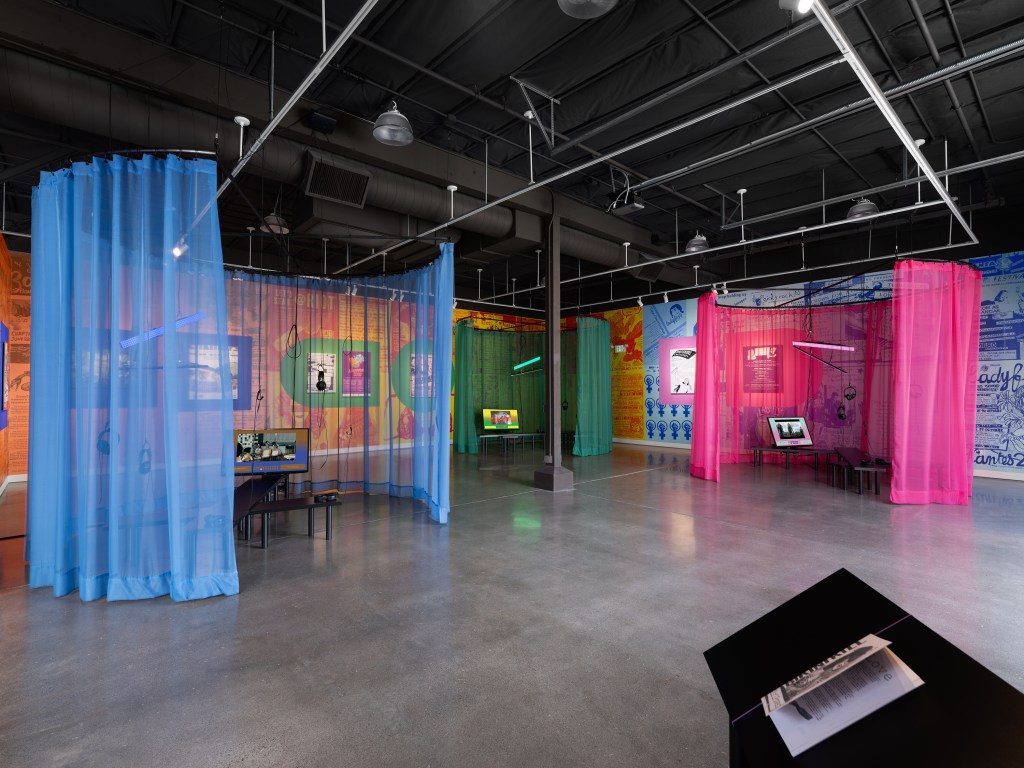
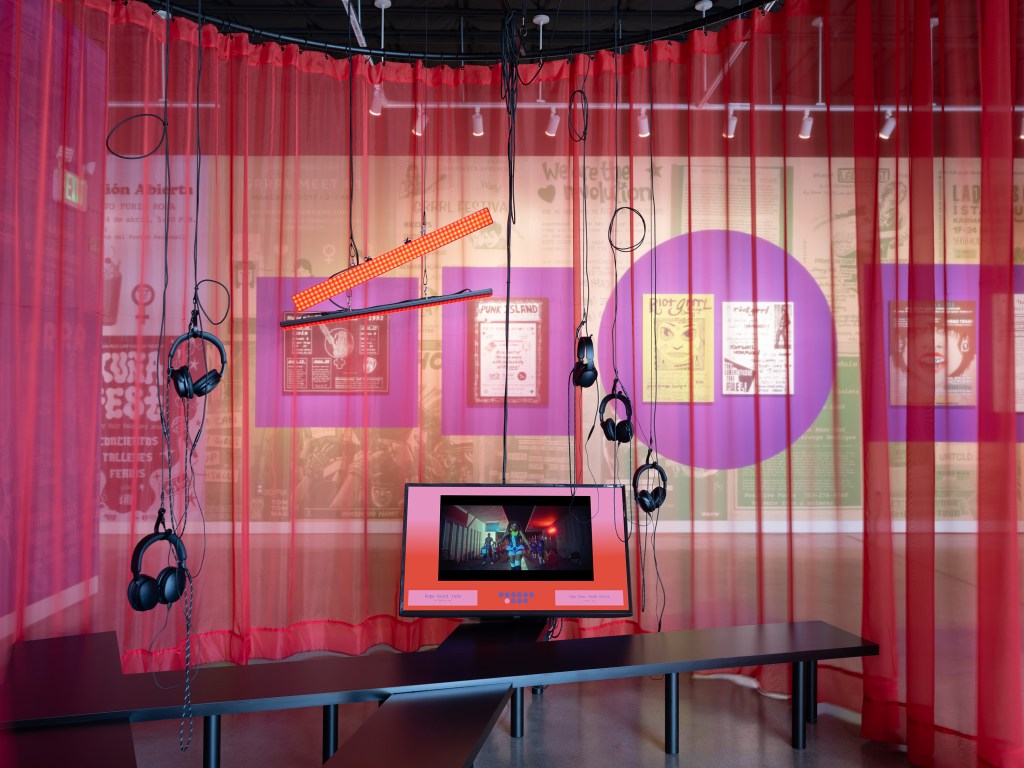
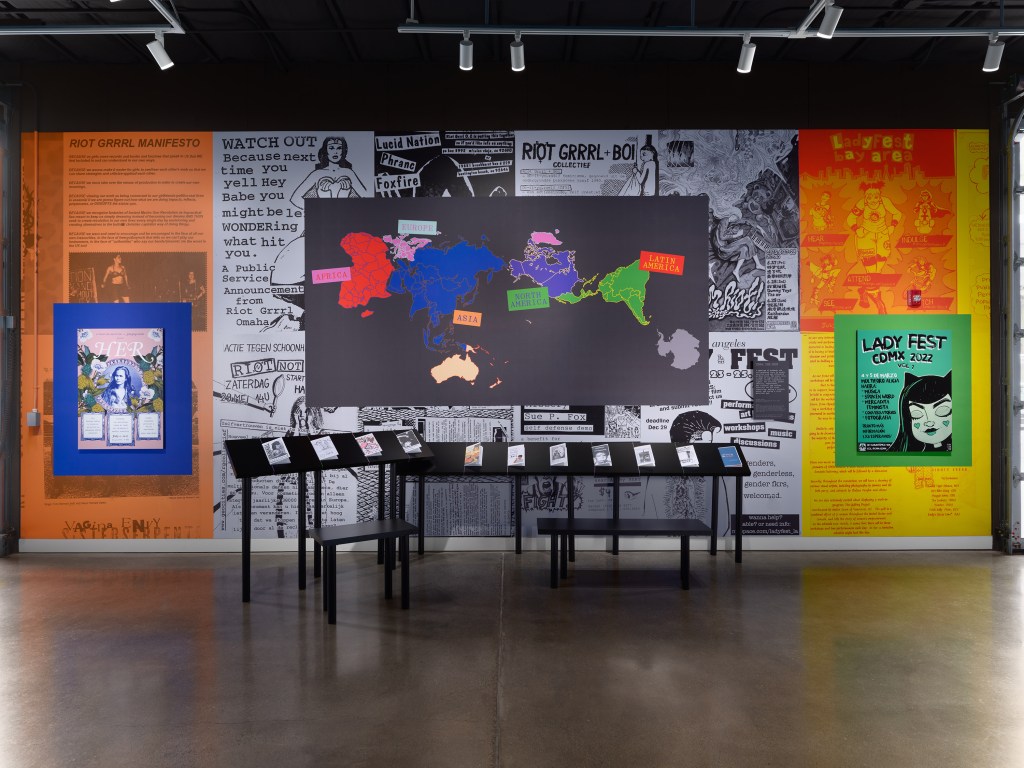
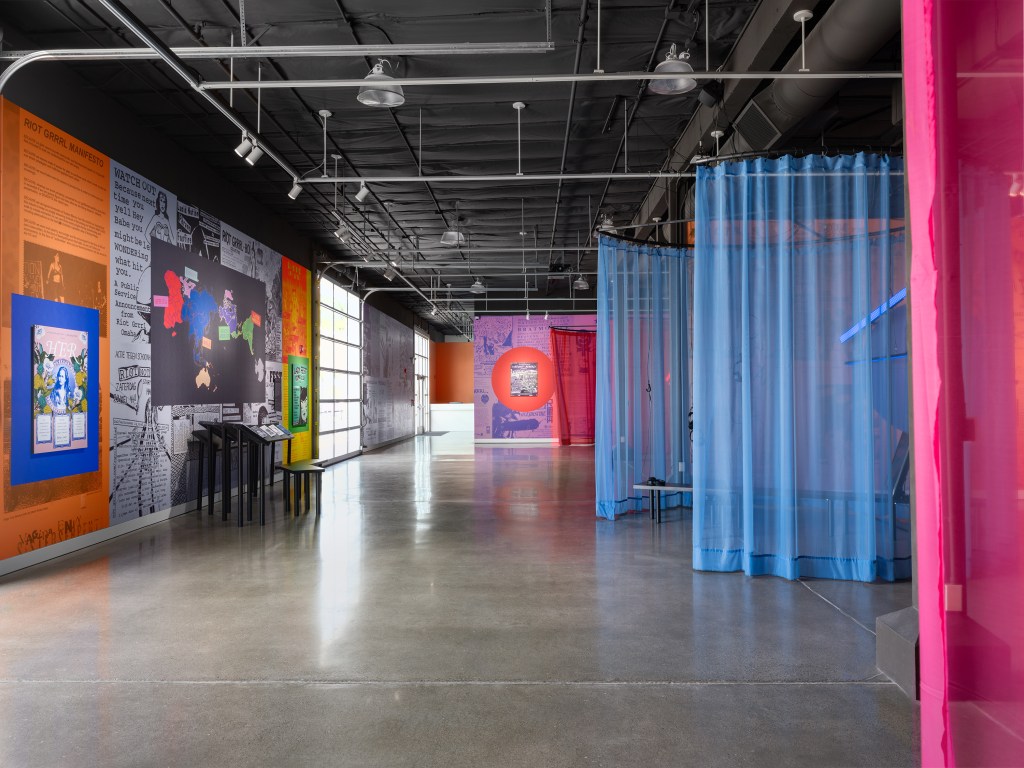
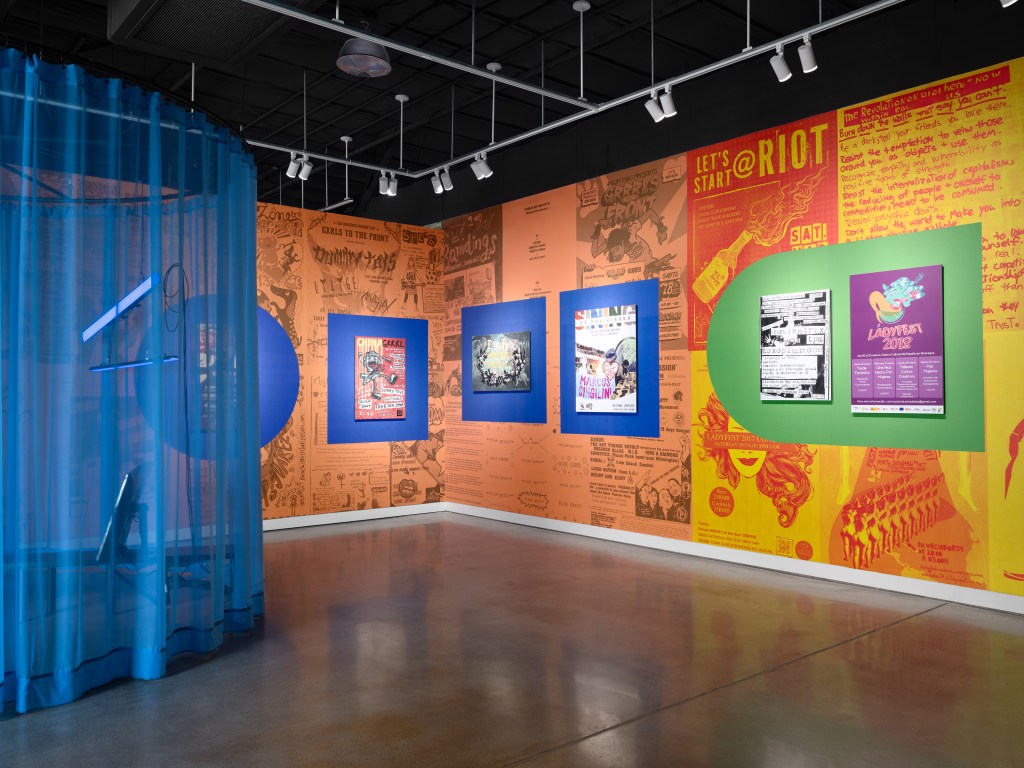
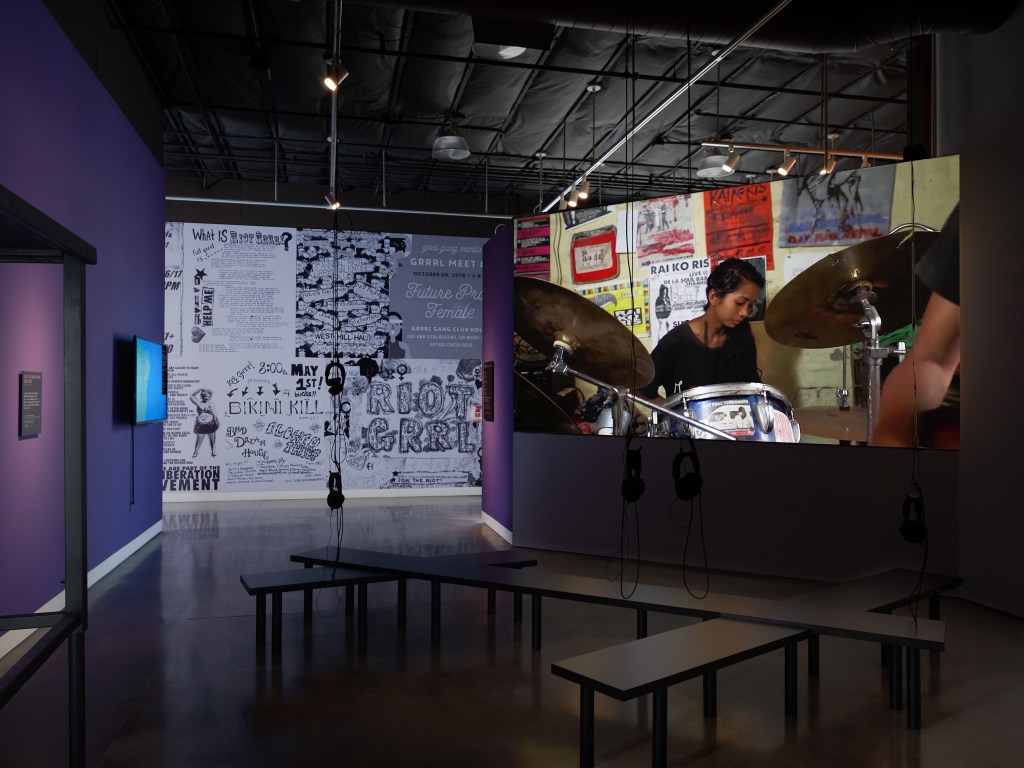
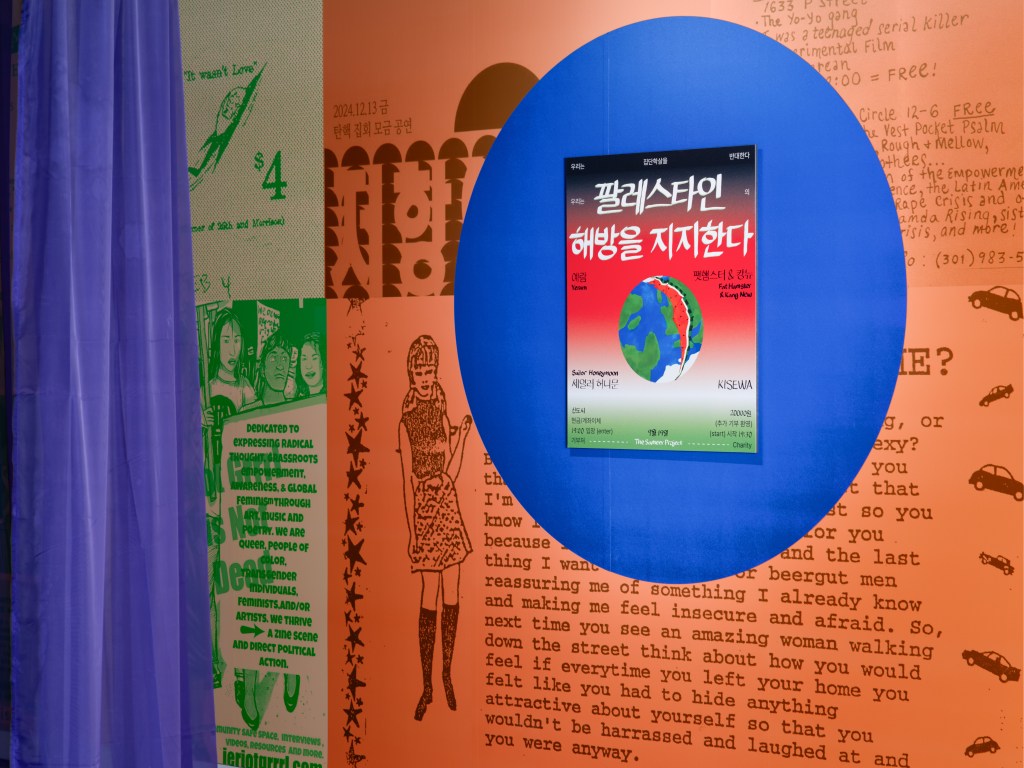
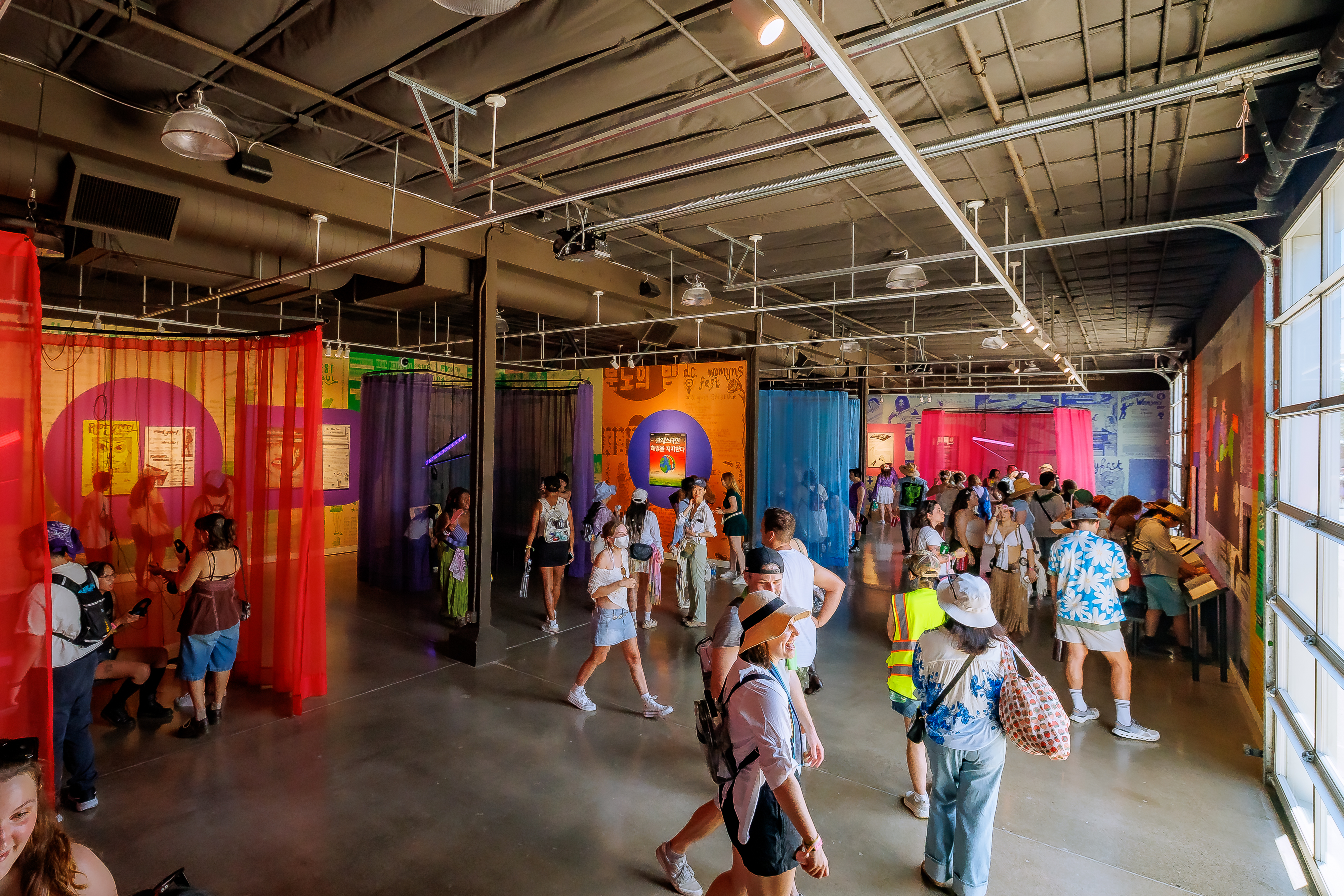
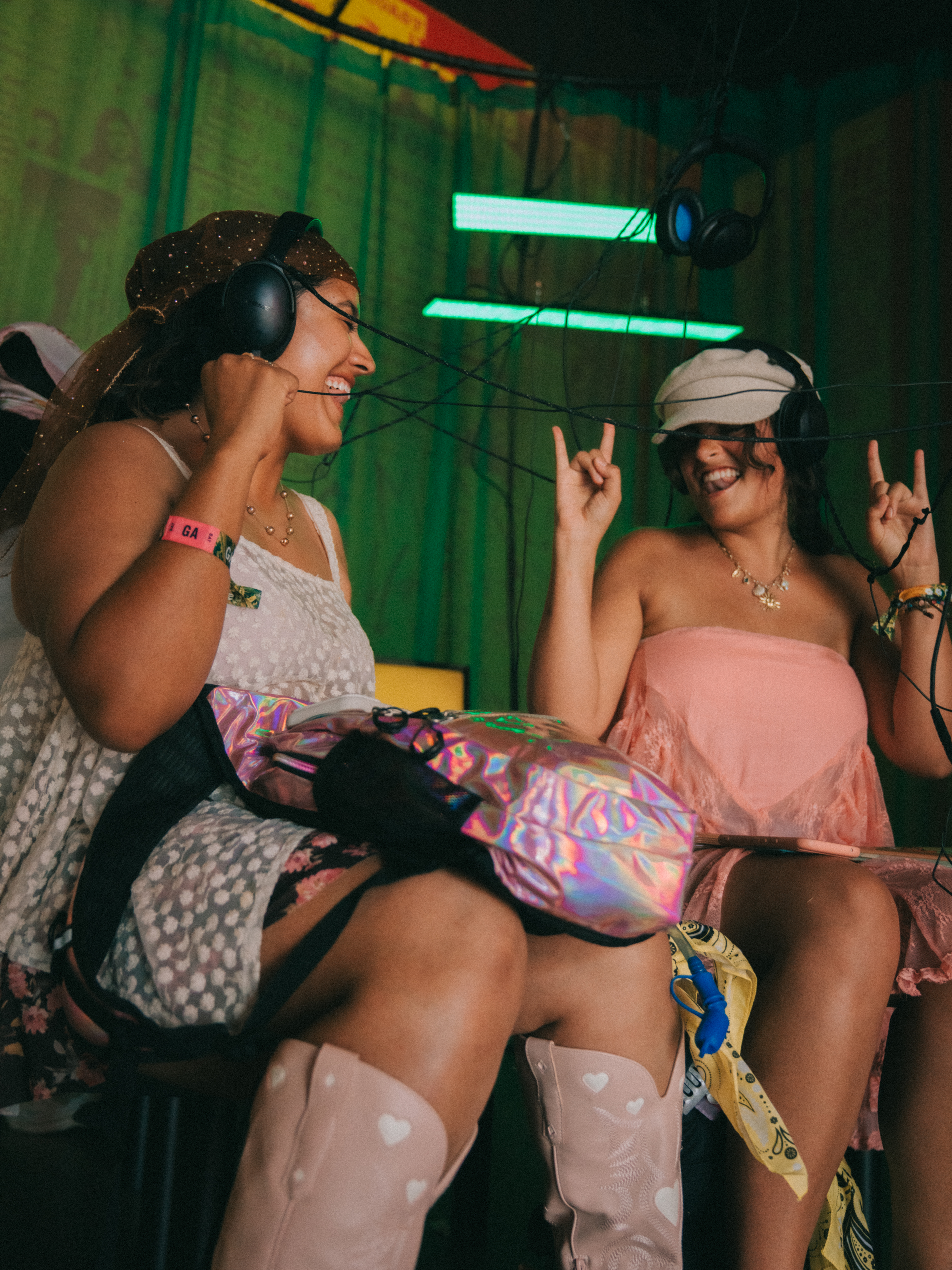
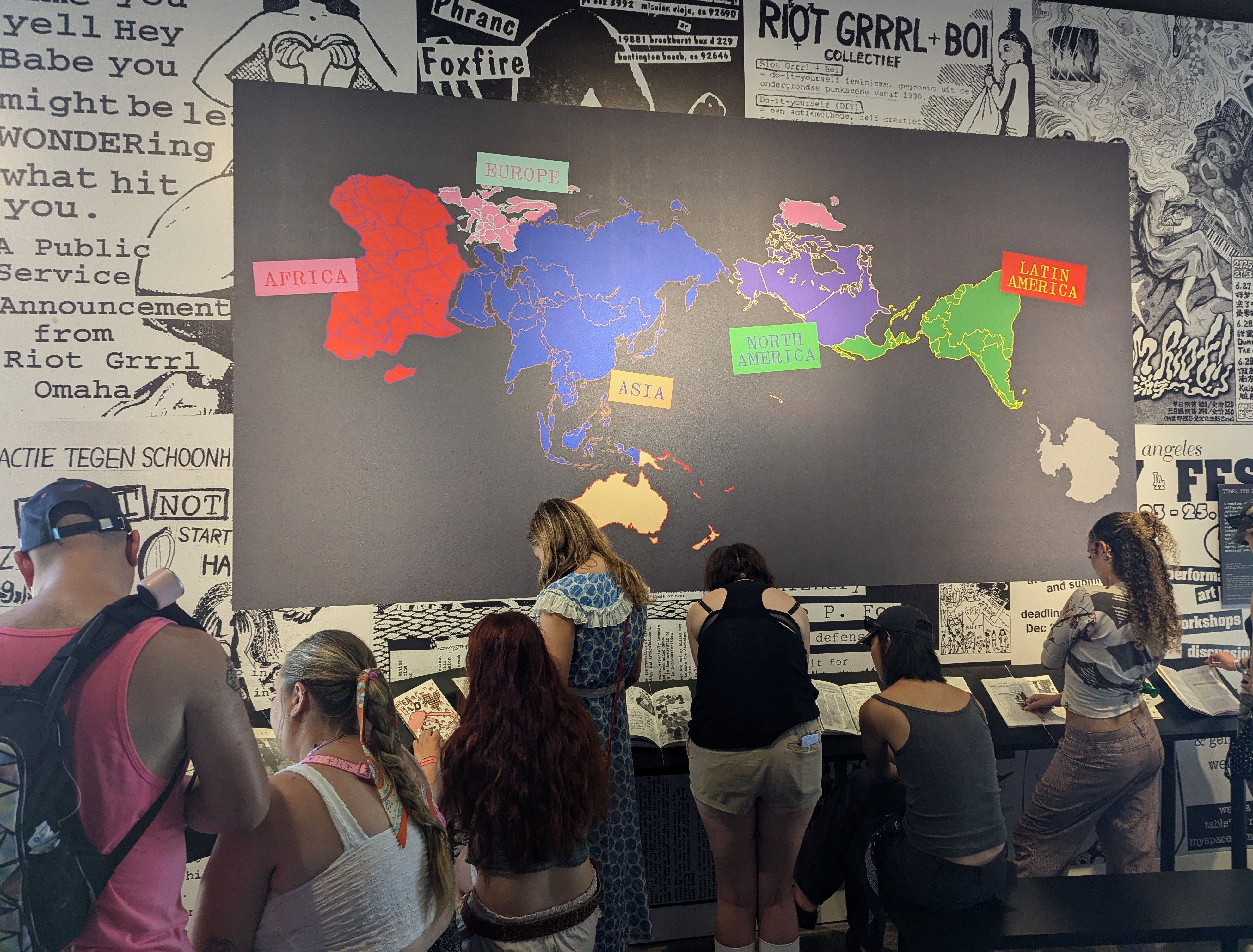
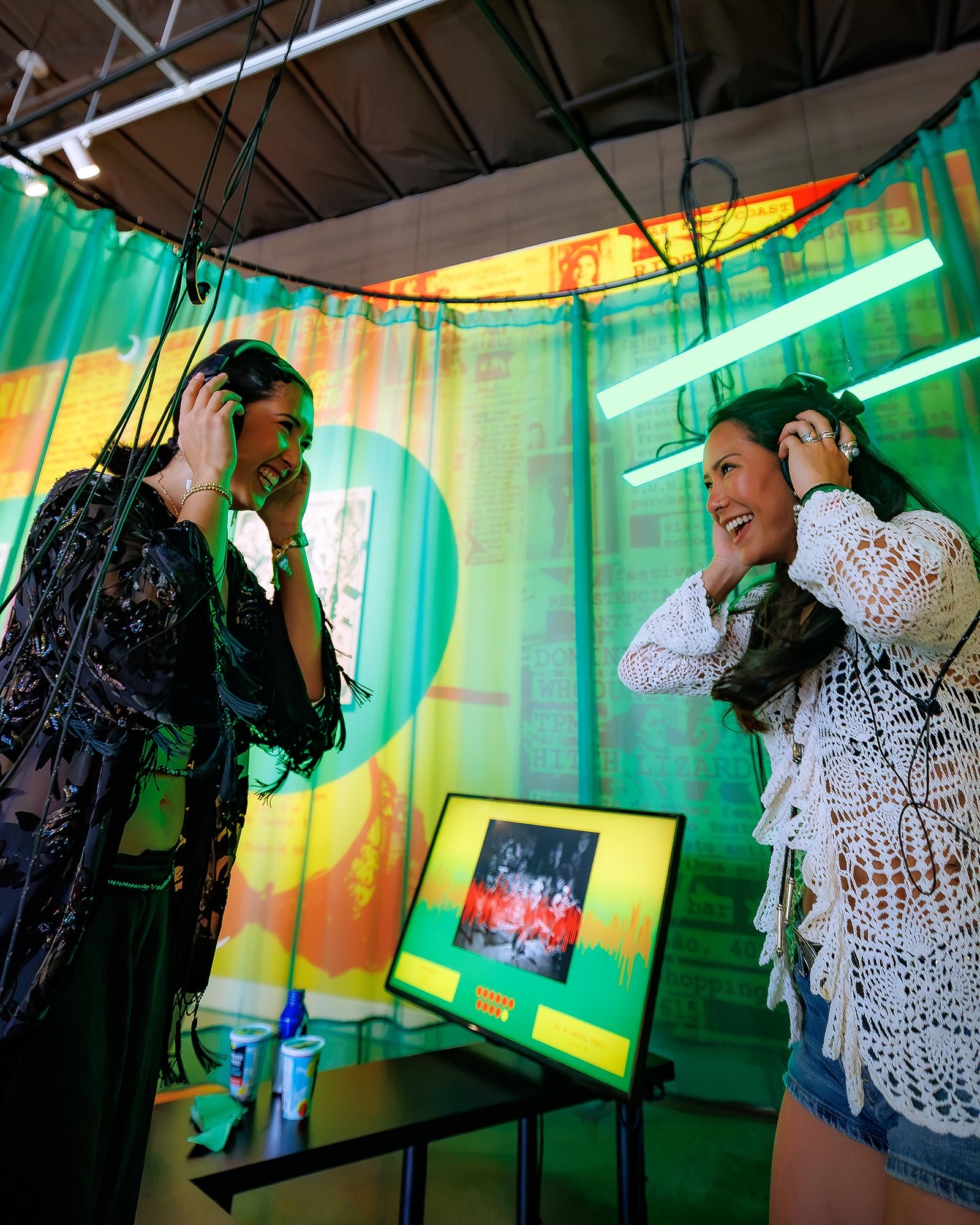
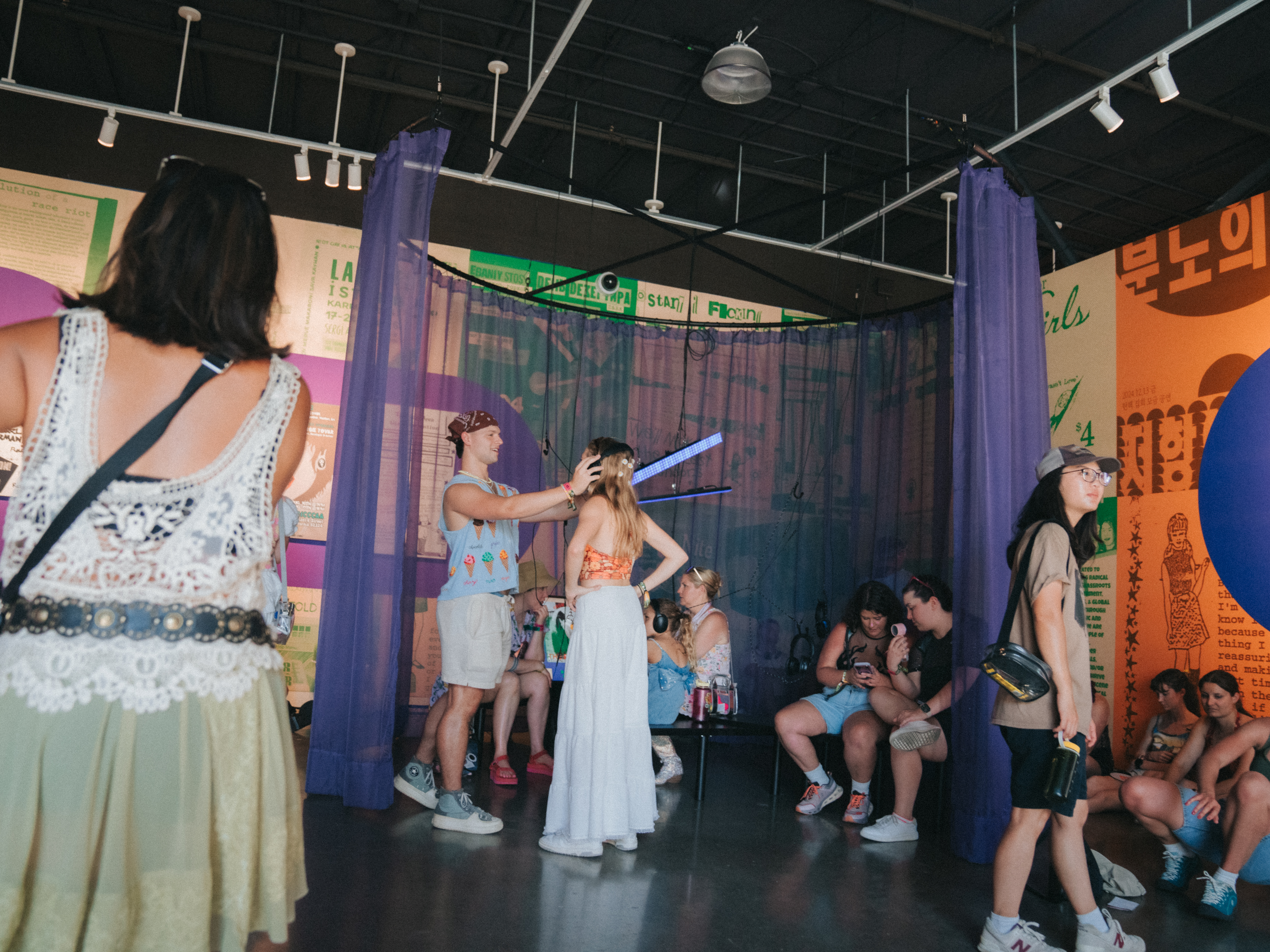
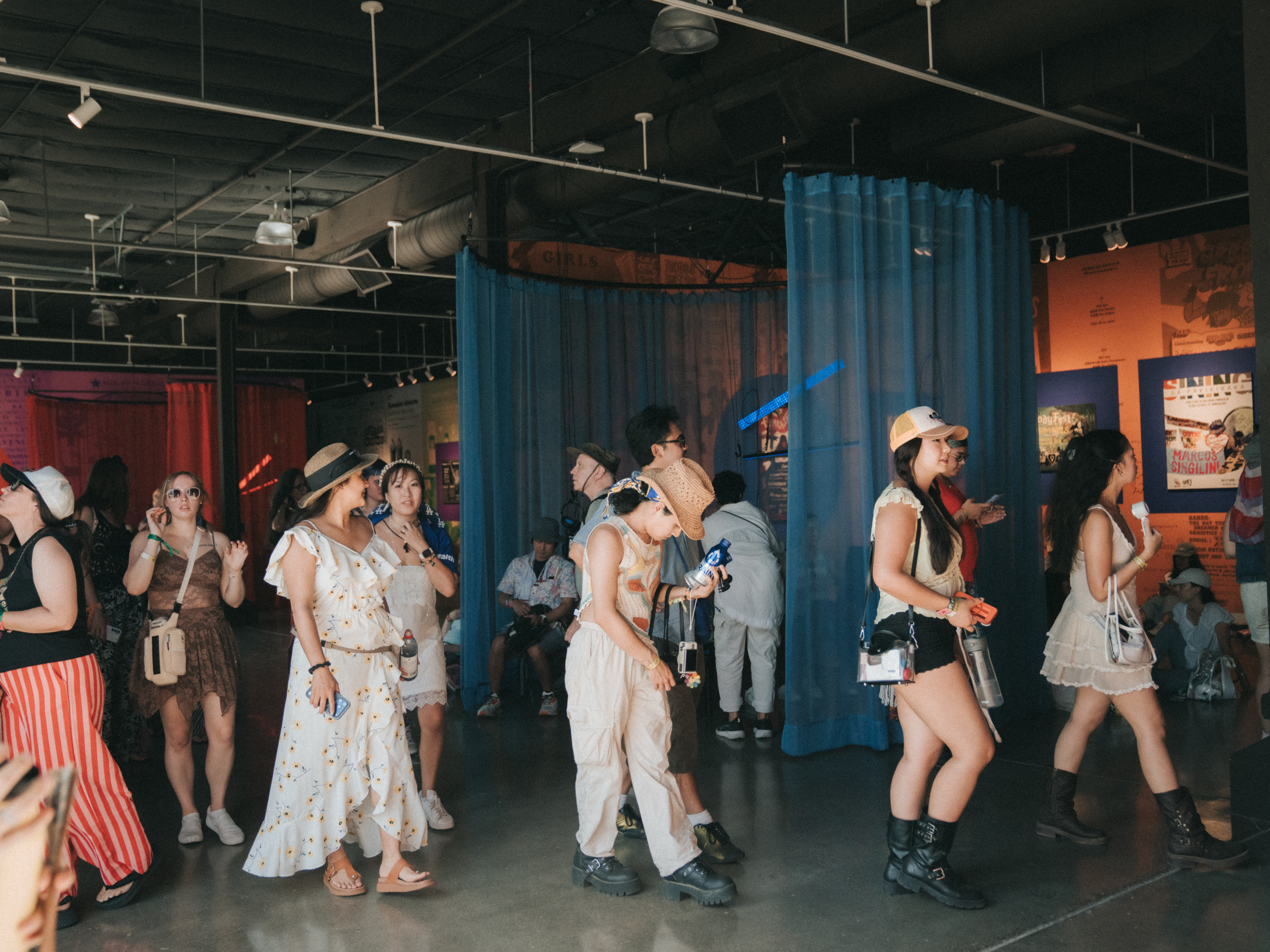
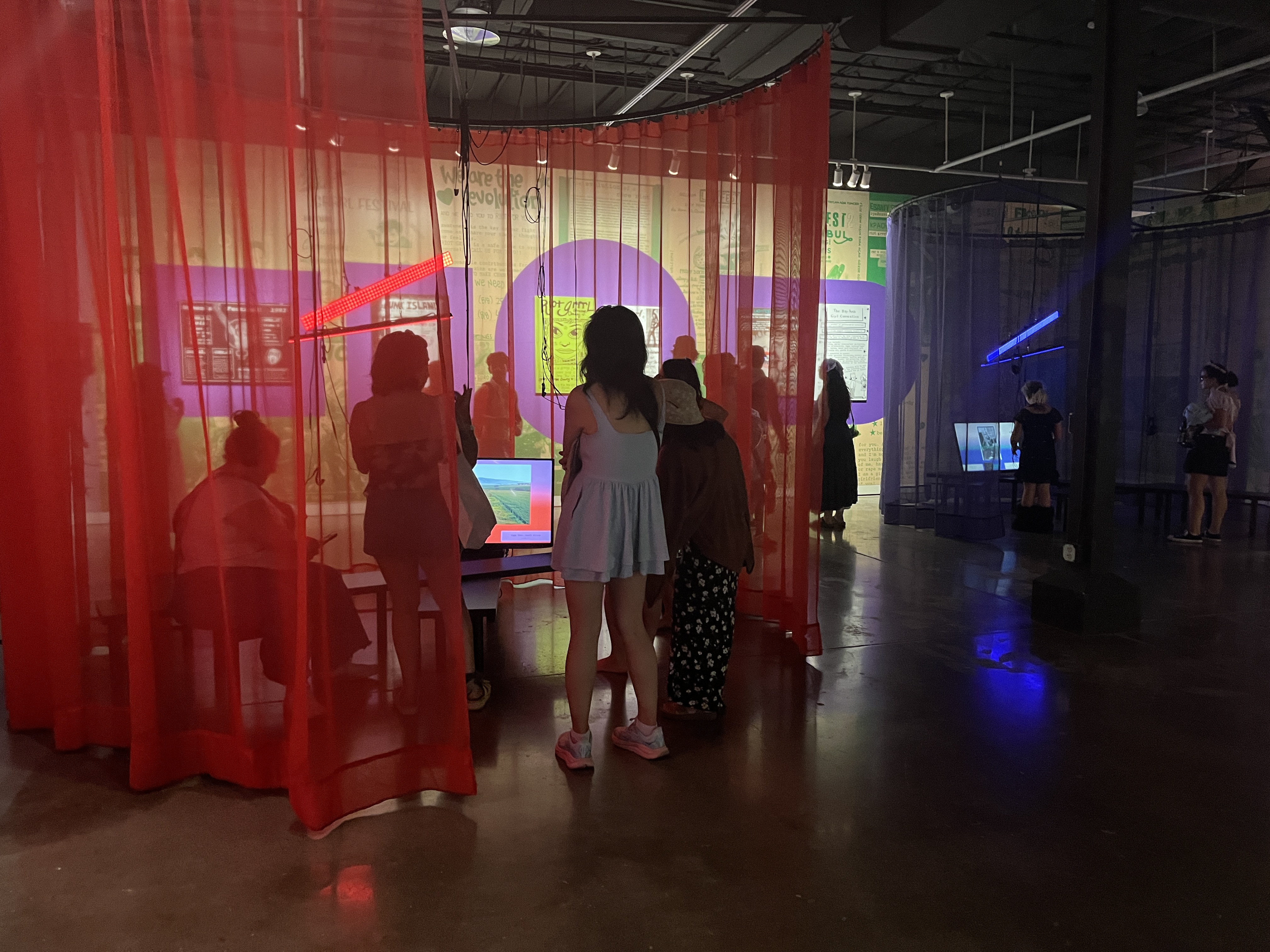
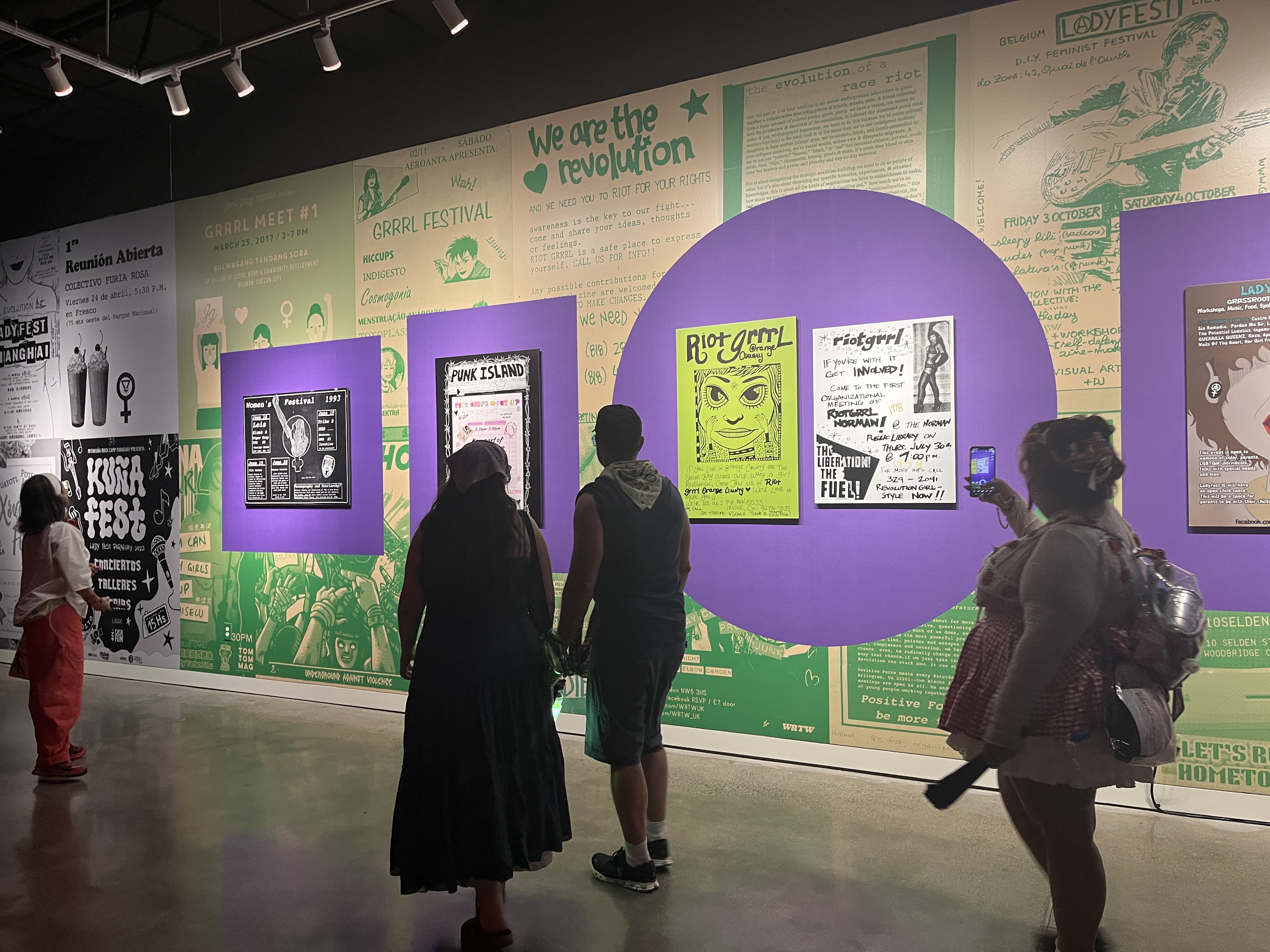
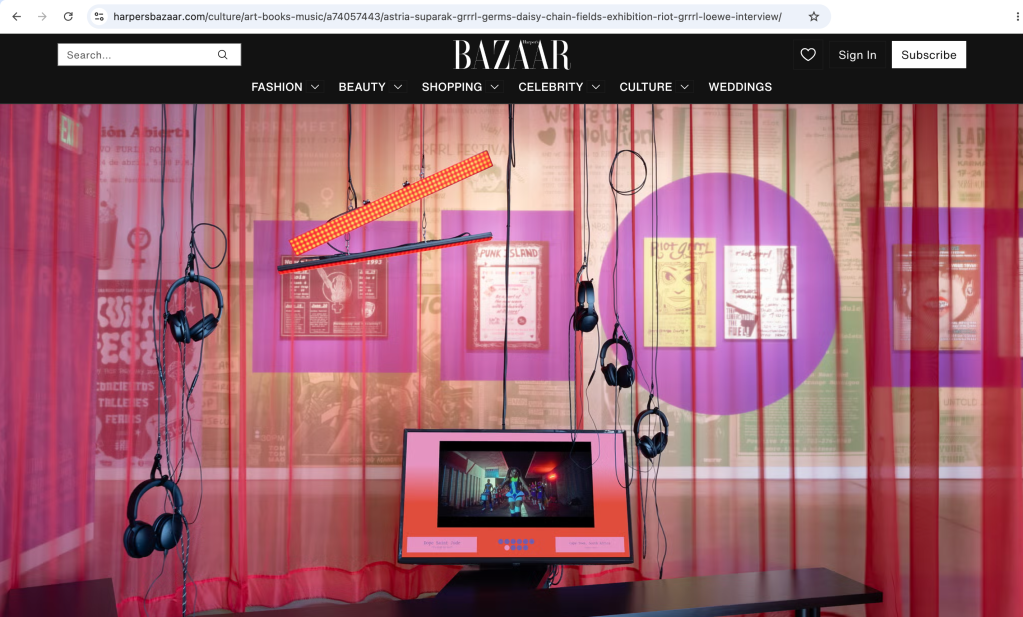
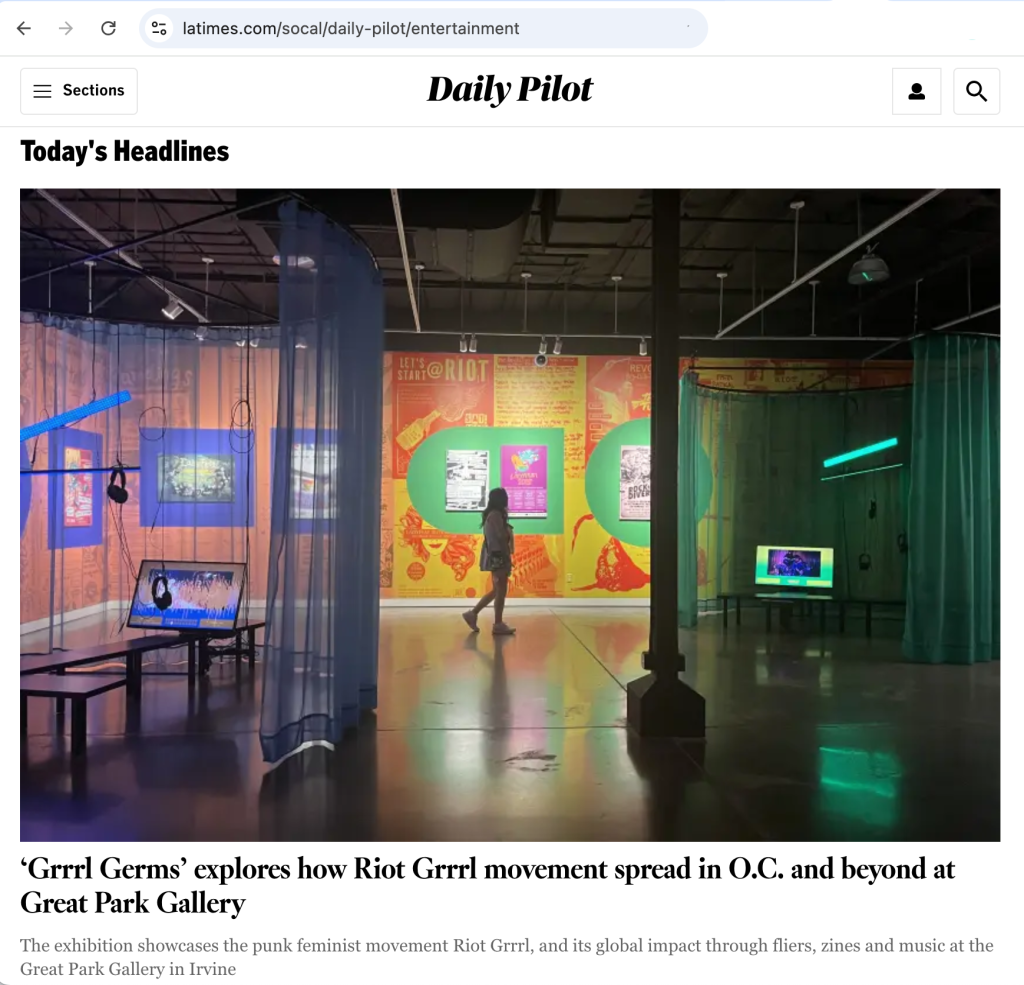
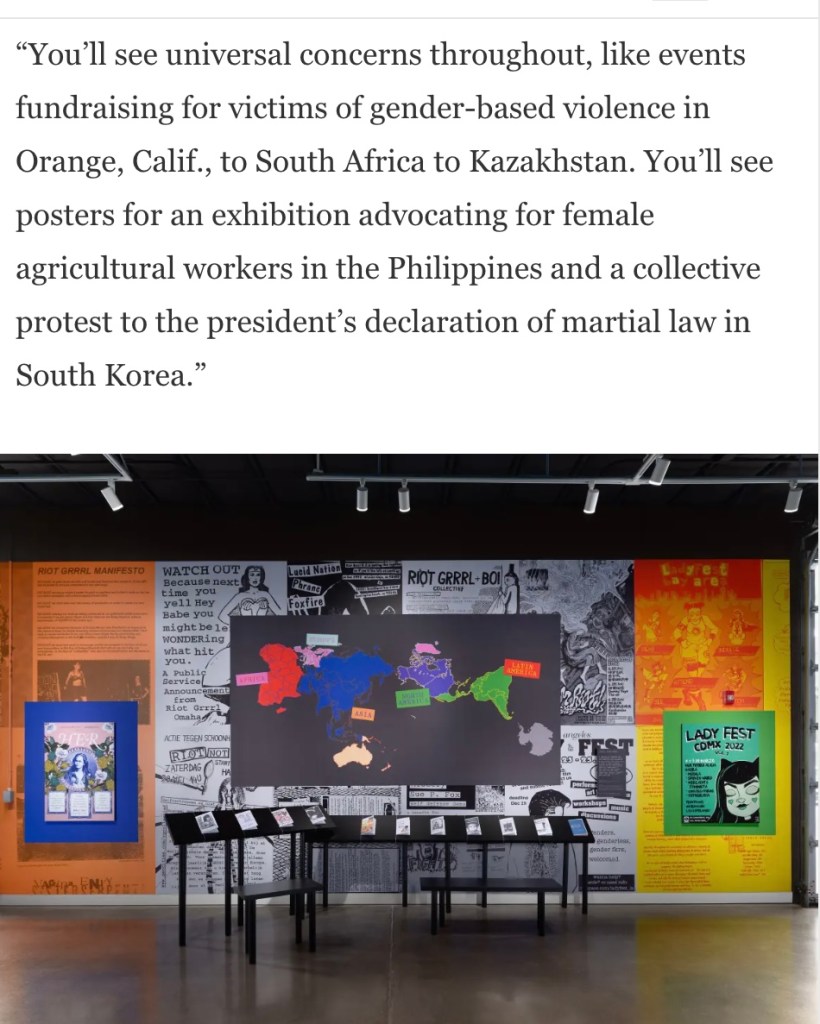
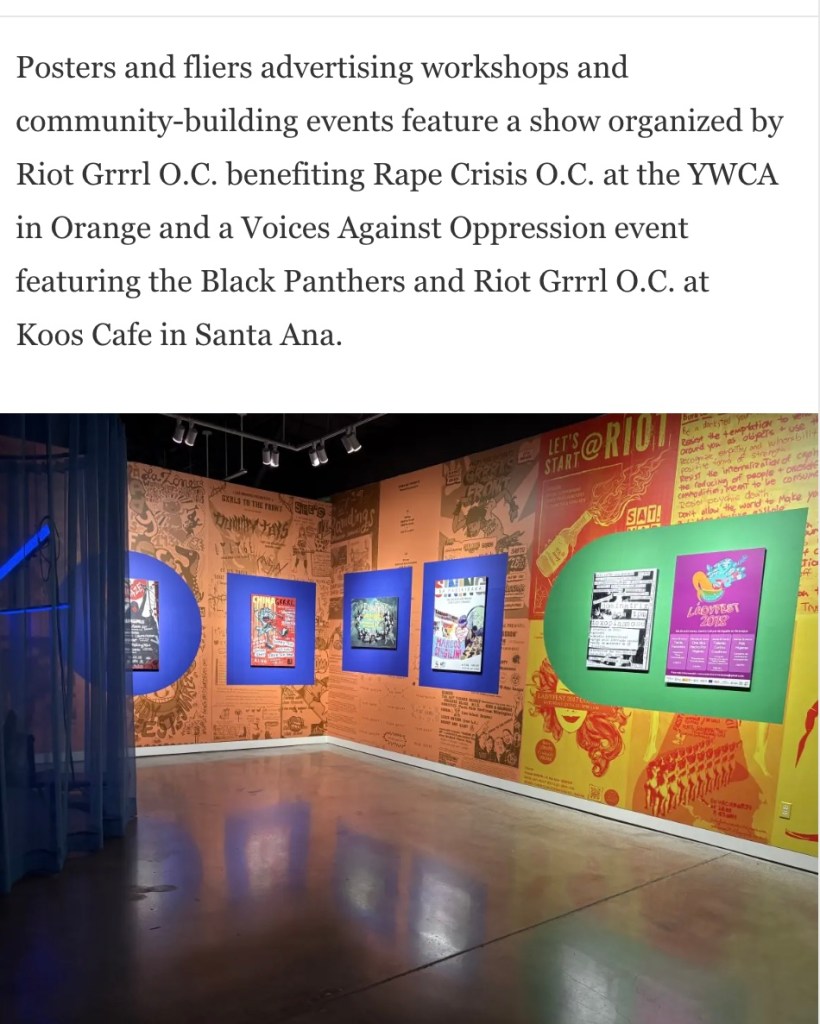
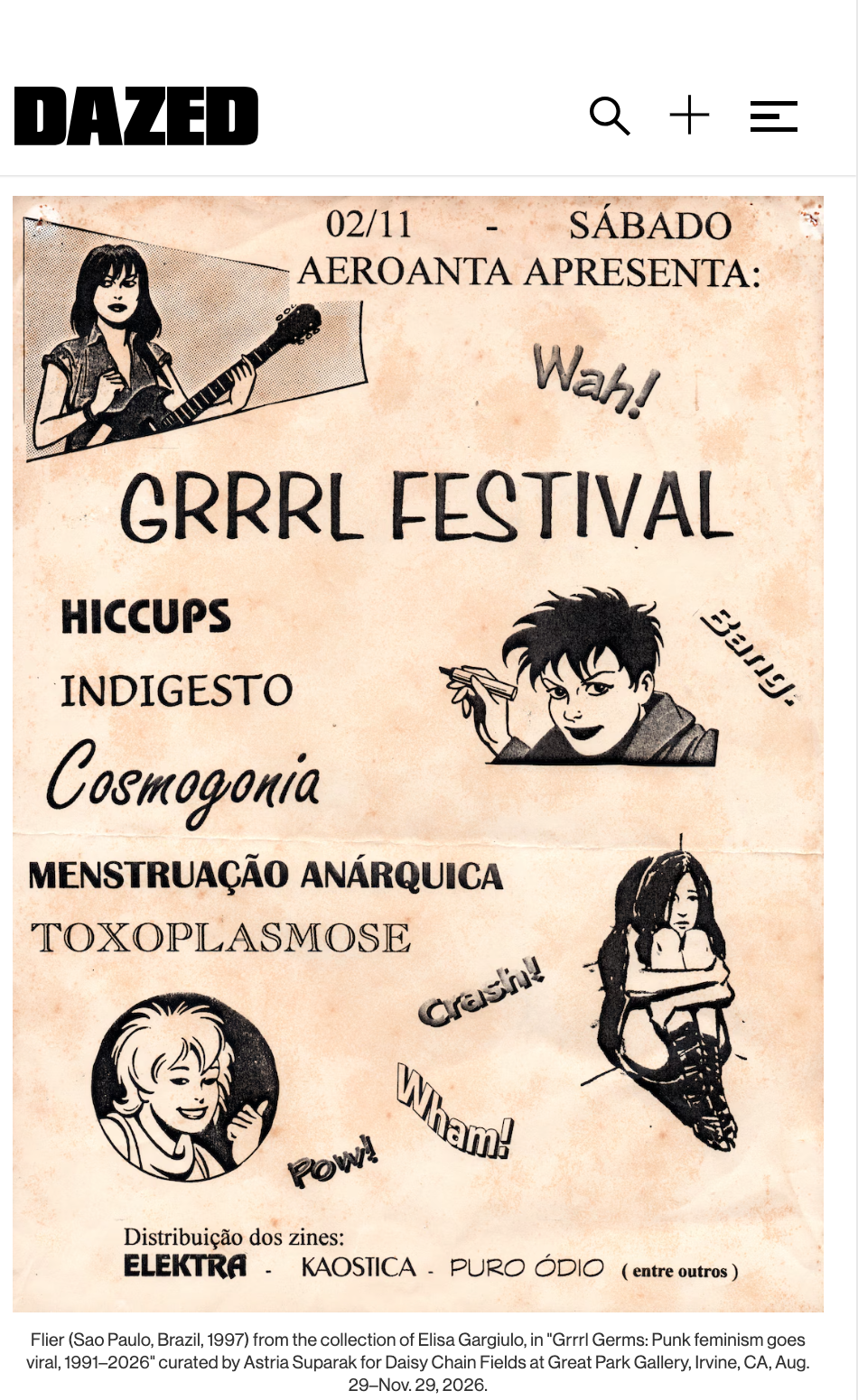
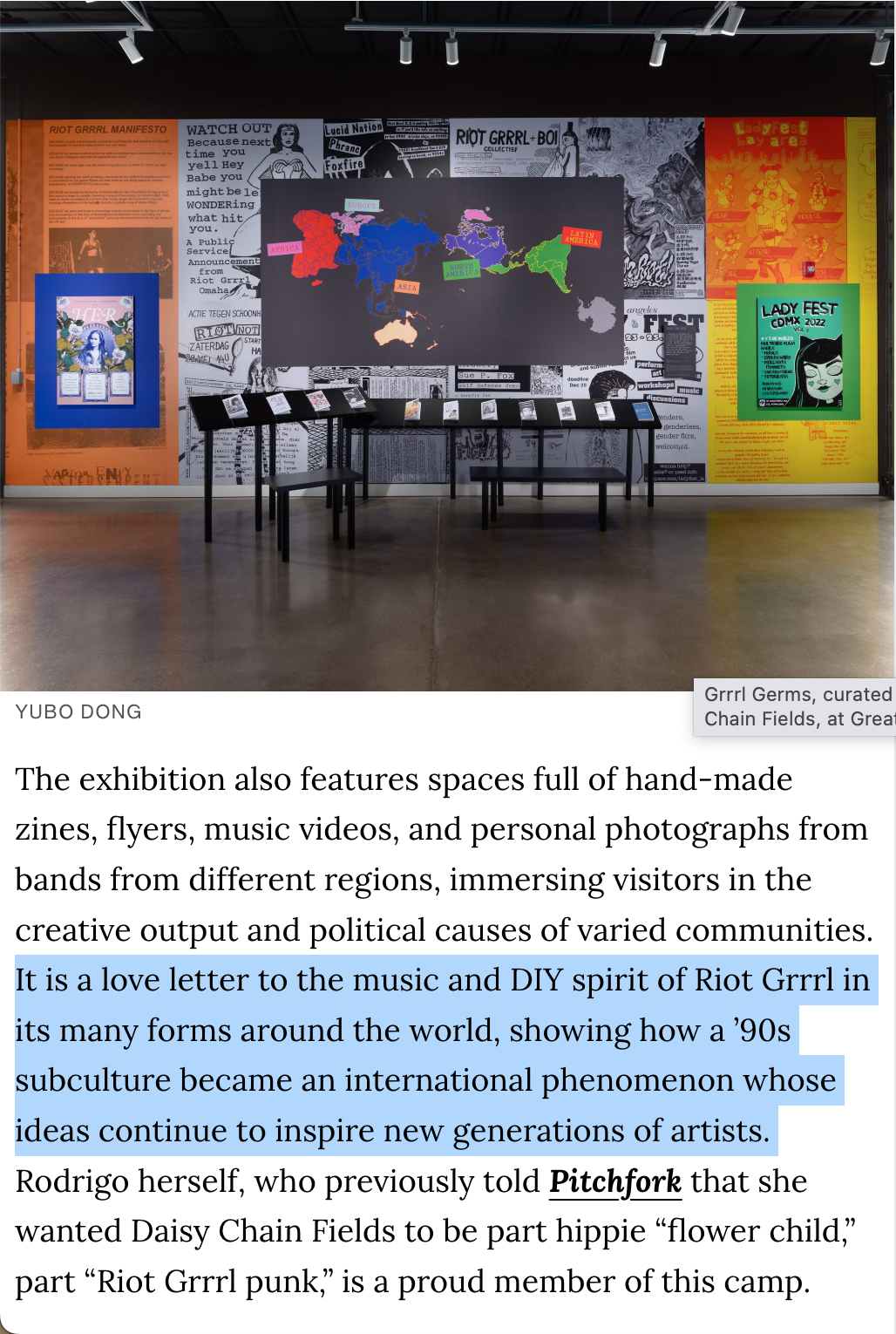
Grrrl Germs is an exhibition showcasing the creativity and passion behind the punk feminist movement Riot Grrrl, and how it radiated globally across 35 years. It features five listening areas with a sampling of music from around the world created or influenced by Riot Grrrl bands; fliers that provide a glimpse into the variety of community-building and activist events; a selection of handmade and self-produced zines; and a collaborative map tracking Riot Grrrl chapters, Ladyfest gatherings, and related endeavors. This is a living history, not a sealed past.
The original movement’s rousing call for girls’ and women’s rights, and its encouragement of DIY artistic expression still resonate, inspiring new generations. The exhibition’s title, Grrrl Germs, is adapted from the song and fanzine “Girl Germs” by the pivotal band Bratmobile (now based in Los Angeles). The title reflects the infectious nature of Riot Grrrl, emboldening us to rebel against oppression and evolve into better citizens for our communities.
Grrrl Germs: Punk feminism goes viral, 1991–2026 is curated by Astria Suparak and presented by Daisy Chain Fields, with special thanks to C3 Presents and the City of Irvine.
Supported by LOEWE.
Event technology, engineering, and technical production services provided courtesy of Creative Technology.
Headphones provided courtesy of Bose.
EXHIBITION CREDITS
Curator: Astria Suparak
Graphic Design: Justin Carder. Typeface: Anthony designed by Sun Young Oh, from open-source collective Velvetyne.
Exhibition Design: Dutra Brown Studio. Design Team: Dutra Brown & Aliah Werth.
Technical Direction: TAIT
Furniture Fabrication: Tractor Vision
Graphics Printing: Mouse Graphics
Video Editors: Haylee Loudenslager and Paul Baudouin, C3
Latin American music research assistance: Michelle Felix, Elisa Gargiulo
The curator would like to thank the musicians, lenders, and contributors; Olivia Rodrigo, Jaime Gerin, and the Daisy Chain Fields team; C3; Great Park Gallery and the City of Irvine; Brett Kashmere; and Anthony Elms.
Grrrl Germs continues archival research conducted for the exhibition Alien She, curated by Astria Suparak and Ceci Moss (2013–16).
TRAILER
PRESS
Agência Maurício Tragtenberg, “Olivia Rodrigo raises US$20 million for women’s causes,” Livia Vilela, Sept. 2, 2026 (Brazil)
Dazed, “Fashion News Highlights, September 2026,” Isobel Van Dyke, Sept. 4, 2026
ELLE, “Culture Watch: What to See and Where to Go in September,” Matthew Velasco, Sept. 8, 2026 (republished by Yahoo! Life)
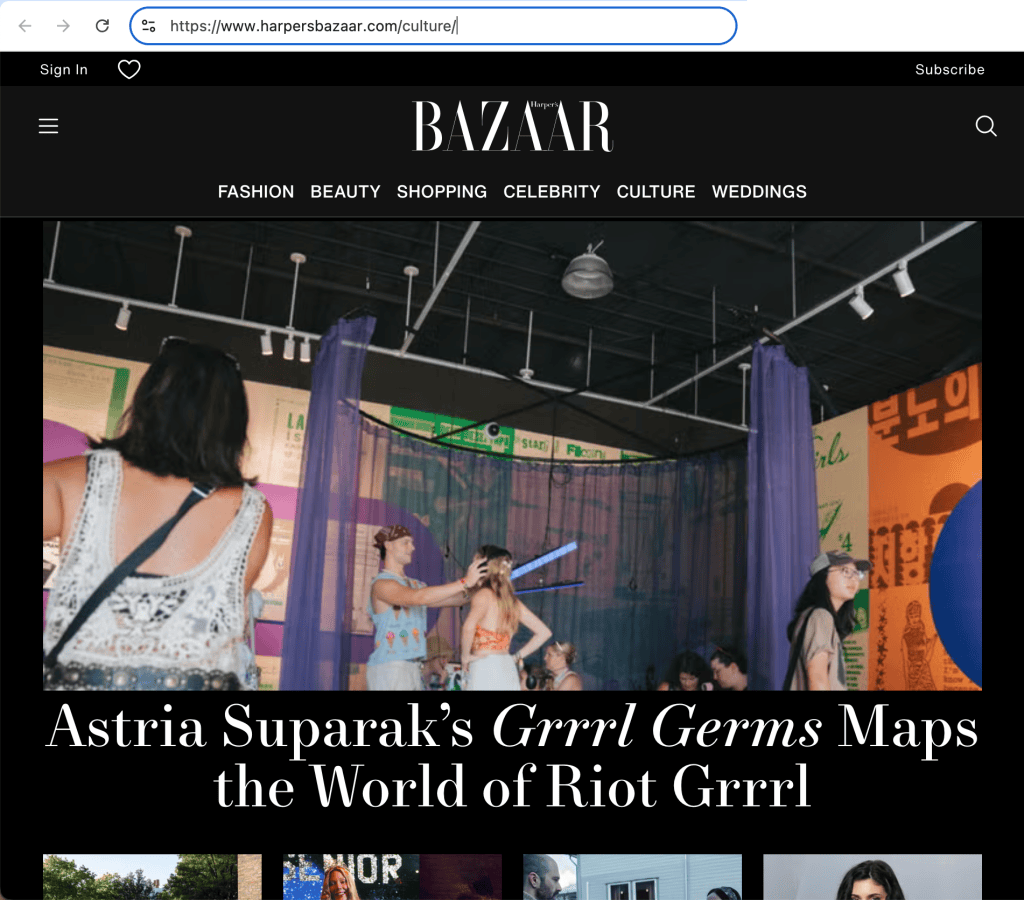
HARPER’S BAZAAR, “Astria Suparak’s Grrrl Germs Maps the World of Riot Grrrl,” Sophie Wang, Oct 7, 2026
Just two or three months before the likes of Stevie Nicks, Chappell Roan, Bikini Kill, and Sarah McLachlan took the Daisy Chain stage and helped raise $20 million for nonprofit partners supporting women and girls, Suparak received the loose brief and got to work. Poring over old music reviews, abandoned Facebook and MySpace pages, and platforms such as Discogs and Bandcamp, she scoured the internet for bands who cited riot grrrl as an inspiration. She spoke with music labels in South Africa and rock clubs in Armenia, tracing the movement’s reach around the world. (And we mean actually mapping it. As part of the exhibit, Suparak expanded an interactive map, begun with “Alien She,” that lets visitors click on locations to learn more about local riot grrrl chapters and Ladyfest gatherings. Visitors can also submit information about chapters missing from the map.)
The exhibition also features spaces full of handmade zines, flyers, music videos, and personal photographs from bands from different regions, immersing visitors in the creative output and political causes of varied communities. It is a love letter to the music and DIY spirit of riot grrrl in its many forms around the world, showing how a ’90s subculture became an international phenomenon whose ideas continue to inspire new generations of artists. Rodrigo herself, who previously told Pitchfork that she wanted Daisy Chain Fields to be part hippie “flower child,” part “riot grrrl punk,” is a proud member of this camp.
L’OFFICIEL, “Loewe Commits To Supporting Grrrl Germs Exhibition,” Alexander Hernandez Gonzalez, Sept. 10, 2026
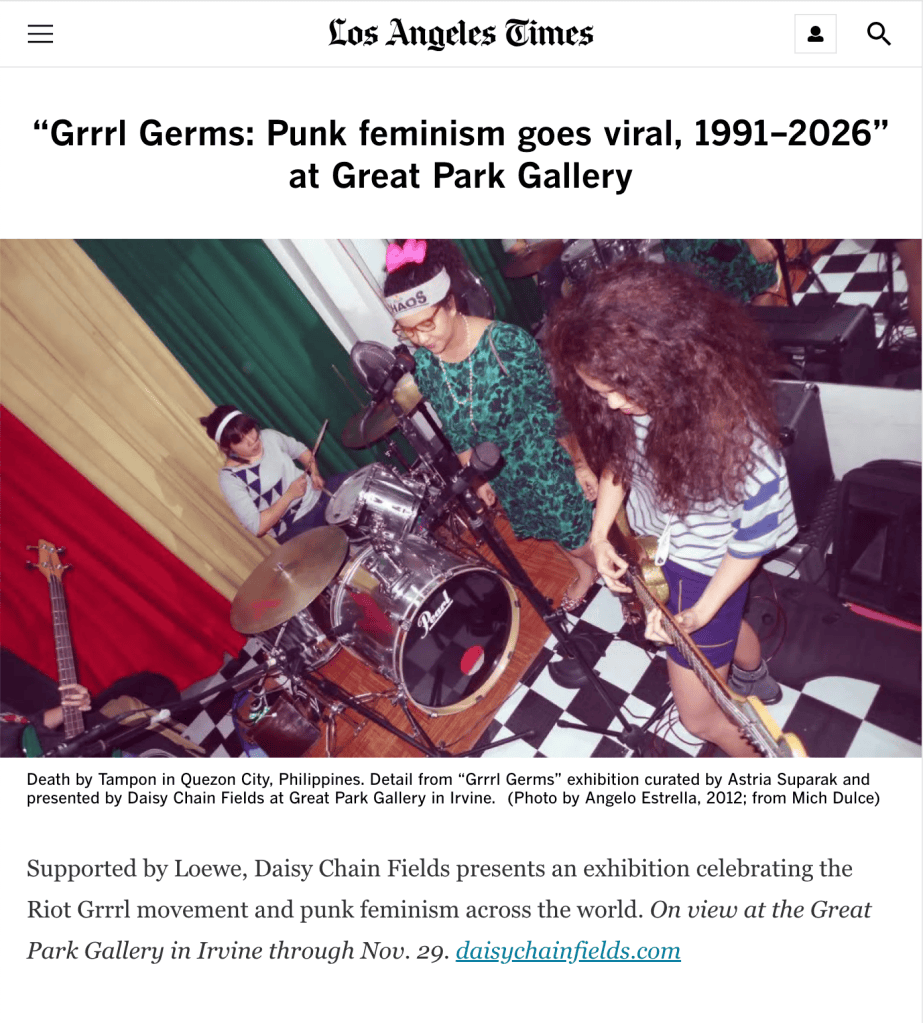
Los Angeles Times, “50 supremely fun things you probably haven’t done in Orange County,” L.A. Times Staff, Sept. 30, 2026
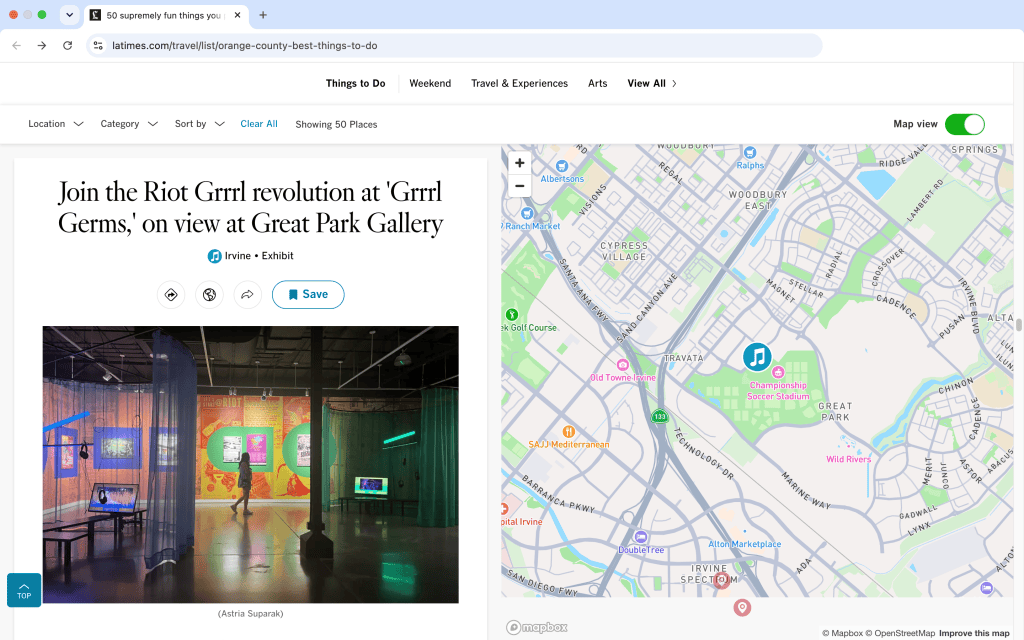
The exhibition opened for Daisy Chain Fields, Olivia Rodrigo’s Lilith Fair-inspired music festival at Irvine’s Great Park, and gets its title from the song and fanzine “Girl Germs” by the band Batmobile. The interactive show explores punk feminist communities from six continents and across 35 years through music, fliers and zines, all capturing the energy and DIY spirit of the movement. […]
Riot Grrrl music vibrates through the gallery’s speakers, and a set of colored blinking lights identify which part of the world each song comes from. The color-coding system continues with the exhibit’s five listening stations, where guests can put on headphones and watch iconic music videos.
Los Angeles Times Images magazine, “What’s new in the worlds of fashion and art this October?,” Julissa James, issue 46, Oct. 2, 2026
Los Angeles Times, Times OC, “‘Grrrl Germs’ explores how Riot Grrrl movement spread in O.C. and beyond at Great Park Gallery” Sarah Mosqueda, Sept. 28, 2026
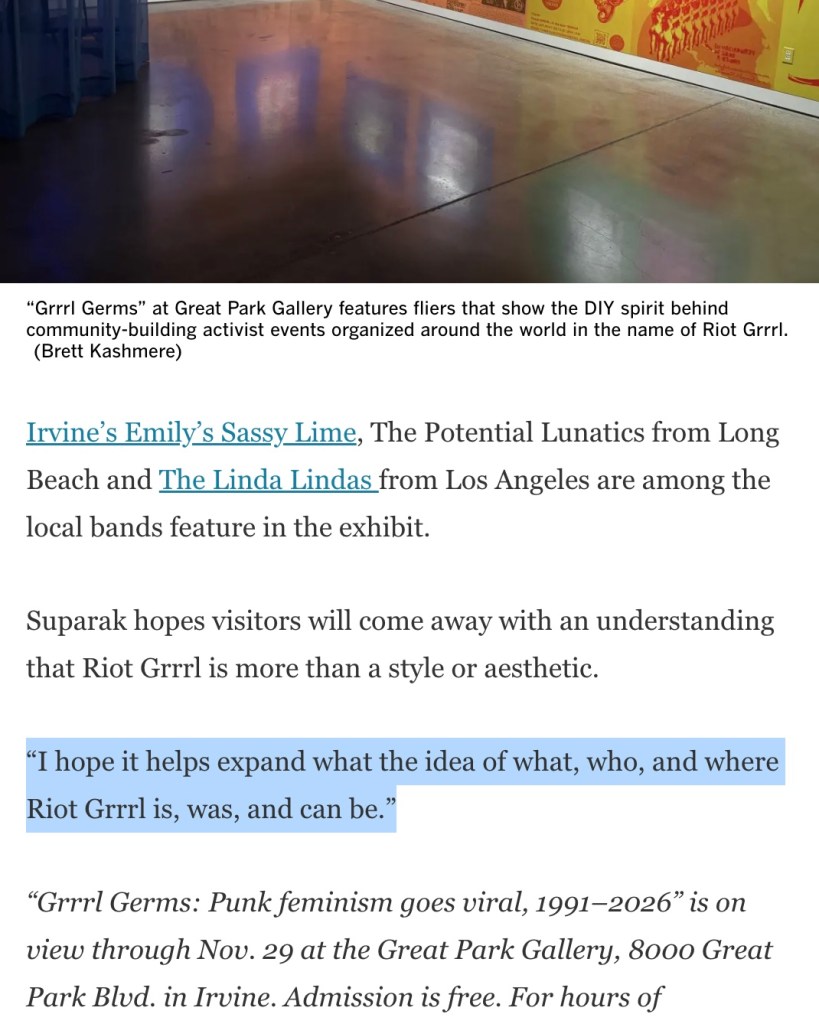
Suparak hopes visitors will come away with an understanding that Riot Grrrl is more than a style or aesthetic.
“I hope it helps expand what the idea of what, who, and where Riot Grrrl is, was, and can be.”
Los Angeles Times, TimesOC, “Daisy Chain Fields festival highlights not only female artists, but the O.C. community,” Sarah Mosqueda, Sept. 4, 2026
On one of the hottest days Orange County has experienced this summer, 45,000 fans gathered at the Great Park in Irvine for the inaugural Daisy Chain Fields festival on Aug. 29, an event that not only thrilled the crowd but brought noteworthy benefits to the surrounding community. […]
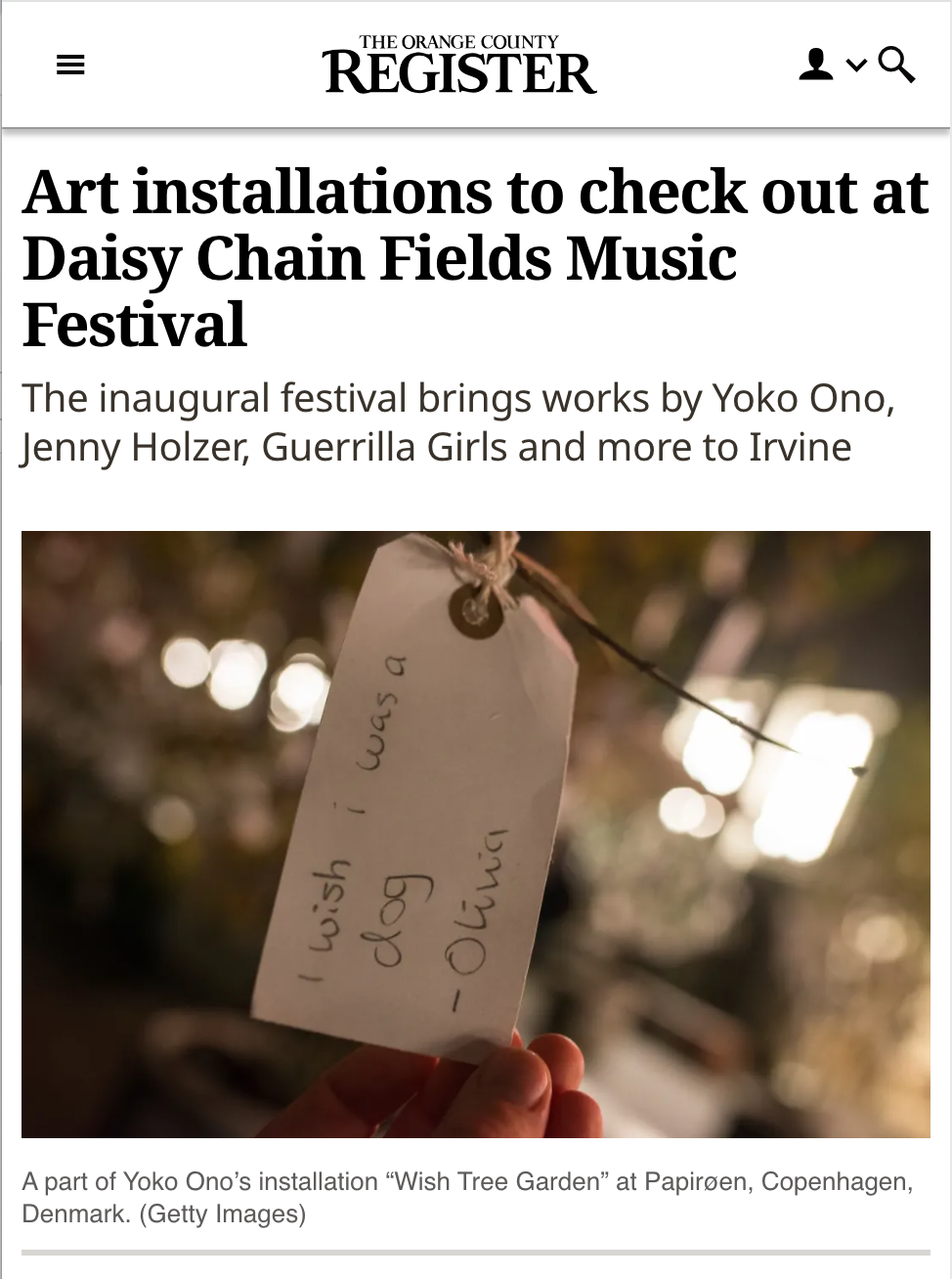
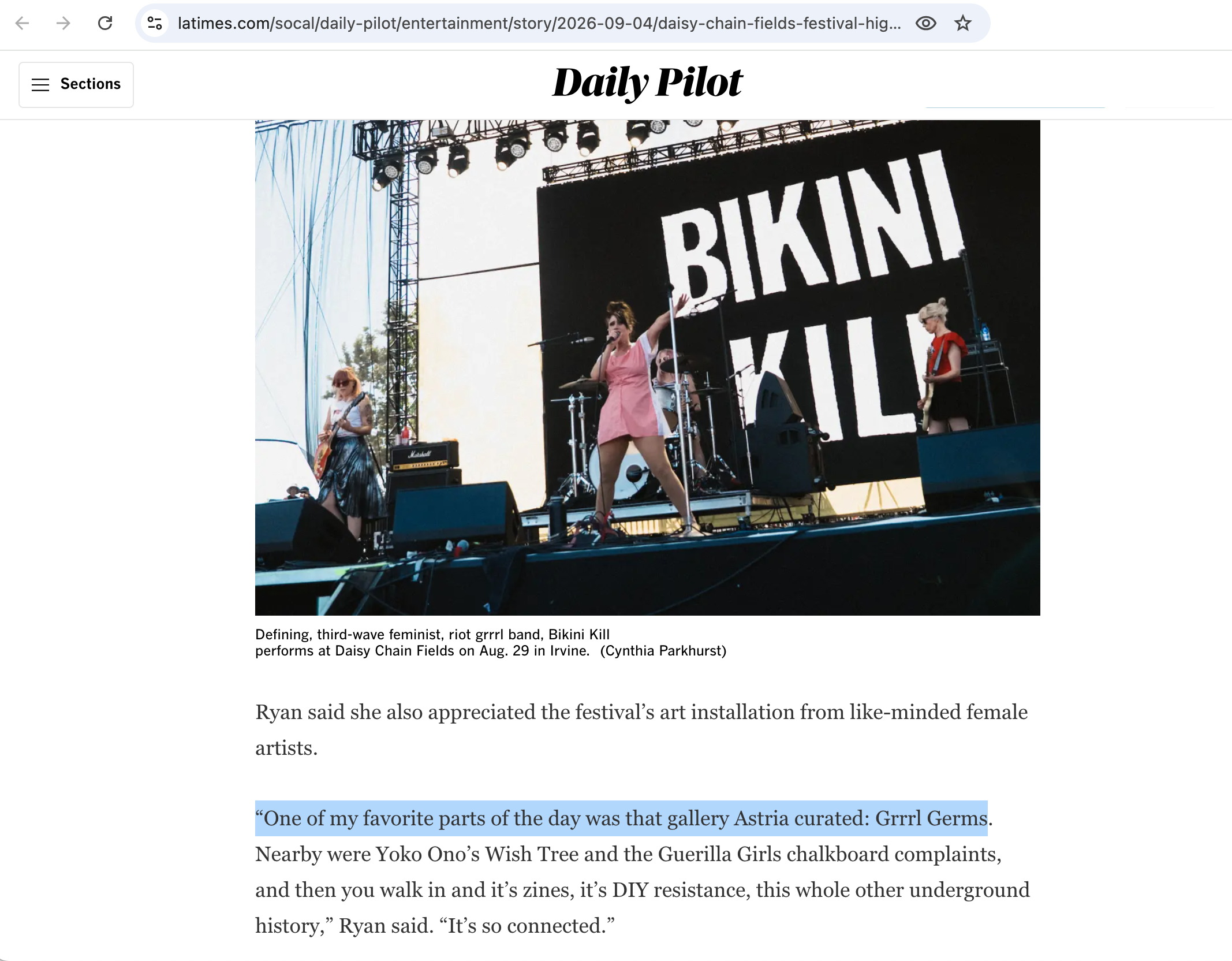
[Emily] Ryan said she also appreciated the festival’s art installation from like-minded female artists.
“One of my favorite parts of the day was that gallery Astria (Suparak) curated: Grrrl Germs. Nearby were Yoko Ono’s Wish Tree and the Guerilla Girls chalkboard complaints, and then you walk in and it’s zines, it’s DIY resistance, this whole other underground history,” Ryan said. “It’s so connected.”
LOUD WOMEN, “Daisy Chain Fields – LOUD WOMEN heads to Olivia Rodrigo’s festival of sisterhood and solidarity,” Aug. 27, 2026
This feels like a year when women in music are very visibly pulling together: looking backwards to the women who kicked doors open, sideways to support each other now, and forwards to the artists coming next. Seeing some of the biggest stars in the music industry using their enormous platforms to celebrate women’s creativity, activism and collective power feels both timely and genuinely exciting. […]
Sisterhood and solidarity on this scale? We love to see it.
That history is woven into Daisy Chain Fields beyond the music stages too.Running alongside the festival at Great Park Gallery is GRRRL GERMS: Punk feminism goes viral, 1991–2026, an exhibition tracing 35 years of riot grrrl through music, zines, flyers, grassroots organising and international networks.
That link between DIY culture and what is happening on a huge festival stage in 2026 feels especially important to us.
Riot grrrl was never only about bands. It was about women finding each other, sharing resources, making their own media, putting on their own shows, creating networks and deciding they didn’t need to wait for somebody else to give them permission.
Sound familiar?
Daisy Chain Fields also places activism at the heart of the event, with women- and girls-focused nonprofit organisations, women-led businesses and makers, art and creative spaces throughout the festival.
At a time when the rights of women, girls and LGBTQ+ people are under very real pressure, there is power in artists using their platforms not simply to make statements, but to bring people together.
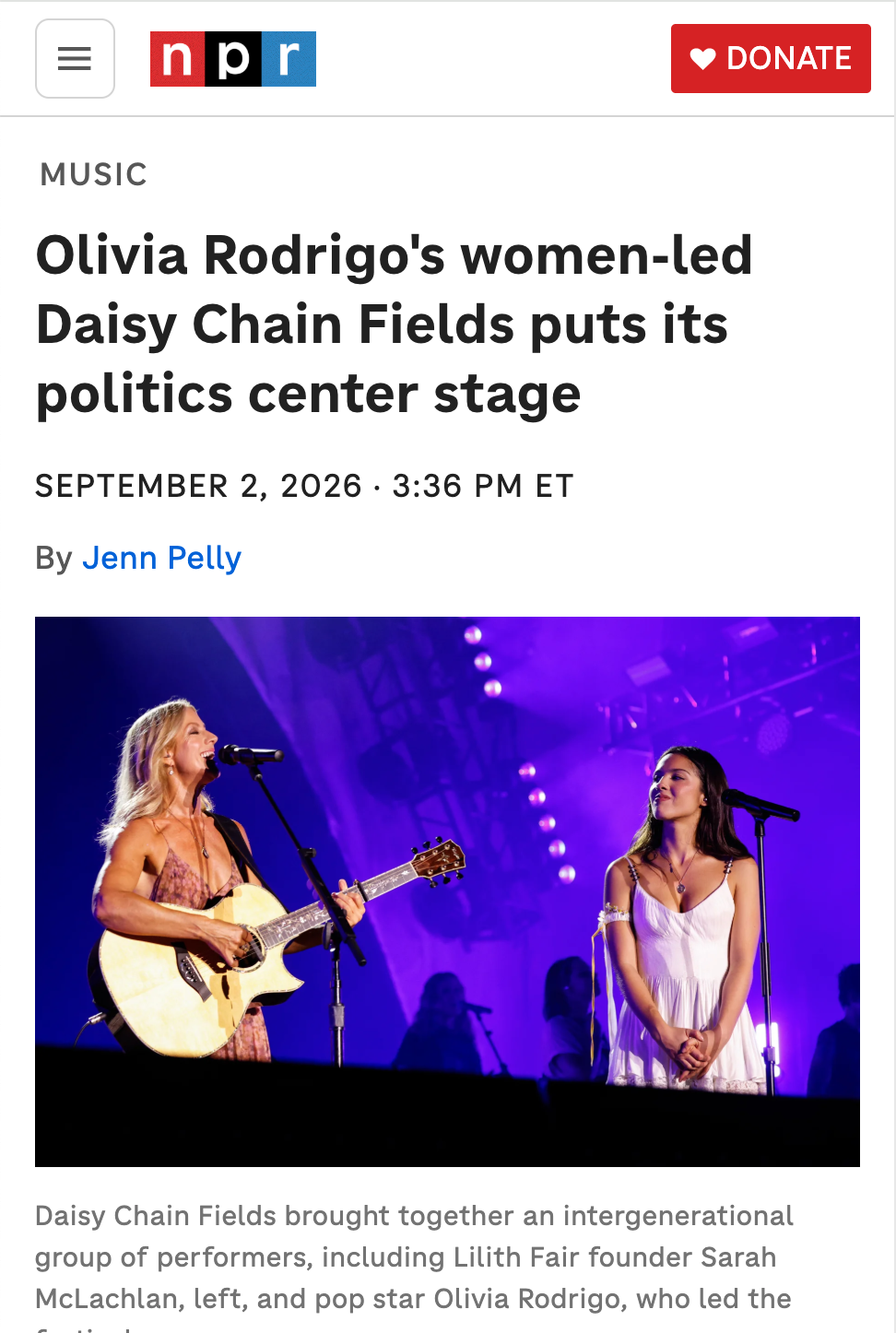
NPR, “Olivia Rodrigo’s women-led Daisy Chain Fields puts its politics center stage,” Jenn Pelly, Sept. 2, 2026
(republished by LAist)
During Bikini Kill’s blazing set, Kathleen Hanna directly addressed the young people at Daisy Chain and told them to keep teaching the older people in their lives — “We have so much that we can learn from one another,” she insisted — and to keep their diaries, which constitute their art, and which will create the world. A participatory spirit was stoked, too, by an exhibition, “Grrrl Germs: Punk feminism goes viral 1991-2026,” curated by the artist Astria Suparak, presenting artifacts of DIY feminist punk with blown-up flyers, manifestos, zines, and listening stations (it also functioned as a desperately needed defacto cooling center). I spoke with two young women who were learning about riot grrrl’s history for the first time and pointed out its relevance in an age of social media self-commodification and Ozempic. “Younger girls need to be exposed to this,” said Claire Hendrick, 24. “You can read about empowerment, but it’s so different when you’re with people in community, actually doing it and being it.”
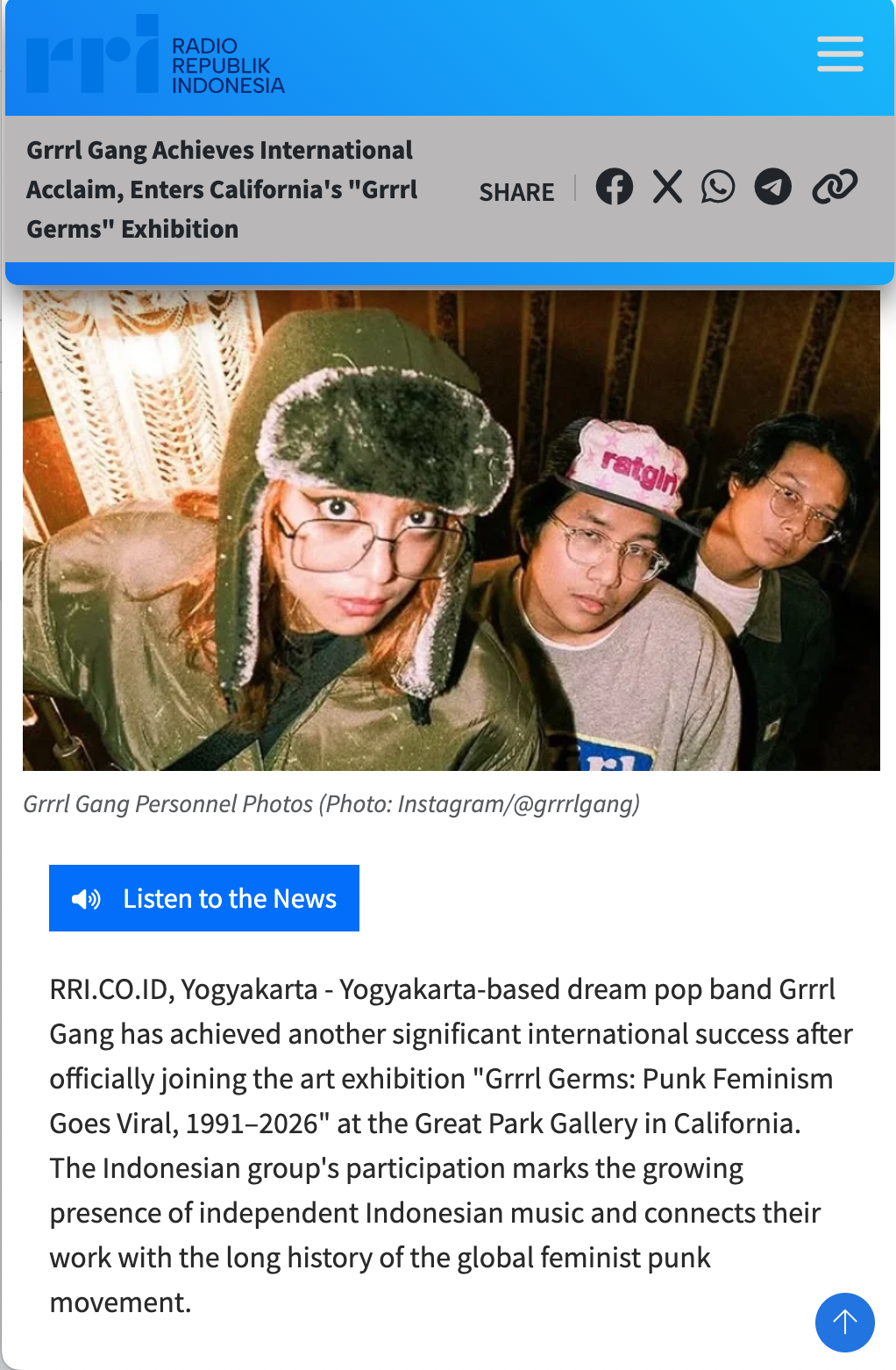
Radio Republik Indonesia, “Grrrl Gang Achieves International Acclaim, Enters California’s ‘Grrrl Germs’ Exhibition,” Mochamad Khoirul Mahsan Hadi, Aug. 27, 2026
The selection of Grrrl Gang demonstrates that narratives of resistance born from local scenes have a resonance that transcends geographical boundaries. Expressions of punk feminism, the DIY spirit, and the ways in which Indonesian youth independently build creative spaces are relevant to various subcultural movements developing globally. This also demonstrates that local experiences can be part of a larger narrative about the development of global alternative music and culture.
Furthermore, Grrrl Gang’s involvement in “Grrrl Germs: Punk Feminism Goes Viral, 1991–2026” can be seen as a validation of Indonesia’s independent music subculture’s position in the global landscape. Indonesian alternative music and culture are no longer merely domestic phenomena, but are also beginning to be placed within the historical context and development of international subcultural movements.
Sonoridad, “Ladyfest CDMX y Cremalleras llegan a exposición sobre riot grrrl en California,” Aug. 25, 2026 (Mexico)
Texx and the City, “South African artists featured in new Riot Grrrl exhibition in California,” TACT Staff, Sept. 1, 2026
For the South African artists involved, the exhibition offers another way of locating the country’s underground music within a global lineage of artists using music, visual culture and DIY practice to create their own spaces.
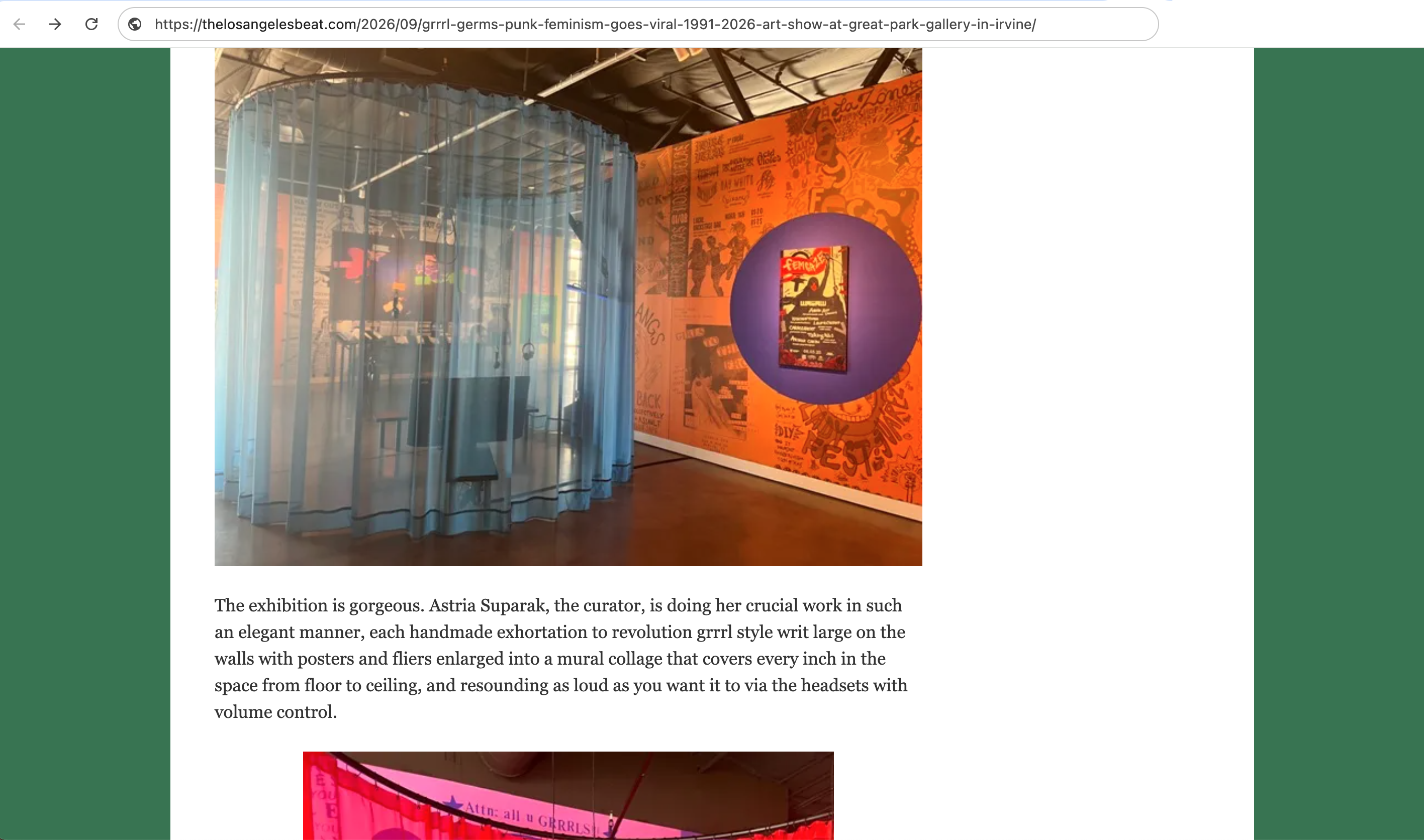
The Los Angeles Beat, “Grrrl Germs: Punk Feminism Goes Viral 1991-2026 art show at Great Park Gallery in Irvine,” Lucretia Tye Jasmine, Sept. 25, 2026
The exhibition is gorgeous. Astria Suparak, the curator, is doing her crucial work in such an elegant manner, each handmade exhortation to revolution grrrl style write large on the walls with posters and fliers enlarged into a mural collage that covers every inch in the space from floor to ceiling, and resoundingly as loud as you want it to via the headsets with volume control.
I love the posters about bands, especially the Riot Grrrl manifesto, fatphobia resistance, birth control/pregnancy care, and self-defense fliers. Music played the whole time I was there but headsets meant you could listen to different songs and interviews and concerts in the various partitioned areas. And from all over the world!
The Orange County Register, “Art installations to check out at Daisy Chain Fields Music Festival,” Holly Alvarado, Aug. 28, 2026
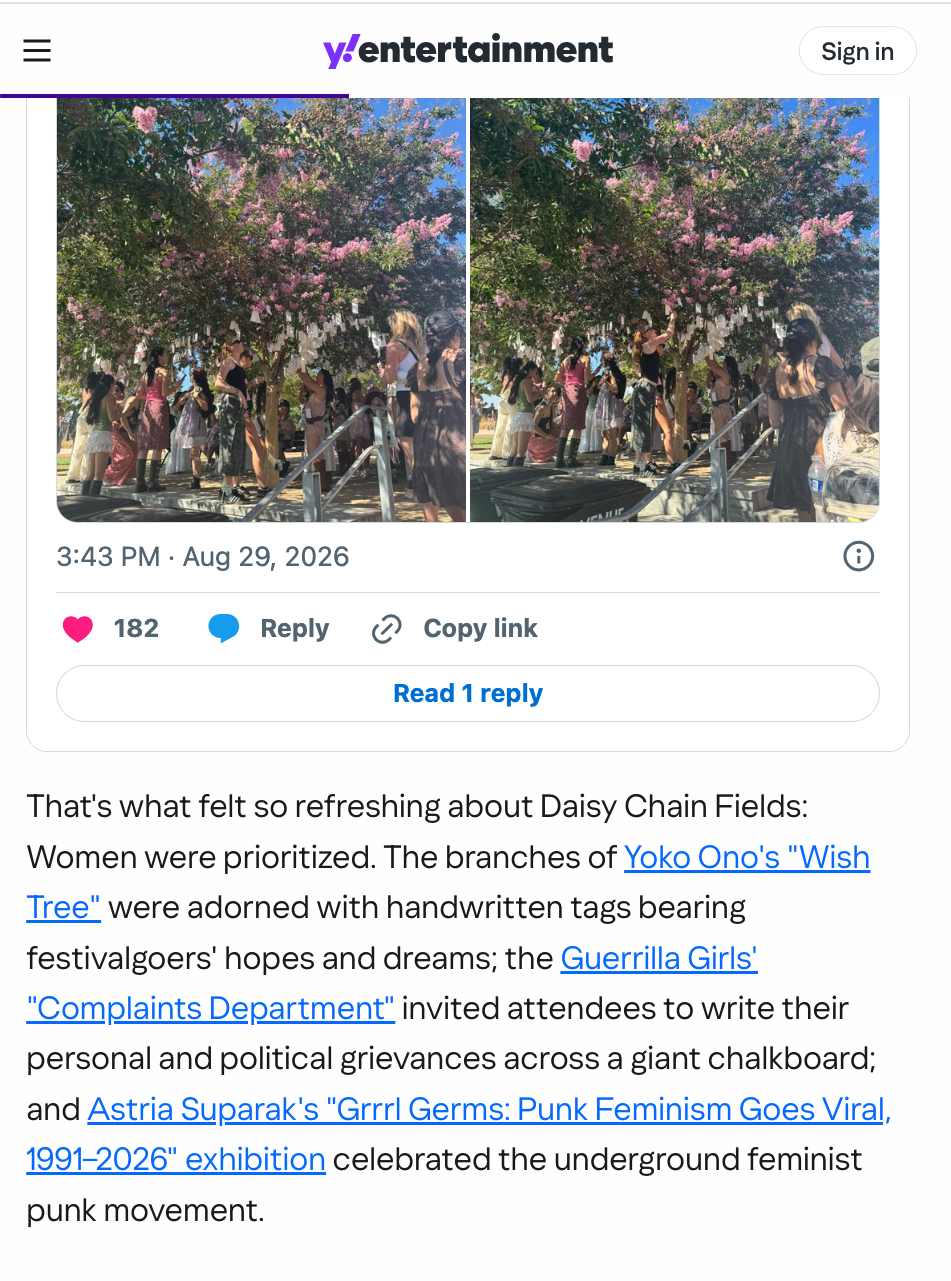
Yahoo, “Olivia Rodrigo made a music festival for women. Obviously, it ruled.,” Neia Balao, Sept. 2, 2026
RELATED
- Alien She exhibition
- Riot Grrrl Map
- Some Kind of Loving video compilation
- Virtually Asian video
- EXPANDING THE FIELD: Sports & Politics Discussion Series
- Pyramid Schemes installation
- Tropical Cats video

