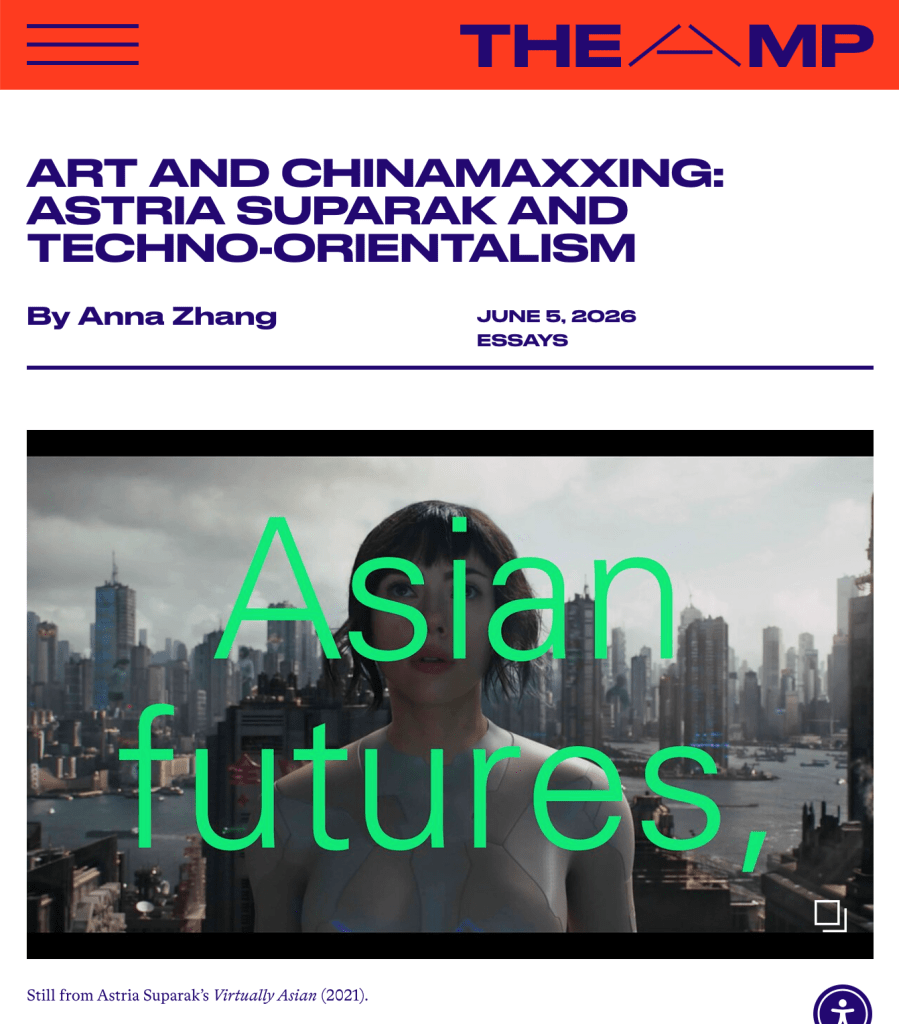
“Art and Chinamaxxing: Astria Suparak and Techno-Orientalism”
Anna Zhang
THE AMP MAGAZINE
June 6, 2026
www.aaartsalliance.org/magazine/stories/art-and-chinamaxxing-astria-suparak-and-techno-orientalism
Excerpt:
…By spring of 2026, “Chinamaxxing” became a viral sensation.
On TikTok and Instagram, young Westerners began drinking hot water each morning, practicing qigong, boiling apples into tea, and captioning it all with the now-ubiquitous line “you met me at a very Chinese time in my life.” Chinese American creators like Sherry Zhu, whose video on drinking hot water has over 5 million views, found themselves cast as guides to becoming a Chinese baddie. White boys squat on street corners chugging bottles of Tsingtao beer. As The New York Times noted, the trend could be considered “an absurdist joke, a wellness goal or an ironic expression of protest–or all of the above.” Chinamaxxing frames Chinese-ness as something that’s consumable: as aesthetic instead of a lived identity.
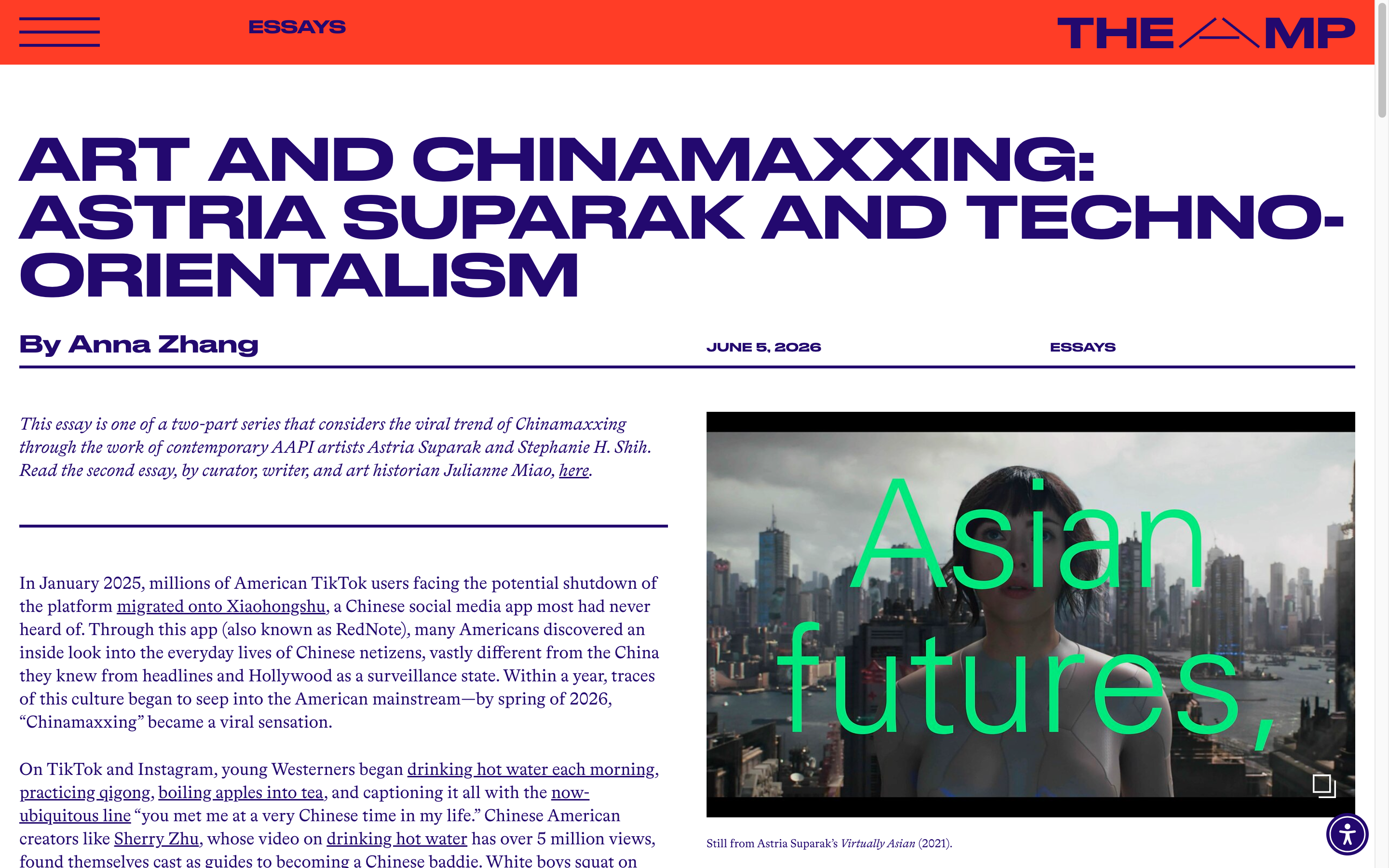
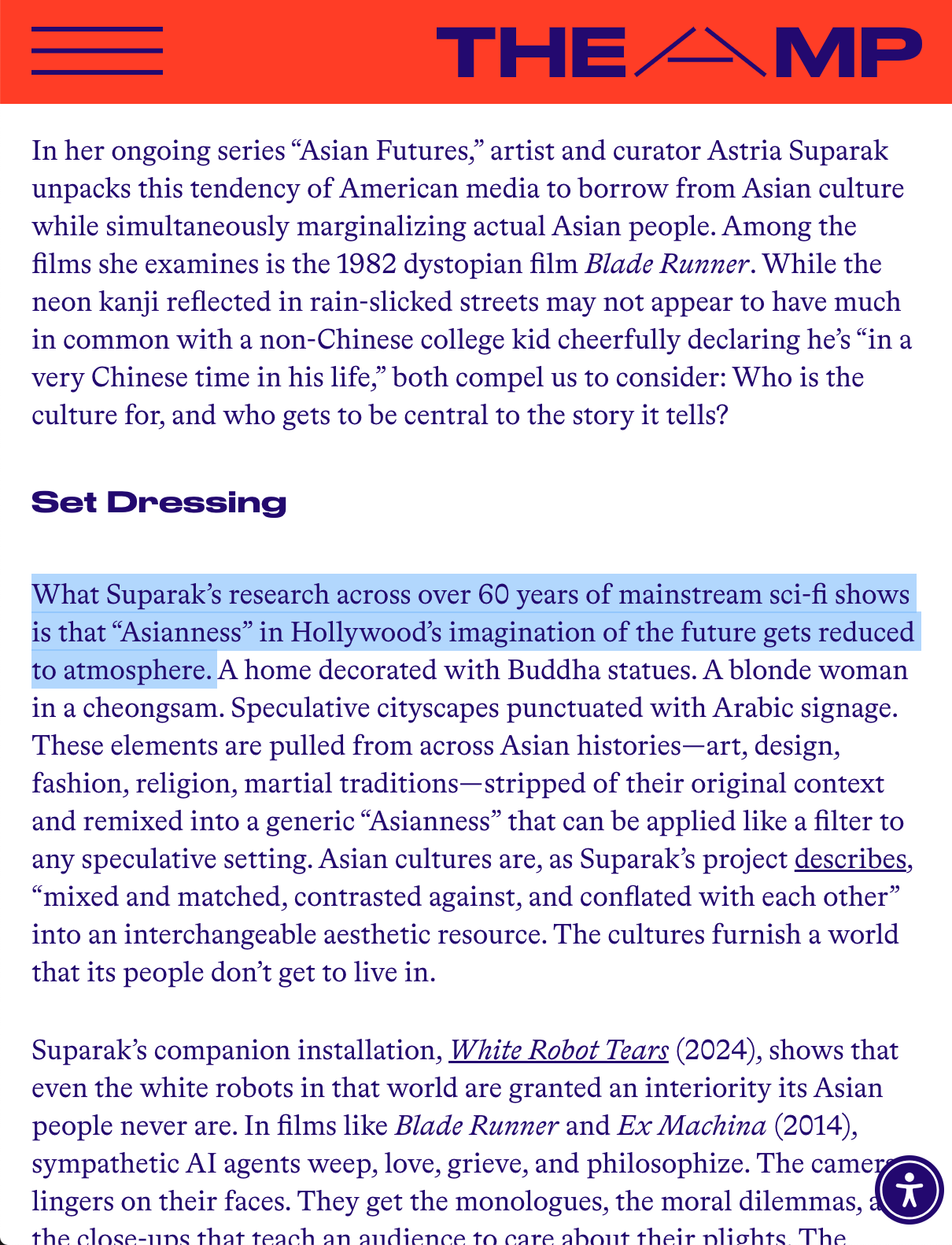
In her ongoing series “Asian Futures,” artist and curator Astria Suparak unpacks this tendency of American media to borrow from Asian culture while simultaneously marginalizing actual Asian people. Among the films she examines is the 1982 dystopian film Blade Runner. While the neon kanji reflected in rain-slicked streets may not appear to have much in common with a non-Chinese college kid cheerfully declaring he’s “in a very Chinese time in his life,” both compel us to consider: Who is the culture for, and who gets to be central to the story it tells?
Set Dressing
What Suparak’s research across over 60 years of mainstream sci-fi shows is that “Asianness” in Hollywood’s imagination of the future gets reduced to atmosphere. A home decorated with Buddha statues. A blonde woman in a cheongsam. Speculative cityscapes punctuated with Arabic signage. These elements are pulled from across Asian histories—art, design, fashion, religion, martial traditions—stripped of their original context and remixed into a generic “Asianness” that can be applied like a filter to any speculative setting. Asian cultures are, as Suparak’s project describes, “mixed and matched, contrasted against, and conflated with each other” into an interchangeable aesthetic resource. The cultures furnish a world that its people don’t get to live in.
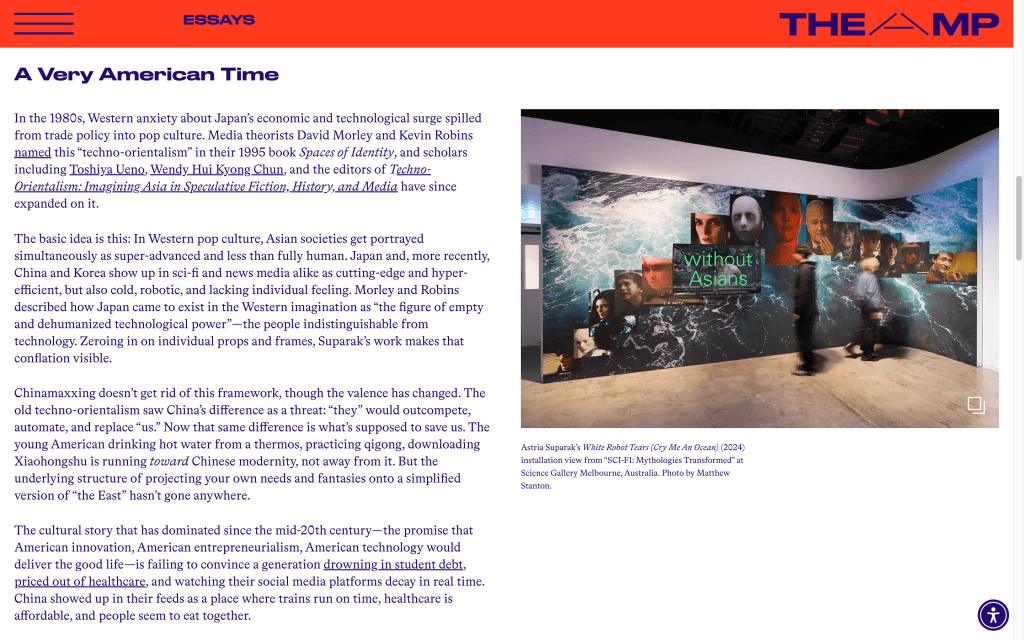
Suparak’s companion installation, White Robot Tears (2024), shows that even the white robots in that world are granted an interiority its Asian people never are. In films like Blade Runner and Ex Machina (2014), sympathetic AI agents weep, love, grieve, and philosophize. The camera lingers on their faces. They get the monologues, the moral dilemmas, and the close-ups that teach an audience to care about their plights. The Asian figures in the same films get none of that; they appear as holographic advertisements, mute virtual geishas, set dressing. As Suparak told The Hollywood Reporter, these robots are “who the audience is supposed to root for,” and “the way they’re presented is in stark contrast to how Asian robots are often dehumanized.” But in many of these films, the comparison isn’t white robots versus Asian robots. It’s white robots versus Asian humans. The machine gets to be a person. The person gets to be scenery.
A Very American Time
In the 1980s, Western anxiety about Japan’s economic and technological surge spilled from trade policy into pop culture. Media theorists David Morley and Kevin Robins named this “techno-orientalism” in their 1995 book Spaces of Identity, and scholars including Toshiya Ueno, Wendy Hui Kyong Chun, and the editors of Techno-Orientalism: Imagining Asia in Speculative Fiction, History, and Media have since expanded on it.
The basic idea is this: In Western pop culture, Asian societies get portrayed simultaneously as super-advanced and less than fully human. Japan and, more recently, China and Korea show up in sci-fi and news media alike as cutting-edge and hyper-efficient, but also cold, robotic, and lacking individual feeling. Morley and Robins described how Japan came to exist in the Western imagination as “the figure of empty and dehumanized technological power”—the people indistinguishable from technology. Zeroing in on individual props and frames, Suparak’s work makes that conflation visible.
Chinamaxxing doesn’t get rid of this framework, though the valence has changed. The old techno-orientalism saw China’s difference as a threat: “they” would outcompete, automate, and replace “us.” Now that same difference is what’s supposed to save us.
[…]
But admiration can be just as flattening as fear. In Suparak’s films, Asian culture is consumed as raw material for building fictional worlds. In Chinamaxxing, it’s raw material for building a better version of yourself—specific histories evaporated into wellness content.
Read in full at: www.aaartsalliance.org/magazine/stories/art-and-chinamaxxing-astria-suparak-and-techno-orientalism
RELATED
- Asian futures, without Asians performance
- Virtually Asian video
- White Robot Tears installation
- Finite Horizon installation
- X-TRA Journal interview
- EXPANDING THE FIELD: Sports & Politics Discussion Series
- Welcome to the Taro Dome installation
- See more #scifi work

