

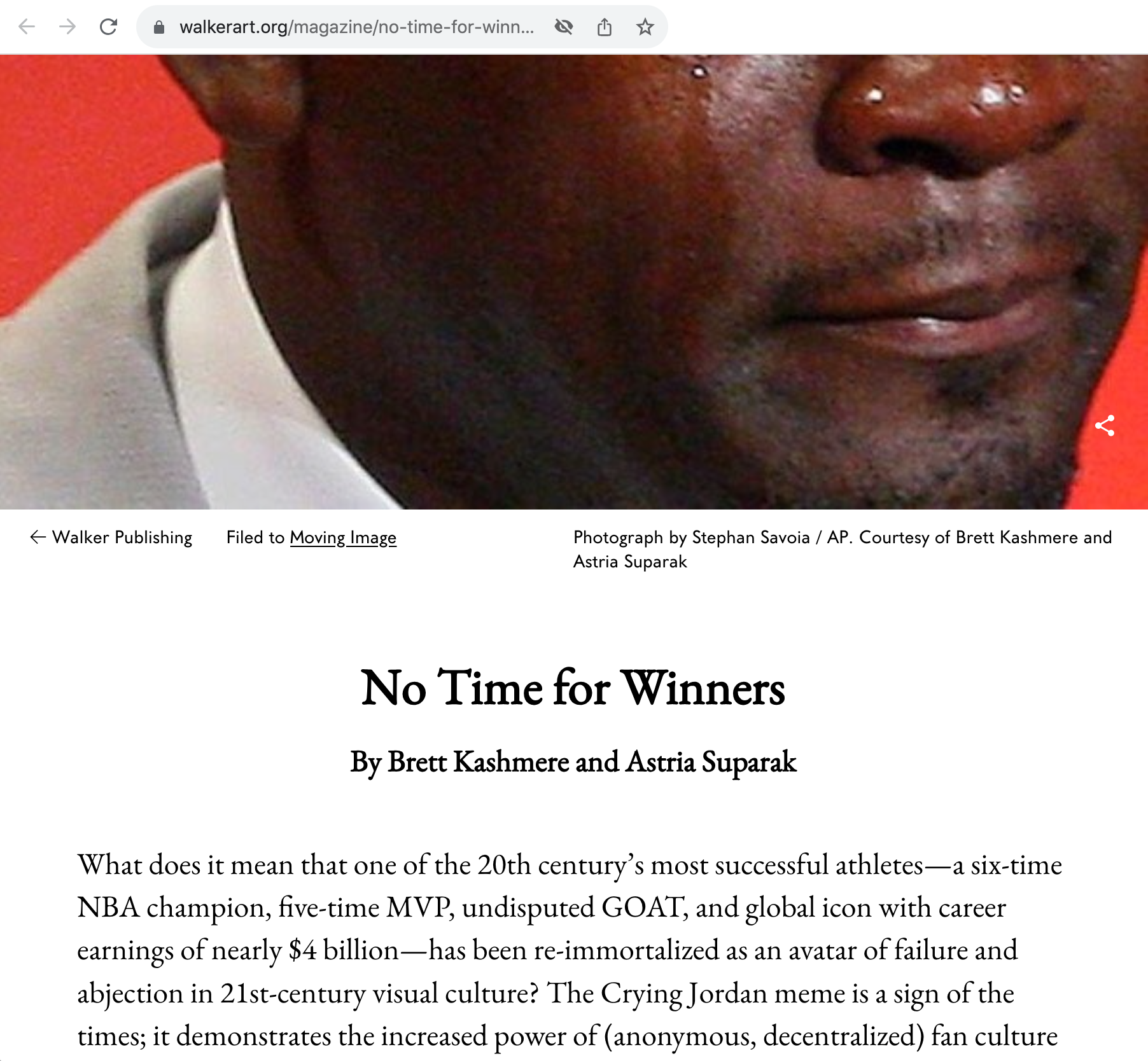


“No Time for Winners“
Essay by Brett Kashmere and Astria Suparak
Walker Art Center Magazine, Fall 2024
https://walkerart.org/magazine/no-time-for-winners
- Essay excerpt
- Performance & Film Series: The Game is Not the Thing: Sport and the Moving Image
- Press
Excerpt:
As The Last Dance attests, mainstream sports cinema is, by and large, deeply conservative and conventional. “As they manipulate athletes’ histories into inspirational narratives and filter real events into sanitized sporting worlds,” Samantha N. Sheppard asserts, “sports films are made to appear factual and intrinsic, grounded in the historicity of the genre’s conventions.”2 In the United States, the sports film genre—as it has come to be defined through its codes, scholarship, production and screening contexts, and broadcast platforms—is dominated by two typologies: fictive sports films, like Hoosiers (1986), White Men Can’t Jump (1992), and The Blind Side (2009), which often reinforce dominant attitudes and social and cultural stereotypes while distorting or whitewashing history for storytelling purposes; and commercial documentaries, including most of the titles in ESPN’s 30-for-30 catalogue, which typically focus on exceptional players, coaches, or teams.3
The sports film was not always a vehicle for utopic narratives and heroic portrayals. In the 1880s, precinematic scientific studies were conducted, such as Ottomar Anschütz’s Pferd und Reiter Springen über ein Hindernis (Horse and Rider Jumping Over an Obstacle) (1888) and Eadweard Muybridge’s animal and human locomotion photo series. Roughly a decade later, Étienne-Jules Marey produced his chronophotographic analysis of Olympic athletes, taken during the 1900 Paris Games. During the silent cinema period and into the 1930s, filmic treatments of sports tended to spotlight its spectacular and visual dimensions, namely athletic bodies and action: from motion experiments and actualities such as Sandow (William K.L. Dickson, 1894), featuring “muscle display performances” of the famed strongman; to fight pictures, many of which were, as the film historian Dan Streible reveals, reenacted matches or staged sparring scenes;4 and highlights of newsworthy college and professional contests packaged into newsreels.5 Media artworks like Nam June Paik’s Lake Placid ’80 (1980), a dizzying, effects-laden collage of motion on ice and snow, commissioned for the Olympic Winter Games; Bette Gordon’s loop-printed diving film An Algorithm (1977); and Paul Pfeiffer’s video sculpture Three Studies for Figures at the Base of a Crucifixion (2001), which digitally erases objects and figures from basketball game footage, have carried forward the use of sport imagery as a springboard for formal exploration.
The preoccupation with hyper-gendered, muscular bodies in cinematic renderings of sport forms a continuity with classical depictions of the athletic body dating as far back as the Bronze Age. “When we think of the athlete’s body,” Judith Butler writes, “we are drawn to the image of a muscular sort of being; it is a body that we see or, rather, imagine . . . a body whose contours bear the marks of a certain achievement.”6 This ideal of the athletic body, Butler suggests, exceeds its athletic function and conditions our desire as viewers. The fetishized spectacle of the athletic body is central to the production of the sporting gaze.
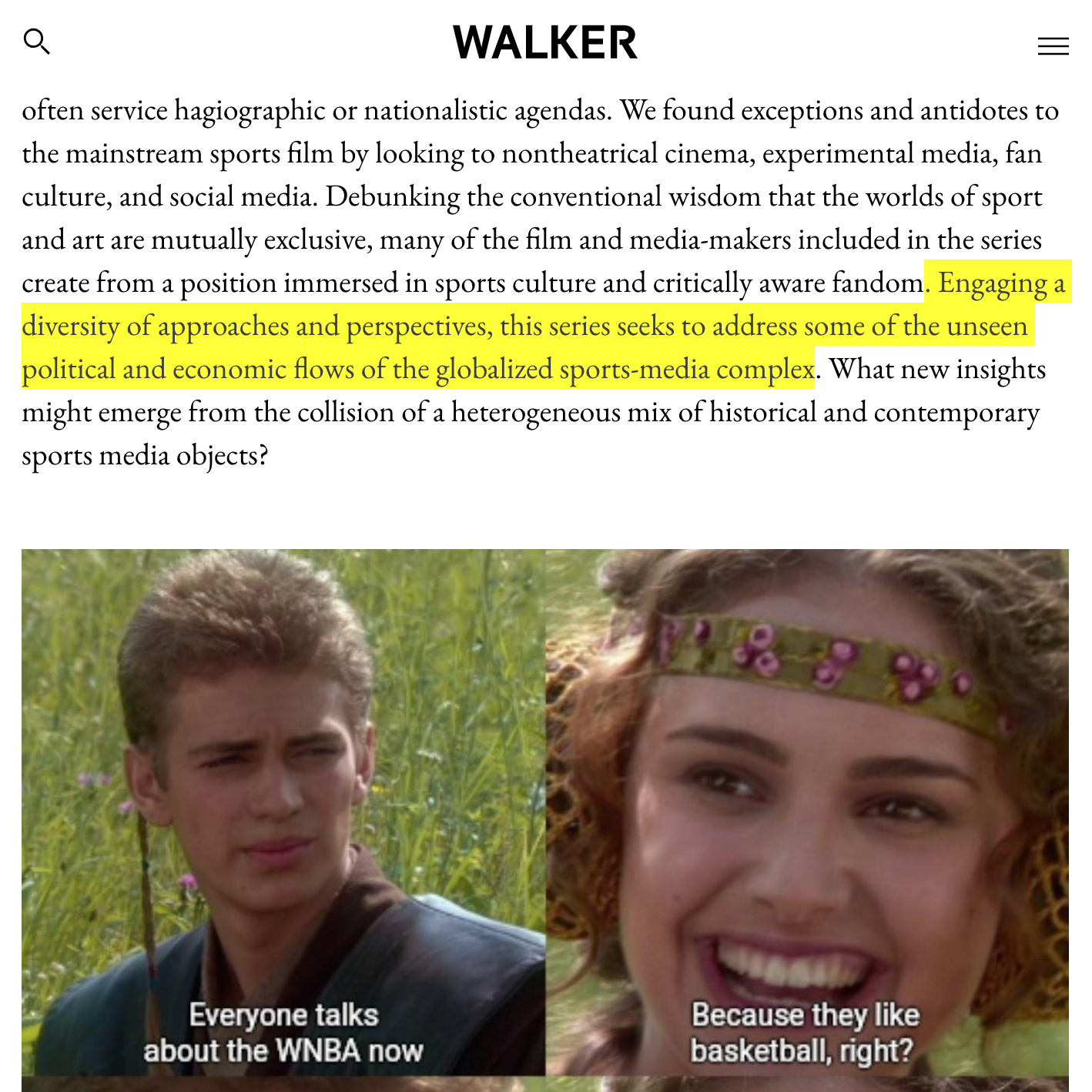
The paradoxical nature of sport—as a site of biopolitical control, collective struggle, and individualized fantasy—makes it a rich and captivating subject. Our film series, The Game is Not the Thing: Sport and the Moving Image, challenges and expands commonplace understandings of the sports film, charted across a period from pre-cinema to post-internet. […]
Read the rest of this essay with accompanying images at:
https://walkerart.org/magazine/no-time-for-winners


The Game is Not the Thing: Sport and the Moving Image
Curated by Astria Suparak and Brett Kashmere
Walker Art Center, Minneapolis, MN
Oct. 11—Nov. 8, 2024
https://walkerart.org/calendar/2024/series/the-game-is-not-the-thing-sport-and-the-moving-image
Spanning 13 decades of filmmaking, from pre-cinema to post-internet, guest curators Astria Suparak and Brett Kashmere’s six-part screening and performance series challenges the idea that the worlds of sports and art are mutually exclusive. The Game is Not the Thing offers an antidote to commercial documentary and mainstream feature film narratives, looking instead to the creative and critical approaches that artists and amateurs bring to the “sports film.”
Programs and details here.

PRESS
THE POLIS PROJECT, “Astria Suparak On The Role of Sports In Upholding Empires and Systems of Power,” Lisa Kwon, Dec. 12, 2024
RELATED WORKS
- The Game is Not the Thing curated film & performance series
- INCITE Journal of Experimental Media: SPORTS publication
- “A Selective Guide To Sports In Experimental Media”
- “We, the Aliens of the Future” essay
- “Seedy Space Ports and Colony Planets” visual essay
- EXPANDING THE FIELD: Sports & Politics Discussion Series
 Astria Suparak