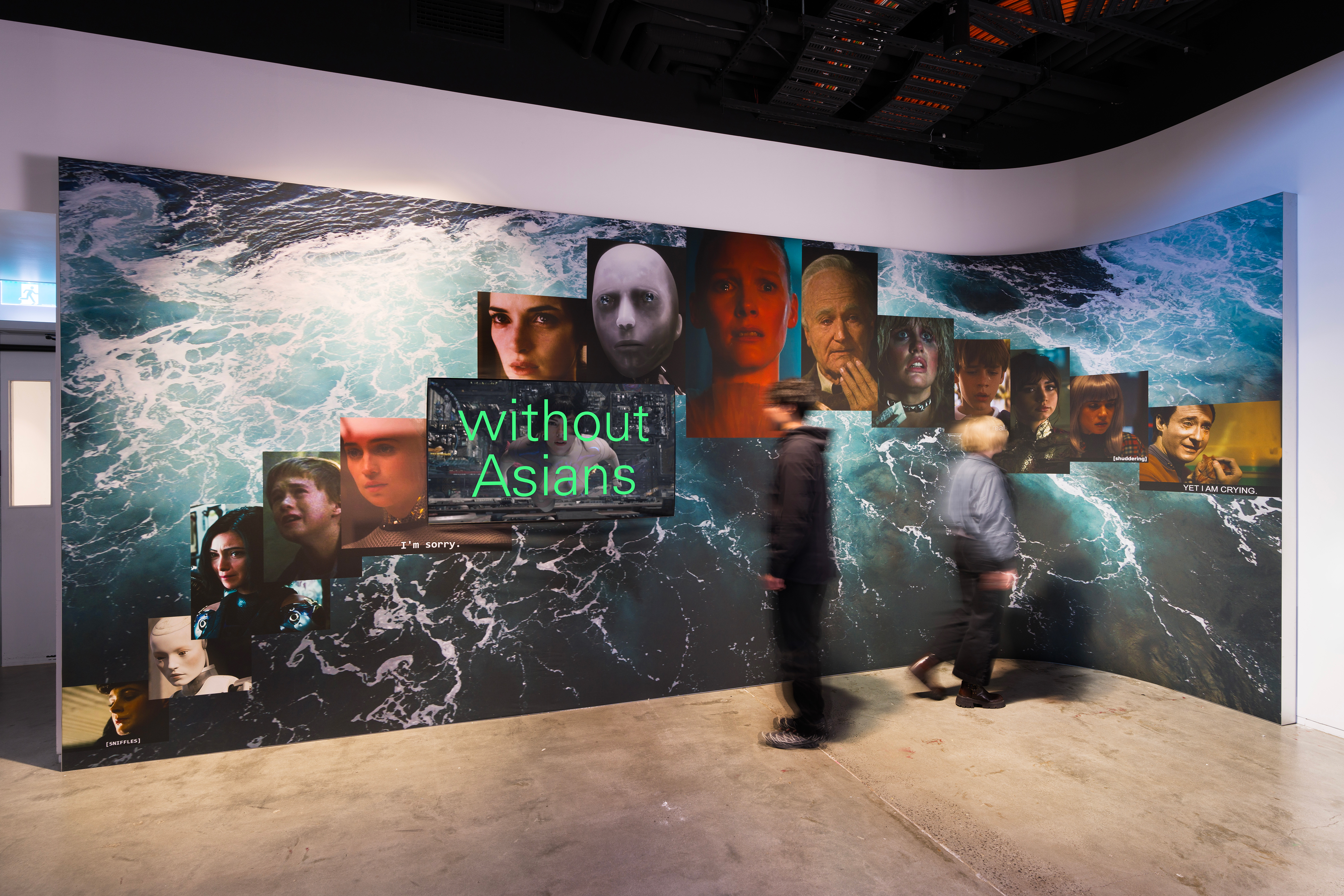



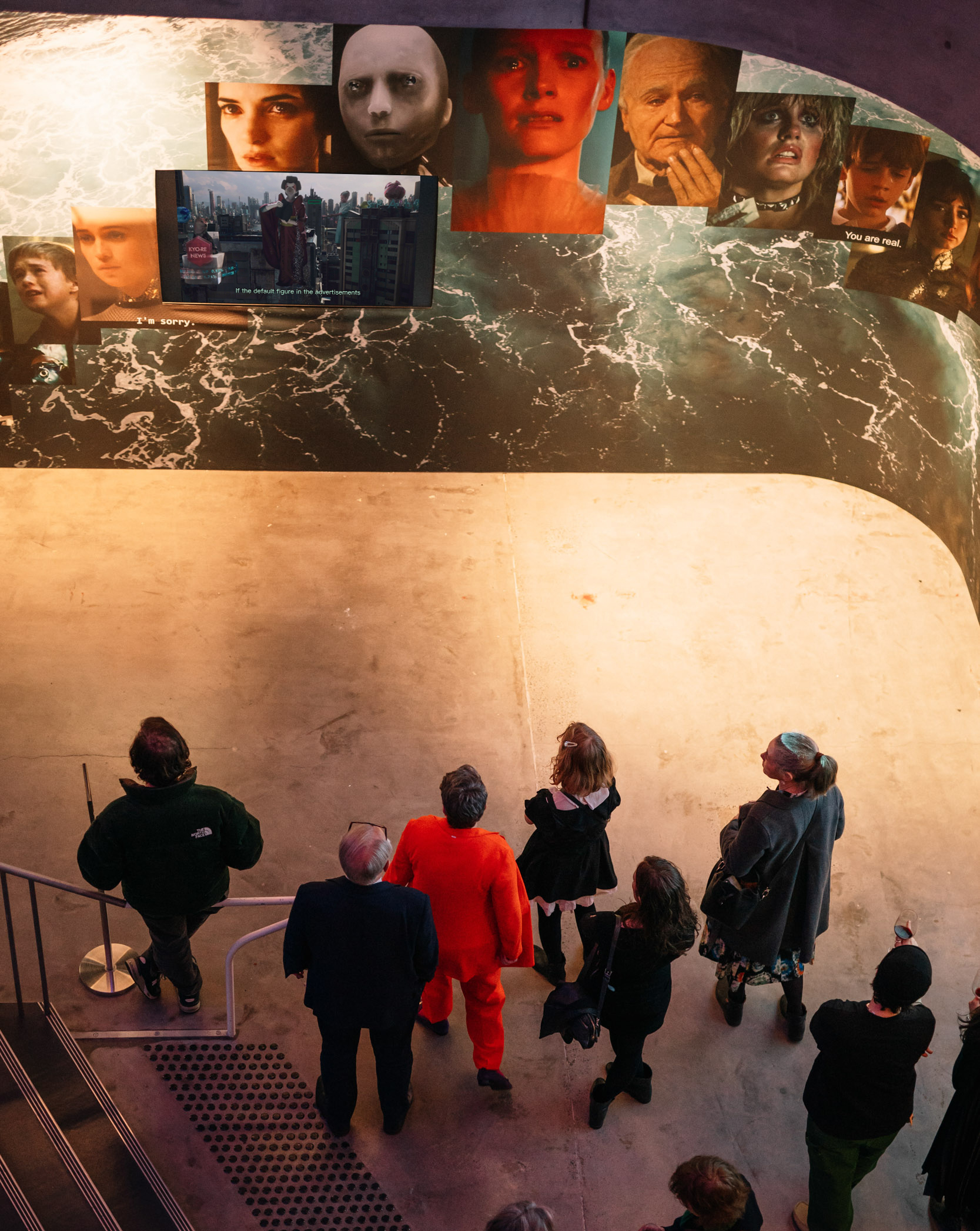
“White Robot Tears (Cry Me An Ocean)”
Astria Suparak
Installation (Printed Fabric, Video on Monitor, Aluminum Frame), 23 x 10 feet / 7295 x 3020 mm
2024
Commissioned for SCI-FI: Mythologies Transformed at Science Gallery Melbourne, Australia
https://bit.ly/wrt-ocean
“In Virtually Asian, Astria Suparak critically examines Hollywood’s deployment of Asian figures in major science fiction films. Often relegated to the backdrop as mere holographic or video advertisements, Suparak argues that these figures serve as illusory markers of diversity in predominantly white casts. In contrast, White Robot Tears (Cry Me An Ocean) features a collage of Caucasian actors in roles as emotionally complex robots, AIs and cyborgs. Scrutinise the subtle biases and stereotypes woven into the fabric of science fiction narratives when you view the two works side by side. They question who is granted the privilege of humanity and emotional depth in these techno-futuristic landscapes.”
– Gail Chin, Joel Chin, Adrian George, and Honor Harger, curators, SCI-FI: Mythologies Transformed
The print features 14 Western films (left to right): Blade Runner (1982), Automata (2014), Alita (2019), A.I. (2001), Ex Machina (2014), Alien Resurrection (1997), I, Robot (2004), Foundation (2021), Bicentennial Man (1999), Blade Runner (1982), D.A.R.Y.L. (1985), Blade Runner 2049 (2018), Zone 414 (2021), Star Trek: Generations (1994)
White Robot Tears (Cry Me An Ocean) is the newest iteration of White Robot Tears (2023) and Sympathetic White Robots (2021).
EXHIBITIONS


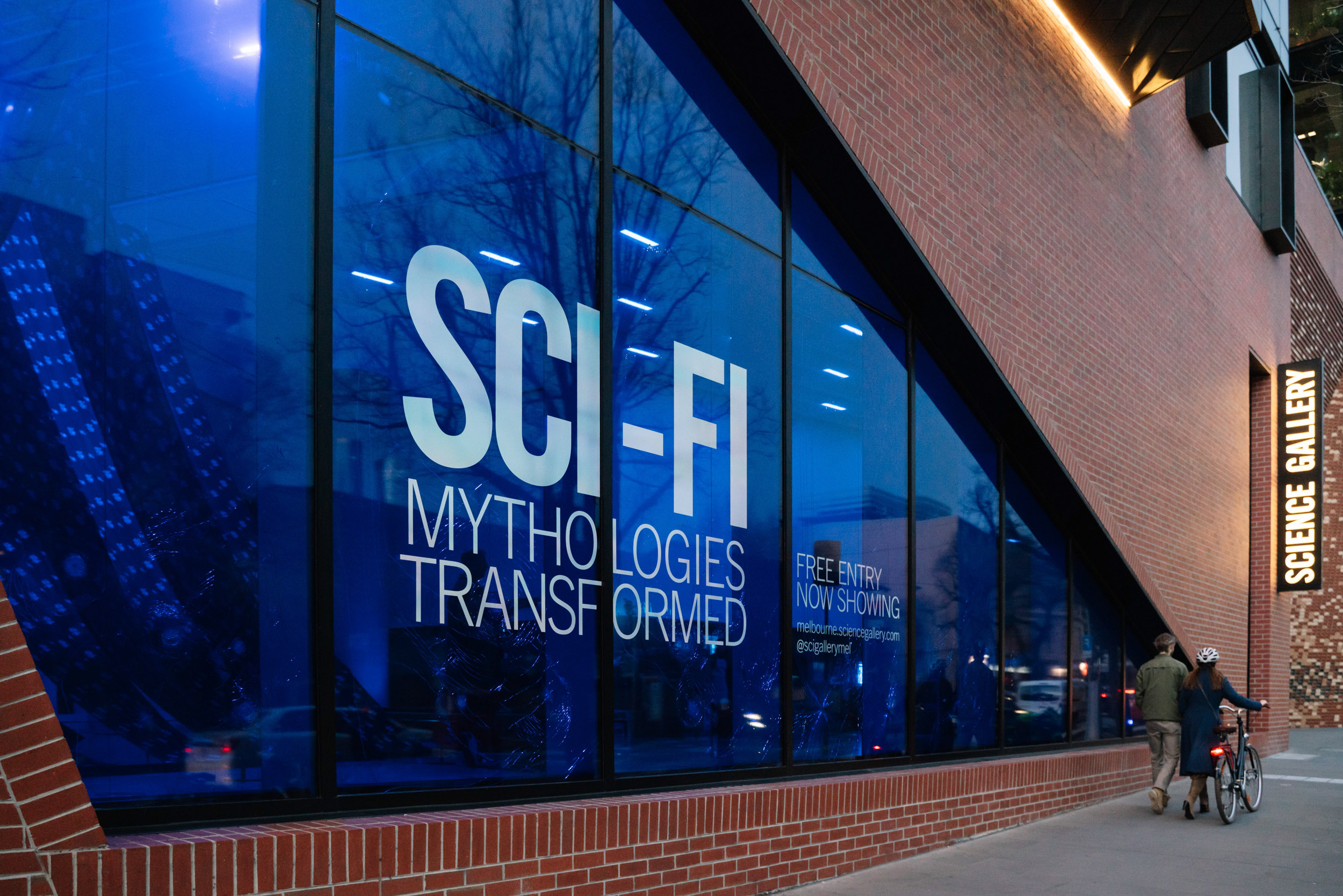
SCI-FI: Mythologies Transformed
Science Gallery Melbourne, 114 Grattan St, Parkville VIC 3052
August 3, 2024—May 31, 2025
- 52,500 visitors
- 14,000 school students attended events (in-person and online)
SCI-FI: Mythologies Transformed offers fresh insights on science fiction, a genre built on envisioning alternative futures and imaginary realms.
The exhibition weaves together narratives found in Western science fiction literature and cinema with ideas inherent in Eastern spiritual traditions that have evolved over centuries and millennia. Adopting Western science fiction paradigms, such as parallel worlds and interdimensional travel, as a starting point, SCI-FI explores science fiction’s possible roots in Asian philosophy and spirituality. Themes such as hybridity, mysticism, transcendence and other-wordly utopias, which are found in both fields, seem to point to cultural traditions in Asia. Shown in Australia for the first time, this narrative is expanded to incorporate First Nations perspectives and knowledges.
SCI-FI: Mythologies Transformed presented at Science Gallery Melbourne is a co-production developed in collaboration between ArtScience Museum and Science Gallery Melbourne.
Artists, Researchers, and Collaborators: Morehshin Allahyari, Paola Balla, Lynda Barry, Cao Fei, Patty Chang, Kara Chin, Chok Si Xuan, Club Ate, Claire G. Coleman, Debbie Ding, Fei Yining, Gridthiya Gaweewong, Shilpa Gupta, Mel Huang, Etsuko Ichihara, Corin Ileto, Tristan Jalleh, Joy Li, Monica Lim, Xin Liu, Mindy Meng Wang, Moon and Jeon, Mariko Mori, Nguyen Trinh Thi, Jen Rae, Sputniko!, Astria Suparak, The House of Natural Fiber, Saya Woolfalk



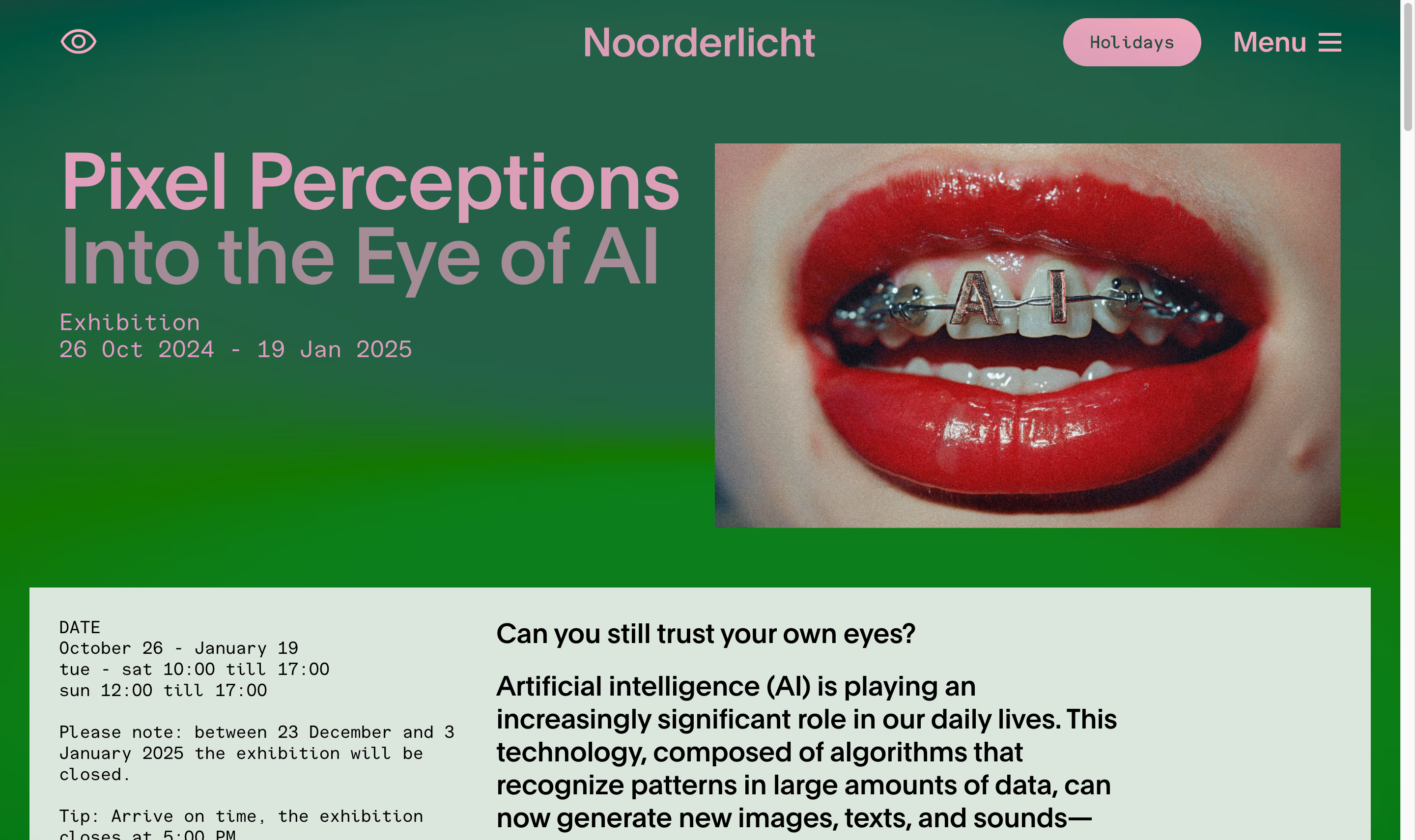
Pixel Perceptions: Into the Eye of AI
Noorderlicht, Akerkhof 12, 9711JB Groningen, Netherlands
Oct. 26, 2024—Jan. 19, 2025
Artificial intelligence (AI) is playing an increasingly significant role in our daily lives. This technology, composed of algorithms that recognize patterns in large amounts of data, can now generate new images, texts, and sounds—from a simple shopping list to a “photographic” portrait. While AI offers many new possibilities, it also raises critical questions about the reliability of images, the relationship between humans and machines, and the impact of AI on photography and visual culture.
Pixel Perceptions explores how AI influences our perception and visual culture, both consciously and unconsciously.
Featuring works by: AI.S.A.M., affect lab, Craig Ames, Minne Atairu, Mark Amerika & Will Luers & Chad Mossholder, Alice Brygo, Vera van der Burg & Gijs de Boer, Kate Crawford & Vladan Joler, Boris Eldagsen, Jake Elwes, Elisa Giardina Papa, Nicolas Gourault, Franc Archive, Philipp Klak, Ethel Lilienfeld, Jonas Lund, Luna Maurer, Mimi Onuoha, Juan Obando & Yoshua Okón, Roope Rainisto, Martina Raponi & Ymer Marinus, Sebastian Schmieg, Martine Stig, Astria Suparak, Synchrodogs, Phillip Toledano, Filippo Venturi, Conrad Weise, Jonas Yip, and Joanna Zylinska

PRESS
Arts Hub, “Exhibition review: SCI-FI – Mythologies Transformed, Science Gallery Melbourne – Disrupting gender and racial stereotypes in sci-fi,” Celina Lei, Aug 2024
“Cinematic tropes are taken apart and reclaimed, most notably in Virtually Asian and White Robot Tears (Cry Me An Ocean) by California-based Astria Suparak. In Virtually Asian, the voice of a robotic female narrator sarcastically points to the lack of Asian casting in sci-fi worlds full of billboard geishas, accompanied by scenes from popular Hollywood films like Blade Runner (1982) and Ghost in the Shell (2017). It’s OK, because ‘you can fix it later in CGI’.
The video is displayed against a wall with collaged photographs of robot and cyborg movie characters that display abnormal humanity and emotions, predominantly played by white actors.”
The Sydney Morning Herald, “Does science fiction have its roots in Asian mythology?,” Kylie Northover, August 13, 2024
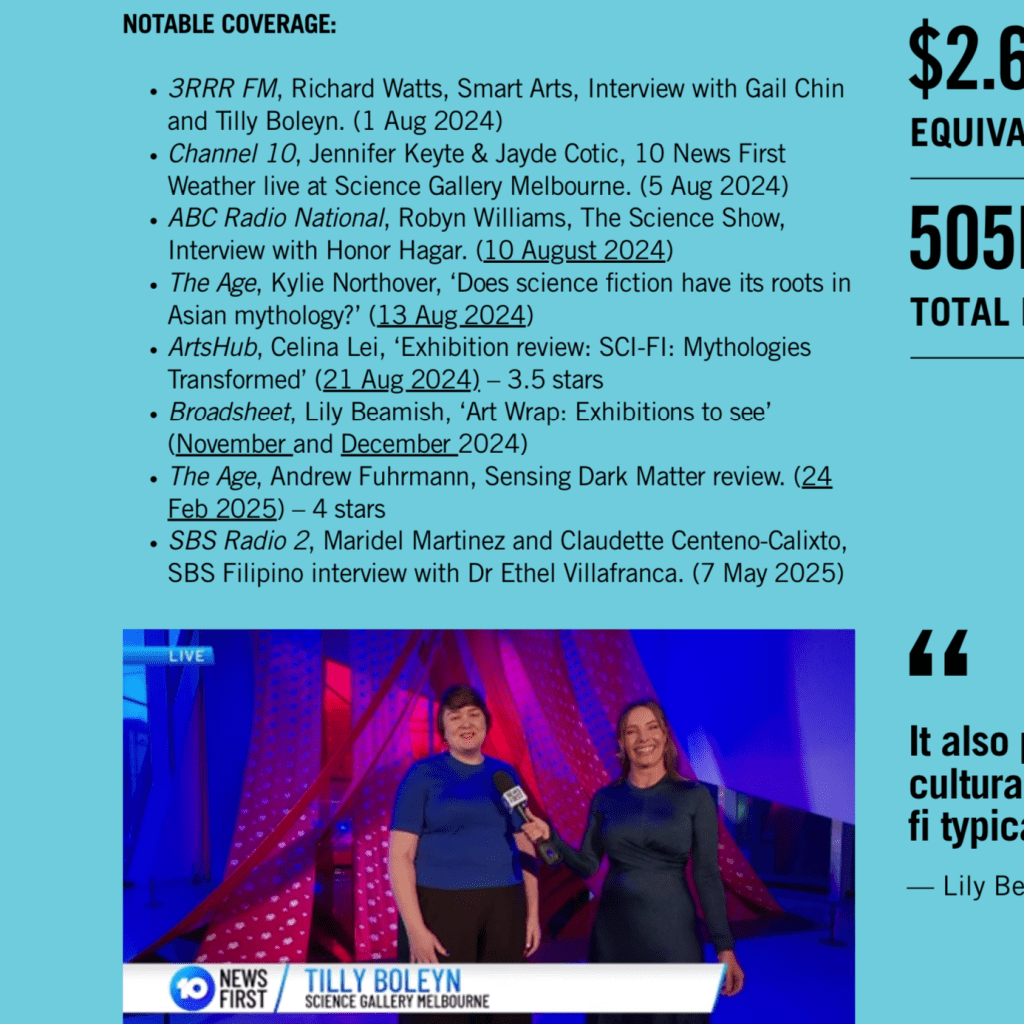
Broadsheet, “Art Wrap: 11 Exhibitions to See in Melbourne This Summer, ” Lily Beamish, Dec. 13, 2024
ABC Radio National, Robyn Williams, The Science Show, 10 August 2024
RELATED WORKS
-
- Virtually Asian (video)
- White Robot Tears (installation)
- Finite Horizon (installation)
- Asian futures, without Asians multipart research series, which includes videos, installations, collages, essays, publications, and other projects
- Check out the posts tagged #scifi
 Astria Suparak