

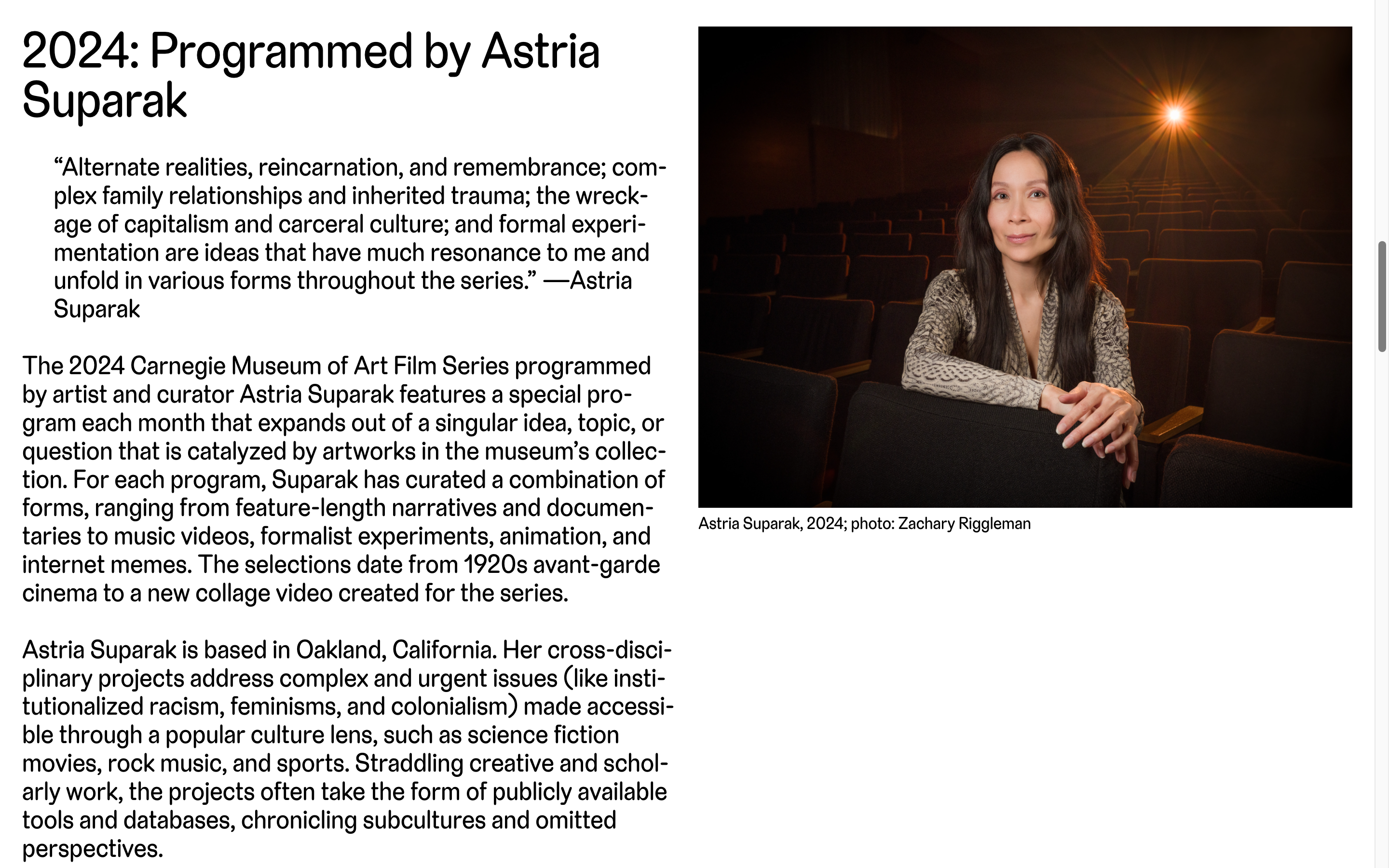


2024 Carnegie Museum of Art Film Series
Curated by Astria Suparak
Carnegie Museum of Art, Pittsburgh, PA
April 27—Nov. 30, 2024
https://carnegieart.org/series/carnegie-museum-of-art-film-series
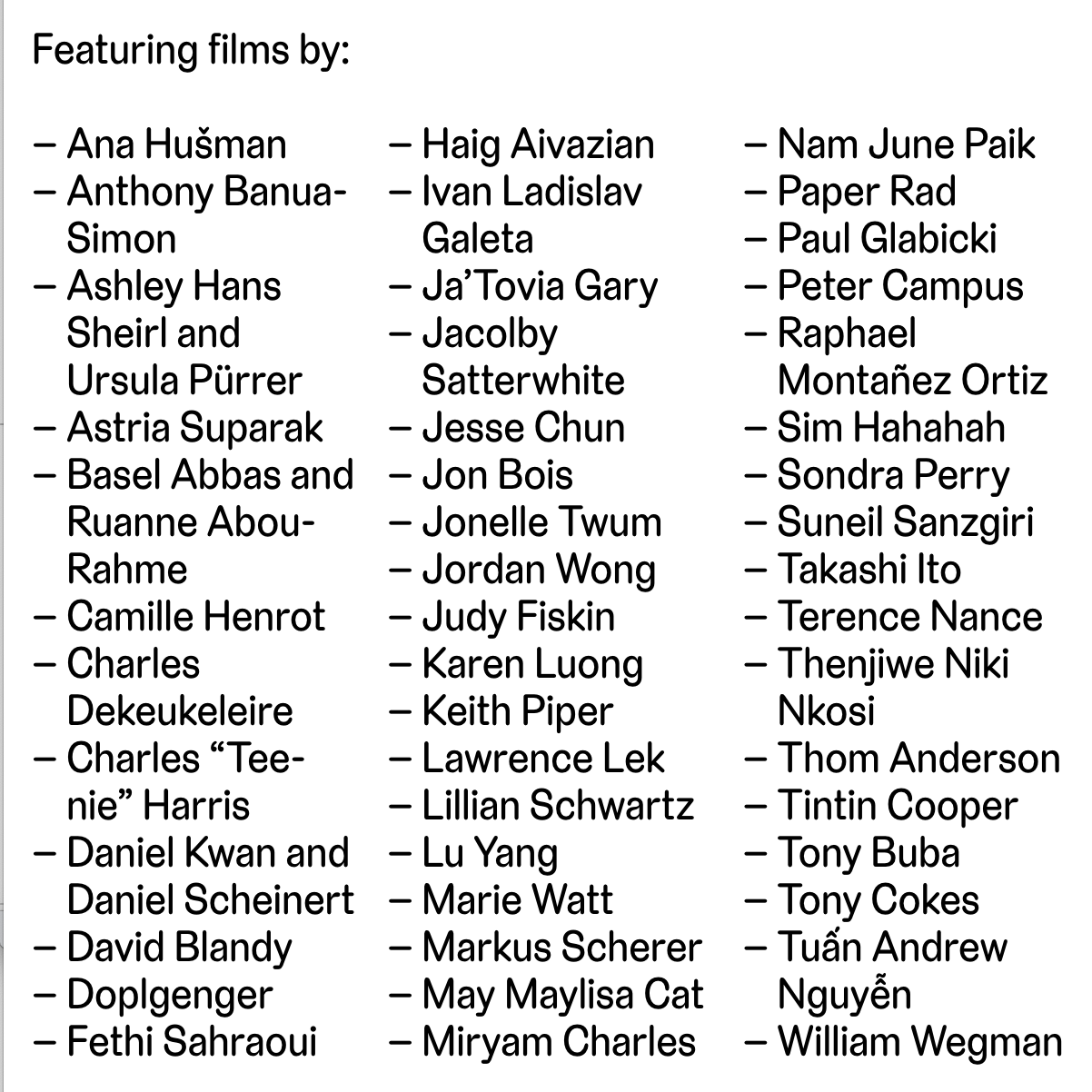
Artists and Filmmakers: Ana Hušman, Anthony Banua-Simon, Ashley Hans Sheirl and Ursula Pürrer, Astria Suparak, Basel Abbas and Ruanne Abou-Rahme, Camille Henrot, Charles Dekeukeleire, Charles “Teenie” Harris, Daniel Kwan and Daniel Scheinert, David Blandy, Doplgenger, Fethi Sahraoui, Haig Aivazian, Ivan Ladislav Galeta, Ja’Tovia Gary, Jacolby Satterwhite, Jesse Chun, Jon Bois, Jonelle Twum, Jordan Wong, Judy Fiskin, Karen Luong, Keith Piper, Lawrence Lek, Lillian Schwartz, Lu Yang, Marie Watt, Markus Scherer, May Maylisa Cat, Miryam Charles, Nam June Paik, Paper Rad, Paul Glabicki, Peter Campus, Raphael Montañez Ortiz, Sim Hahahah, Sondra Perry, Suneil Sanzgiri, Takashi Ito, Terence Nance, Thenjiwe Niki Nkosi, Thom Anderson, Tintin Cooper, Tony Buba, Tony Cokes, Tuấn Andrew Nguyễn, William Wegman
Program Introducers: Dessane Lopez Cassell, Theodossis Issaias, M. Neelika Jayawardane, Liz Park, Zoé Samudzi, Dr. Samantha N. Sheppard, Astria Suparak, and Damon Young
The 2024 Carnegie Museum of Art Film Series programmed by artist and curator Astria Suparak features a special program each month that expands out of a singular idea, topic, or question that is catalyzed by artworks in the museum’s collection. For each program, Suparak has curated a combination of forms, ranging from feature-length narratives and documentaries to music videos, formalist experiments, animation, and internet memes. The selections date from 1920s avant-garde cinema to a new collage video created for the series.
The 2024 Film Series introduces 50+ films & time-based works. For all programs in the series, Suparak has included artwork from the museum’s collection, which will either be incorporated into the curated line-up, featured in our galleries, or on view in the theater during museum hours preceding the scheduled screening. Each screening will open with a brief introduction from a featured writer, scholar, or curator to provide expanded context into the program.
“Alternate realities, reincarnation, and remembrance; complex family relationships and inherited trauma; the wreckage of capitalism and carceral culture; and formal experimentation are ideas that have much resonance to me and unfold in various forms throughout the series.” —Astria Suparak



PROGRAMS

1. Kick Rocks
Sat., Apr. 27, 2 p.m.
https://carnegieart.org/event/kick-rocks
My first video, Virtually Asian (2021), looks at a common trope in mainstream science fiction: how white filmmakers create the appearance of an Asian-inflected world without hiring Asian people in any significant capacity, in front of or behind the camera. An oft-used excuse was that American audiences would not turn out for movies with an Asian lead. This racist rationalization overlooked numerous examples throughout film history: silent era heartthrob Sessue Hayakawa and icon Anna May Wong, martial arts stars such as Bruce Lee, the stoner buddy franchise Harold and Kumar with John Cho and Kal Penn, and the often white-coded Keanu Reeves and Latino-coded Lou Diamond Phillips.
Since Virtually Asian’s release, a cluster of movies featuring actors and directors of Asian descent found wide success in the US, including Daniel Kwan and Daniel Scheinert’s 2022 blockbuster Everything Everywhere All at Once, which became the most awarded film of all time. American audiences (which, it shouldn’t have to be said, include people of Asian descent) are not only willing to watch an Asian-led film, but also majority-Asian casts and stories that don’t uphold bootstrapper American Dream myths or respectability politics. Plus, this movie is weird. It centers a middle-aged Asian woman with a non-American accent, and it doesn’t heroicize narrow notions of masculinity. You can trace the filmmakers’ idiosyncratic, high-energy mixture of absurdity, bawdiness, joy, and physical comedy in the banger music video created years earlier for DJ Snake and Lil Jon’s Turn Down for What.
Evoking a similar fantasy world of maniacal joy and darkness, body horror, and 1980s/90s-kid homages, Paper Rad’s Welcome to My Homeypage (2002) precedes the program.
Astria Suparak, curator, artist, and programmer of the 2024 Carnegie Museum of Art Film Series, will introduce the films.
- Welcome to My Homeypage*† (Paper Rad, 2002, 3 min.)
- Virtually Asian (Astria Suparak, 2021, 3:05 min.)
- Turn Down For What (Dir: Daniels, Music artists: DJ Snake, Lil Jon, 2014, 4 min.)
- Everything Everywhere All at Once (Daniel Kwan, Daniel Scheinert, 2022, 139 min)
Run time: Two hours and 26 min.
* Looped in the Art Theater prior to screening.
† Part of Carnegie Museum of Art’s collection


2. Vivid Sunsets Over Glistening Oceans
Sat., May 25, 2 p.m.
https://carnegieart.org/event/vivid-sunsets-over-glistening-oceans
The tropics exist as a dreamy respite from “real” life…for some people. White-made media reinforces a racialized, exotic vacation trope, training their cameras on and constructing sets with gangly palm trees, pristine beaches, glistening oceans, and deferential Pacific Islander, Asian, Caribbean, and/or Indigenous people. That is the cherry-picked, colonialist view of tropical lands. Wish you weren’t here.
Dessane Lopez Cassell, New York-based editor, writer, and curator, will introduce the films.
- Tropical Fruit in European Still Lifes*† (Astria Suparak, 2024, 7.5 min.)
- Tropical Cats‡ (Astria Suparak, 2024, 7 min.)
- Tropicollage (Astria Suparak, 2021, 2 min.)
- Vers les colonies (Towards the Colonies) (Miryam Charles, 2016, 5 min.)
- Cane Fire (Anthony Banua-Simon, 2020, 90 min.)
Run time: One hour and 44 min.
* Looped in the Art Theater prior to screening
† Contains works from Carnegie Museum of Art’s collection
‡ Premiere of a new artwork

3. Vibe Check
Sat., June 29, 2 p.m.
https://carnegieart.org/event/vibe-check
The Yankee Candle store, Claude Monet’s tranquil garden, a volatile family BBQ, a sketchy art residency, and a Sinofuturist ghost town. These are some of the settings for the various dystopian scenarios in this program, which address or evoke a surveillance state, hypercapitalism, the loneliness epidemic, police brutality, #MeToo, misogynoir, and the increasingly hazy line between reality and AI. Feeling safe is elusive. You can be both a victim and perpetrator of violence. You can be so good at your job that you destroy yourself.
Vibe Check has emotional depth and range, balancing heartbreak with laugh out loud moments as humor is engaged as a coping mechanism. Even when “all of your escape routes only lead back to where you started,” as Lawrence Lek observes, we endure nonetheless.
“Making art is a transformative process that transmutes pain or trauma into something beautiful, useful, functional, instructive.” —Ja’Tovia Gary
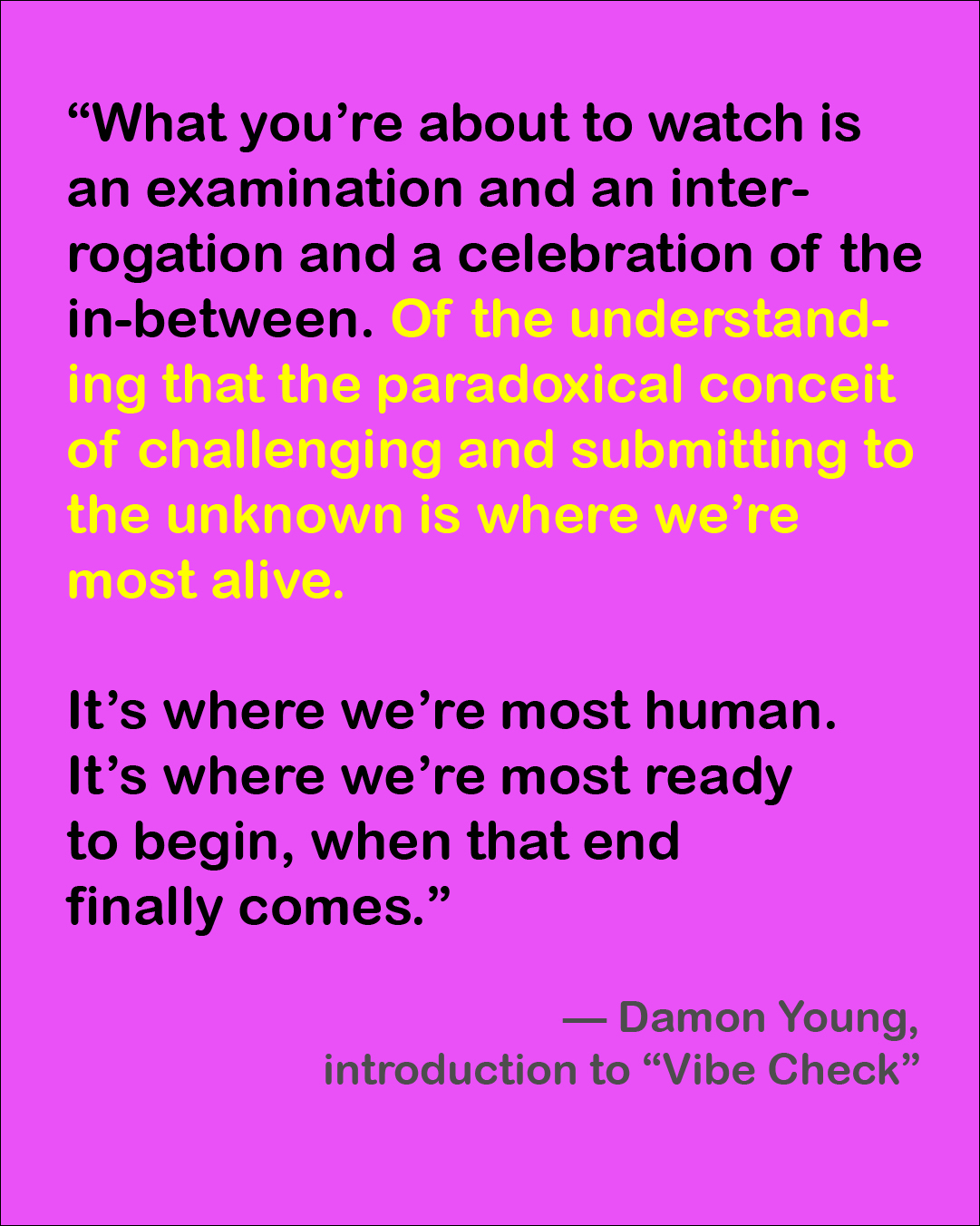
Introduction by Damon Young, author of What Doesn’t Kill You Makes You Blacker.
- Black Celebration (A Rebellion Against the Commodity)*† (Tony Cokes, 1988, 17:11 min.)
- Cite Specific*† (Tony Buba, 2023, 1:52 min.)
- Memory Playthrough (Sim Hahahah, 2022, 1:50 min.)
- The Art Residency (May Maylisa Cat, 2022, 2:20 min.)
- Mountain Lodge (Jordan Wong, 2020, 7:51 min.)
- Deodorant† (William Wegman, 1970–1978, 51 seconds)
- Don’t Worry Be Happy (Stressful Mix)† (Paper Rad, 2006, 3 min.)
- Black Cloud 黑云 (Lawrence Lek, 2021, 11 min.)
- Giverny I (Négresse Impériale) (Ja’Tovia Gary, 2017, 6 min.)
- Random Acts of Flyness: Season 1 Episode 4: Items Outside the Shelter But Within Reach
(Dir. by Terence Nance, Mariama Diallo, Darius Clark Monroe, Naima Ramos-Chapman, and Jamund Washington; Created by Terence Nance, 2018, 30 min.)
Run time: One hour and 3 min.
* On view in Scaife Collection Galleries
† Part of Carnegie Museum of Art’s collection

4. Power Plays
Sat., July 27, 2024, 2 p.m.
https://carnegieart.org/event/power-plays
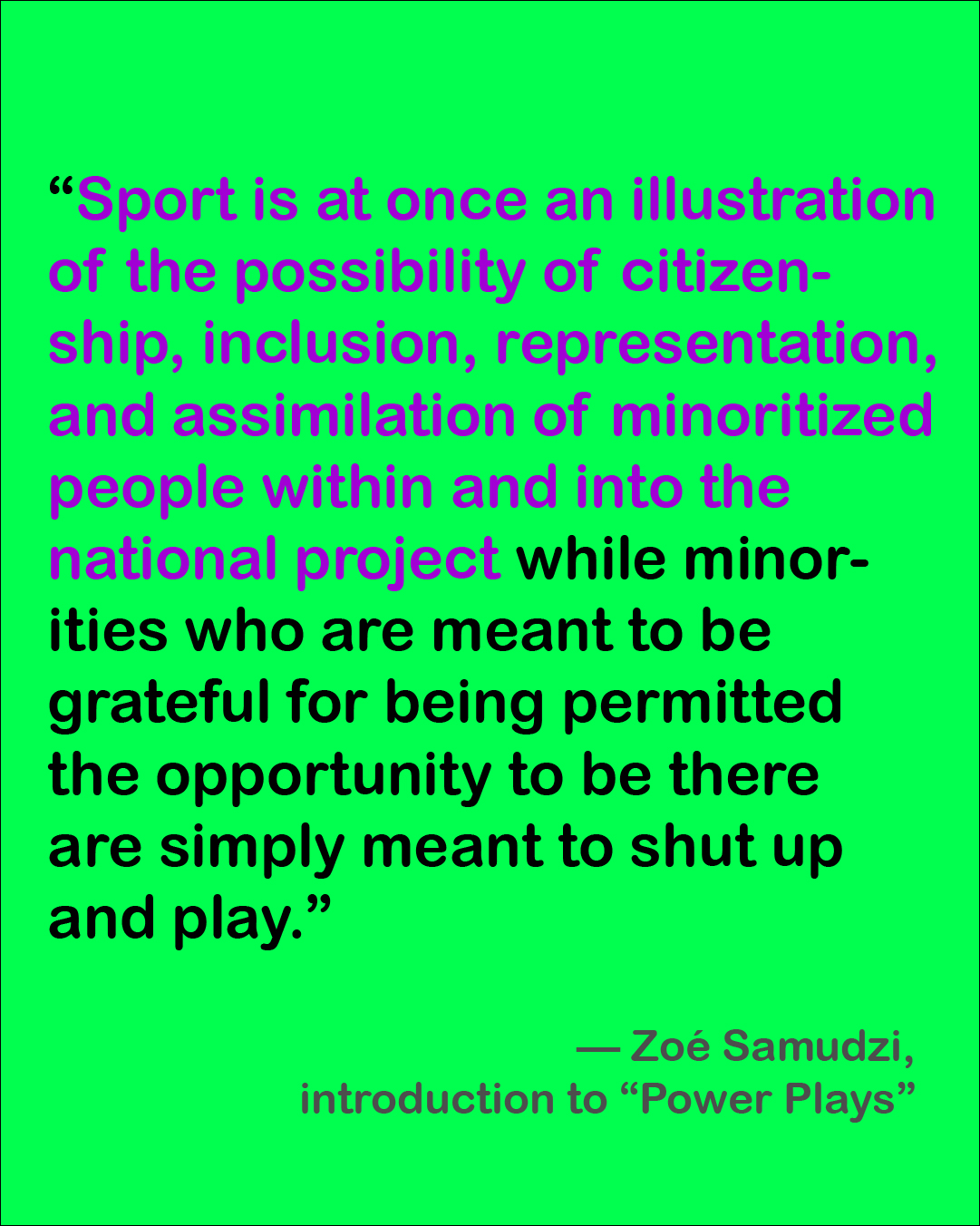
Tool for exploitation or arena of resistance? The paradoxical nature of sport—as a site of biopolitical control, collective struggle, and individualized fantasy—makes it a rich and captivating subject. This program challenges commonplace understandings of the sports film genre by focusing on artist-made media and counter-narratives rather than commercial documentary and fiction sports movies, which often service hagiographic or nationalistic agendas. Power Plays seeks to address some of the unseen political and economic flows of the globalized sports-media complex.
Themes in this program include the confluence of nationalism, militarism, exploitation, spectacle, and sport, as well as activist resistance to sport’s hegemonic tendencies; the complex imbrications of sports, race, gender, desire, and representation; and the interplay of sports technology, visuality, and public space.
Zoé Samudzi, the Charles E. Scheidt Visiting Assistant Professor of Genocide Studies and Genocide Prevention at Clark University, will introduce the program.
- Jackie Robinson in locker room† (Charles “Teenie” Harris, Kodak safety film, c. 1947)
- Little boy boxer possibly in the ring at Kay Boys’ Club† (Charles “Teenie” Harris, Kodak safety film, c. 1945)
- Youthupia: an Algerian Tale* (Fethi Sahraoui, 2020, 7 min.)
- The Nation’s Finest (Keith Piper, 1990, 7 min.)
- IT’S IN THE GAME ‘17 (Sondra Perry, 2017, 16 min.)
- The Same Track (Thenjiwe Niki Nkosi, 2022, 5 min.)
- Fragments untitled #6 (Doplgenger, 2022, 6 min.)
- Prometheus (Haig Aivazian, 2019, 23 min.)
Run time: 57 min.
* Looped in the Art Theater prior to screening
† Part of Carnegie Museum of Art’s collection and installed in the hall outside the theater


5. A Spell Against Amnesia
Sat., Aug. 31, 2024, 2 p.m.
https://carnegieart.org/event/a-spell-against-amnesia
Like a phoenix rising from ashes and a lotus blooming from mud, beauty can be born of anguish and destruction. Living after loss can feel like life hollowed out. History is never past, the repercussions of war are felt decades after the fight’s official end, and memories linger. These videos model ways to honor ourselves and our ancestors, and to transform weapons into nourishment. Utopia doesn’t have to be removed of sadness; we heal with scars, our past trauma informs our future decisions, and we can warn those behind us. We birth our new selves. To many happy returns.
M. Neelika Jayawardane, Professor of English at the State University of New York-Oswego, and a Research Associate at the Centre for the Study of Race, Gender & Class, University of Johannesburg, South Africa, will introduce the program.
- We Are In Hell When We Hurt Each Other*† (Jacolby Satterwhite, 2020, 24 min.)
- Three Transitions† (Peter Campus, 1973, 5 min.)
- The Incidental Insurgents: Unforgiving Years (Part 2) (Basel Abbas and Ruanne Abou-Rahme, 2012–2015, 6:20 min.)
- The Unburied Sounds of a Troubled Horizon (Tuấn Andrew Nguyễn, 2022, 60 min.)
Run time: One hour and 11 min.
* Looped in the Art Theater prior to screening
† Part of Carnegie Museum of Art’s collection


6. Aesthetic Athletics
Sat., Sept. 21, 2024, 2 p.m.
https://carnegieart.org/event/aesthetic-athletics
Spanning nearly a century of production, the artists in this program devise formalist interventions into sports-media imagery and engage in a diversity of approaches: in-camera techniques like multiple exposure, video synthesis, optical printing, rapid editing, physical manipulations of the film strip like puncturing and scratching, and a variety of animation including drawn, stop-motion, computer, GIF, and machinima.
Some trailblazing films of note: a 1927 cinematic poem about boxing by Charles Dekeukeleire using negative image, a technique rare for the period; a 1957 golf film with holes ritualistically punched into the film stock by destructivist Raphael Montañez Ortiz, making presence out of absence and a visual pun on the game; a 1971 film with computer-generated imagery by groundbreaking media artist Lillian Schwartz; video pioneer Nam June Paik’s commission for the National Fine Arts Committee of the 1980 Olympic Winter Games; a 1981 masterpiece of stop motion by Takashi Ito creating a recursive rollercoaster journey through a gymnasium from still photographs; and a “Copernican twist in the structure and perception” of a water polo match, with the ball becoming the static center of the 1988 film by Ivan Ladislav Galeta (Le Collectif Jeune Cinéma).
Introduction by Dr. Samantha N. Sheppard, cinema and media studies scholar, professor, and author of Sporting Blackness: Race, Embodiment, and Critical Muscle Memory on Screen (2020) and the forthcoming The Basketball Film: A Cultural and Transmedia History.
- Object Conversation*† (Paul Glabicki, 1985, 10 min.)
- Pferd und Reiter Springen über ein Hindernis (Horse and Rider Jumping Over an Obstacle (Ottomar Anschütz, 1888, 30 sec.)
- Combat de Boxe (Charles Dekeukeleire, 1927, 7:30 min.)
- TV Ping Pong (Ivan Ladislav Galeta, 1988, 2 min.)
- Golf (Raphael Montañez Ortiz, 1957, 1:30 min.)
- Water Pulu 1869 1896 (Ivan Ladislav Galeta, 1988, 9 min.)
- Spacy (Takashi Ito, 1980–1981, 10 min.)
- O.T. (Markus Scherer, 2013, 4 min.)
- Olympiad (Lillian Schwartz, 1971, 3 min.)
- Lake Placid ‘80 (Nam June Paik, 1980, 4 min.)
- Super-8 Girl Games (Ashley Hans Scheirl and Ursula Pürrer, 1985, 3 min.)
- Bubka (Karen Luong, 2018, 1 min.)
- Football (Ana Hušman, 2011, 15 min.)
- The Breaking Madden Super Bowl: The Conclusion (Jon Bois, 2015, 5 min.)
- Kiss Gif (Tintin Cooper, 2015, 10 sec.)
Run time: One hour and 5 min.
* Looped in the Art Theater prior to screening
† Part of Carnegie Museum of Art’s collection

7. Urban Legends
Sat., Oct. 26, 2024, 1:30 p.m.
https://carnegieart.org/event/urban-legends
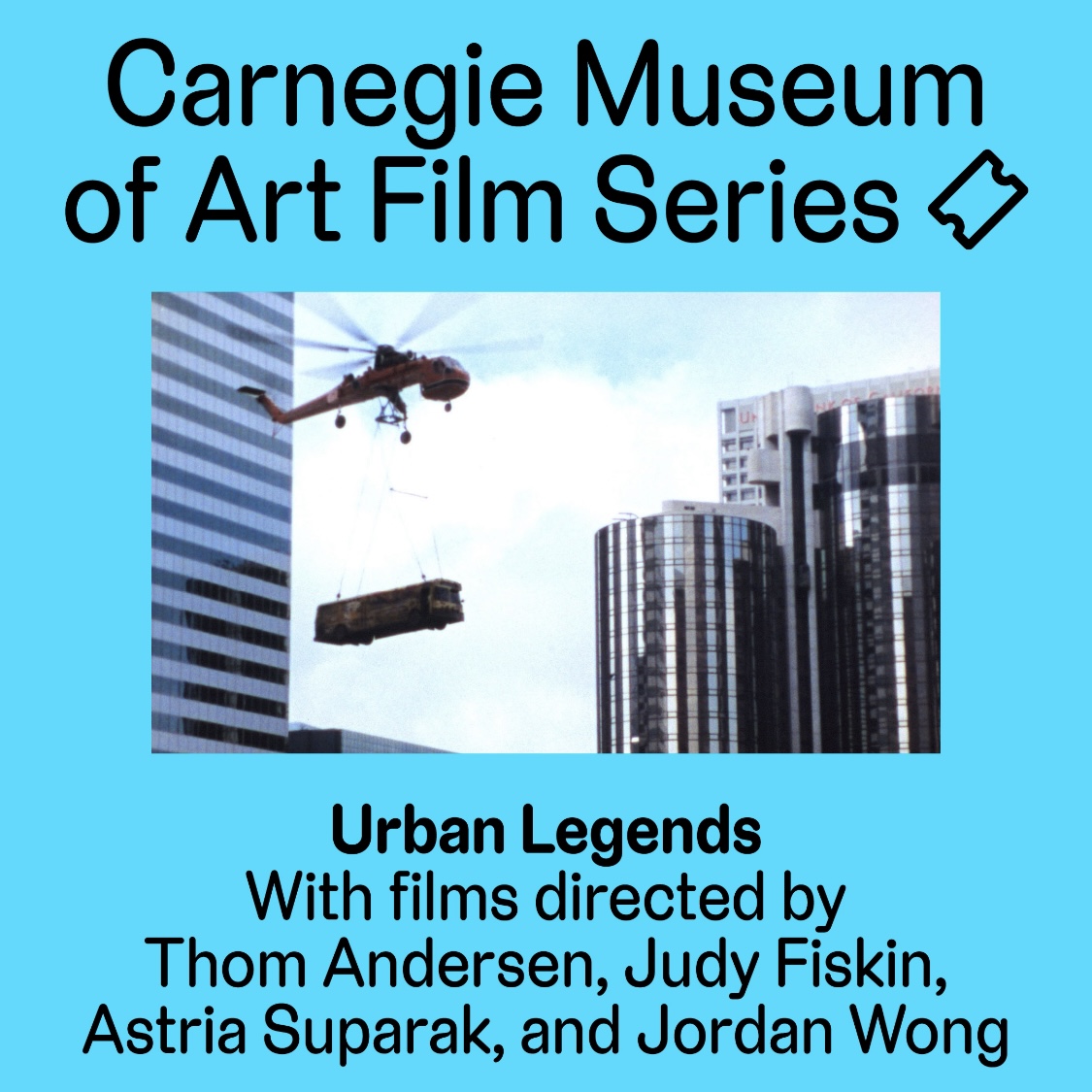
Let me direct your attention to the background, to the smoggy skyline, to decorative flourishes on residential facades, and to business signage designed to be illegible to a target audience. The films in this program focus on architecture, cities, and elements of the built environment transient, immortalized, or willfully forgotten.
Buildings, both ostentatious and banal, can transcend space and time through scripting and art direction. Cities are passed off as other cities, sometimes in other countries. Architecture not only reflects the culture, geography, and class that delivered it, but it can also insinuate morality, psychology, and oppression. Are these utopias, dystopias, or both?
Introduced in person by Theodossios Issaias, associate curator, Heinz Architectural Center.
- I Would’ve Been Happy* (Jordan Wong, 2023, 9 min.)
- The End of Photography† (Judy Fiskin, 2006, 2:26 min.)
- On the Neon Horizon (Astria Suparak, 2023, 8:27 min.)
- Los Angeles Plays Itself (Thom Andersen, 2003, 170 min.)
Run time: 3 hours. There will be a 10 min. intermission about 1 hour and 41 minutes into the program.
* Looped in the Art Theater prior to screening
† Part of Carnegie Museum of Art’s collection


8. […]
Sat., Nov. 30, 2024, 2 p.m.
https://carnegieart.org/event/18441
Language is woefully insufficient. “The limits of language are the limits of my world” (Wittgenstein). Intonation can reverse the meaning of a phrase, and there are ways to communicate without words. “Loud silences of pain, defiance, endurance, poetics. A silence that sings refusal,” observes Jonelle Twum.
Speech trailing off, indicating words left unsaid; perhaps doubt setting in… Lapses of time, a pause (dot, dot, dot) An indeterminate amount of words omitted or disappeared […]
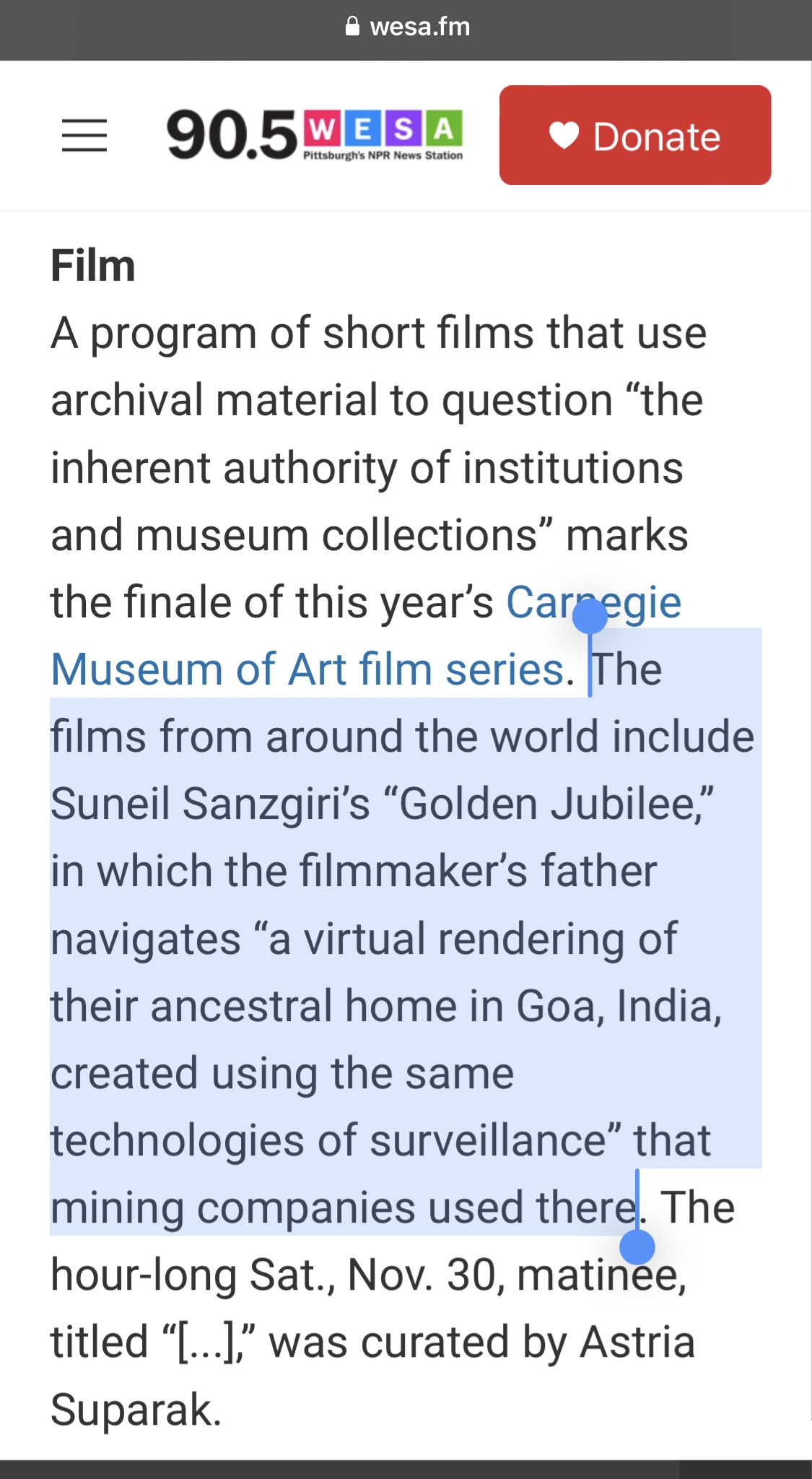
“What is liberation when so much has already been taken?” asks Suneil Sanzgiri’s father. He tours a virtual rendering of their ancestral home created with the same technology used by mining companies before their toxic extraction in the region.
Other phantoms: culture that can’t be touched, can’t be held, evoked by Jesse Chun’s sojourn through the Intangible Heritage archives, interspersed with a letter to her late grandmother. Camille Henrot mashes up the most common form of myth, usually orally passed down, of how the universe formed. Origin stories followed by cataclysms, with a world after humans visualized by David Blandy in collaboration with teenagers and young adults in North West London. And the world starts anew, again. Elliptical, ellipses.
“We are here because you were there.” Ambalavaner Sivanandan’s aphorism is an evergreen explanation of migration that is a legacy of colonialism.
Sites include: the filmmakers’ ancestral lands in Ghana and Goa, the Intangible Heritage archives of UNESCO (United Nations Educational, Scientific and Cultural Organization) in Paris, the collection storage of the Smithsonian Institution in Washington, DC, and the roleplaying game The World After.
Introduced in person by Liz Park, Richard Armstrong Curator of Contemporary Art, Carnegie Museum of Art.
- Skywalker/Skyscraper (Dawn)† (Marie Watt, 2021, reclaimed wool blankets, steel I-beam, cedar)
- Wrathful King Kong Core* (Lu Yang, 2011, 5 min.)
- I THINK OF SILENCES WHEN I THINK OF YOU (Jonelle Twum, 2023, 9 min.)
- O dust (Jesse Chun, 2022–2023, 7:27 min.)
- Golden Jubilee (Suneil Sanzgiri, 2021, 19 min.)
- Visions of the Deep Past (David Blandy, 2020, 4:30 min.)
- Grosse Fatigue (Camille Henrot, 2013, 13 min.)
Run time: 53 min.
* Looped in the Art Theater prior to screening
† Part of Carnegie Museum of Art’s collection, on view in Scaife 16 gallery in the exhibition Crossroads: 1945 to Now





PRESS
“Carnegie Museum of Art opening 2024 Film Series with ‘Everything Everywhere All at Once’,”
Joshua Axelrod, Pittsburgh Post-Gazette, April 5, 2024
“Siegel said he and CMOA leadership sought [Suparak] out for their 2024 Film Series after a decade of keeping up with her creations that often involved media or moving images. […]
There will be plenty of international offerings, projects created specifically for CMOA’s 2024 Film Series and seven pieces that Suparak picked out from the museum’s expansive “moving image film collection,” according to Siegel. He said that Suparak considers the 2024 Film Series “an all encompassing experience” […]
For Siegel, beginning CMOA’s 2024 Film Series with “Everything Everywhere All at Once” made perfect sense given that Suparak curated a lineup “that also has everything.”
“You are getting such a broad selection of stuff that you’re not going to see anywhere else in Pittsburgh,” he said, “and frankly not anywhere else in the country.”
“What to do in Pittsburgh this weekend: May 24-26,” Bill O’Driscoll, 90.5 WESA, May 23, 2024
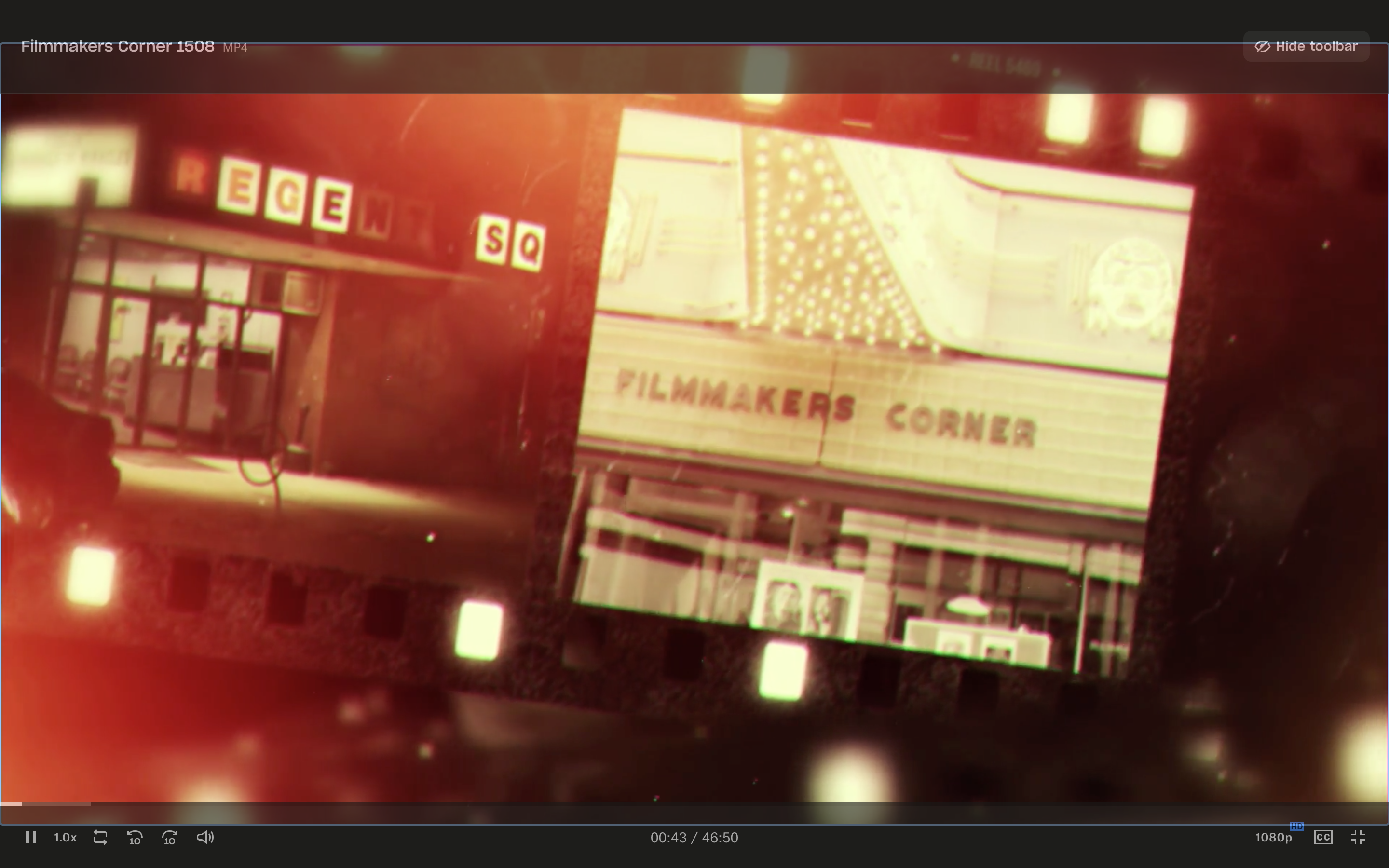
“Filmmakers Corner,” WQED TV, July 2024
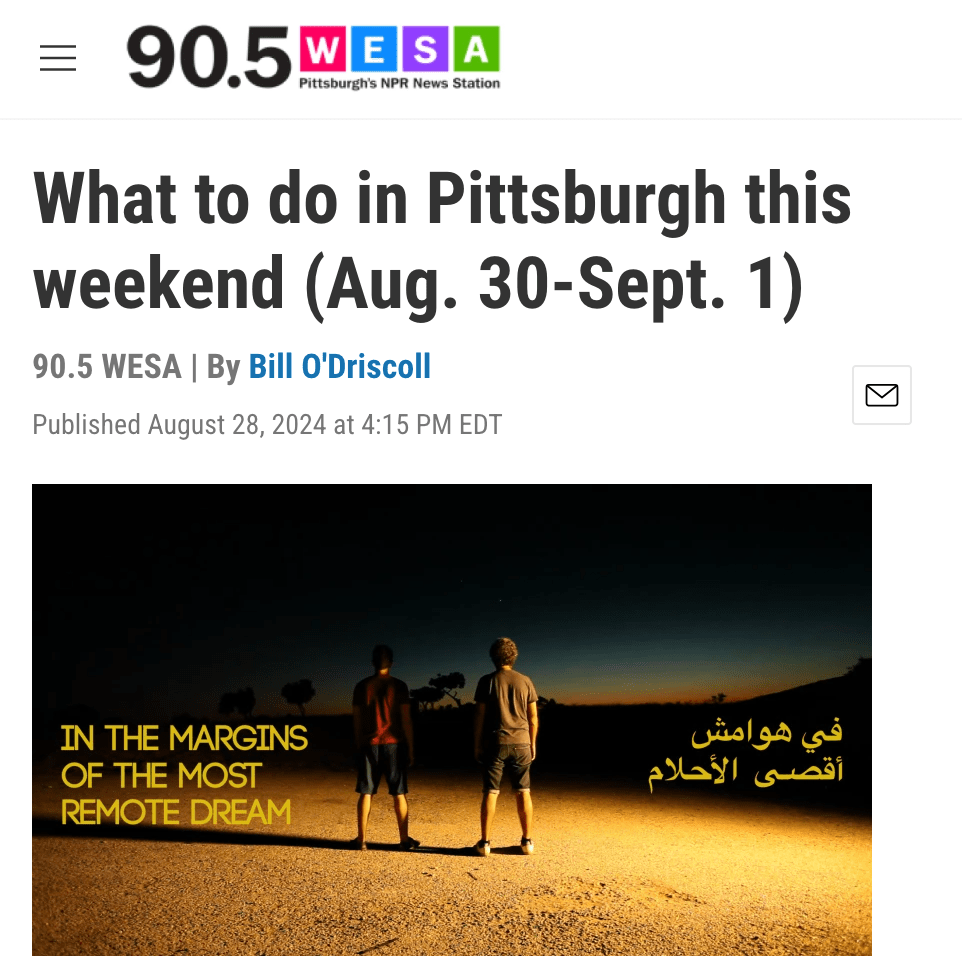
“What to do in Pittsburgh this weekend: Aug. 30-Sept. 1,” Bill O’Driscoll, 90.5 WESA, Aug. 28, 2024
“Beauty can be born of anguish and destruction,” writes guest curator Astria Suparak of the Sat., Aug. 31, installment of the Carnegie Museum of Art’s Annual Film Series. The afternoon program “A Spell Against Amnesia” includes “We Are In Hell When We Hurt Each Other,” an immersive virtual-reality video by Jacolby Satterwhite; a 1973 work by new-media and video-art pioneer Peter Campus; and “The Unburied Sounds of a Troubled Horizon,” Tuan Andrew Nguyen’s 60-minute drama about a Vietnamese mother and daughter who run a junkyard in an area heavily bombed during the war.
“What to do in Pittsburgh this weekend: Oct. 25-27,” Bill O’Driscoll, 90.5 WESA, Oct. 23, 2024
“What to do in Pittsburgh this weekend: Nov. 29-Dec. 1,” Bill O’Driscoll, 90.5 WESA, Nov. 27, 2024
“11 things to do this weekend in Pittsburgh,” Jennifer Baron, Next Pittsburgh, Nov. 27, 2024
“‘Burgh bulletin 11/25-12/2,” Claire Thurston, The Tartan, Dec. 1, 2024
The newest installment of the Carnegie Museum of Art’s art film series, […], is a screening of seven short films that each explore the concept and the material of the archive. Archives, including art museums, are facilities that contain primary source materials of all types. But is the archive objective? Who gets to control and access the archive? What is included and what is excluded in the archive? The artists riff on these questions in each of their films. Programmer Astria Suparak explains how the title reflects this theme, describing it as “Lapses of time, a pause (dot, dot, dot) An indeterminate amount of words omitted or disappeared [from the archive].”
RELATED WORK
- The Game is Not the Thing film & performance series
- See other curated #exhibitions & #events
- See other #scifi, #sports, #tropical work
 Astria Suparak