

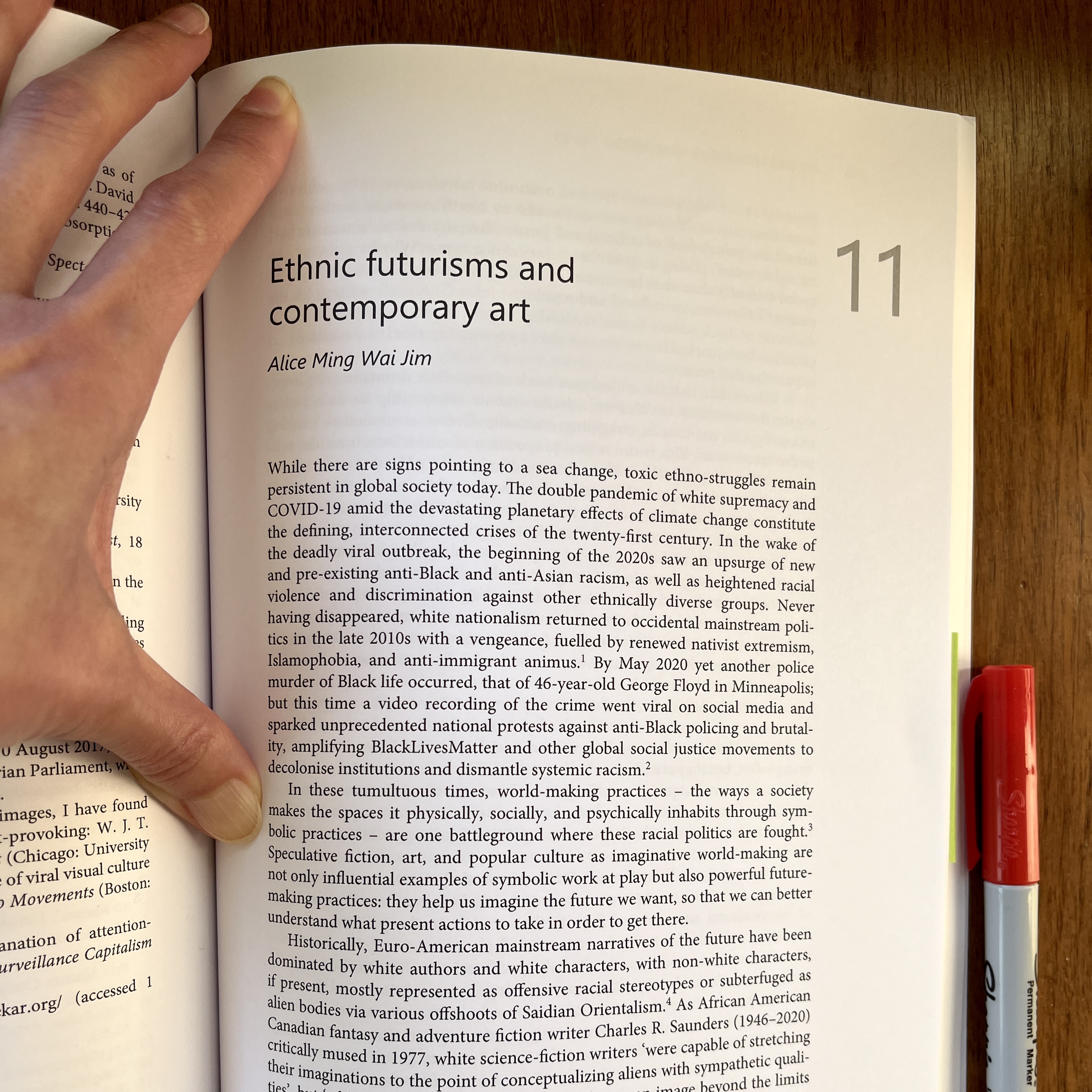


“Ethnic futurisms and contemporary art”
Alice Ming Wai Jim
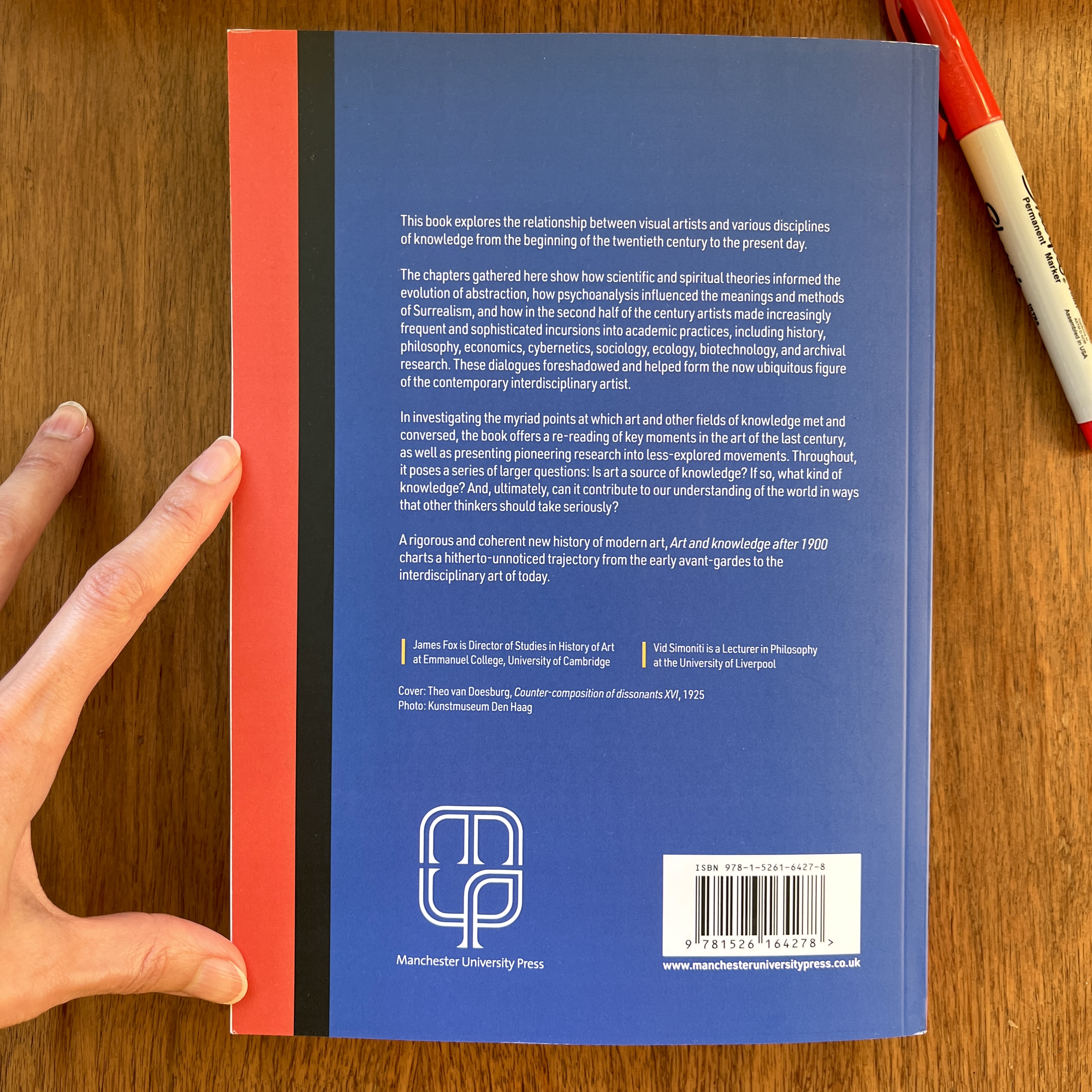
Art and Knowledge After 1900: Interactions Between Modern Art and Thought
Manchester University Press, December 2023
https://manchesteruniversitypress.co.uk/9781526164261
This ground-breaking new history of modern art includes color plates and image reproductions of Virtually Asian and Asian futures, without Asians, and an analysis of the work (as well as works of Afrofuturism and Indigenous futurism) by Alice Ming Wai Jim that is theoretical and historical. Jim argues: “in the service of creating new futures, of bringing a future perfection, such works can play an important reparative function in the negotiation of both the current political landscapes and how we think of history.”
ABOUT THE BOOK:
The publication explores the relationship between art and knowledge from the beginning of the twentieth century to the present day. Each chapter examines artistic responses to a particular discipline of knowledge, from quantum theory and theosophy to cybernetics and ethnic futurisms. The authors argue that art’s incursion into other intellectual disciplines is a defining characteristic of both modernism and postmodernism. Throughout, the volume poses a series of larger questions: is art a source of knowledge? If so, what kind of knowledge? And, ultimately, can it contribute to our understanding of the world in ways that thinkers from other fields should take seriously?
EXCERPT FROM JIM’S ESSAY:
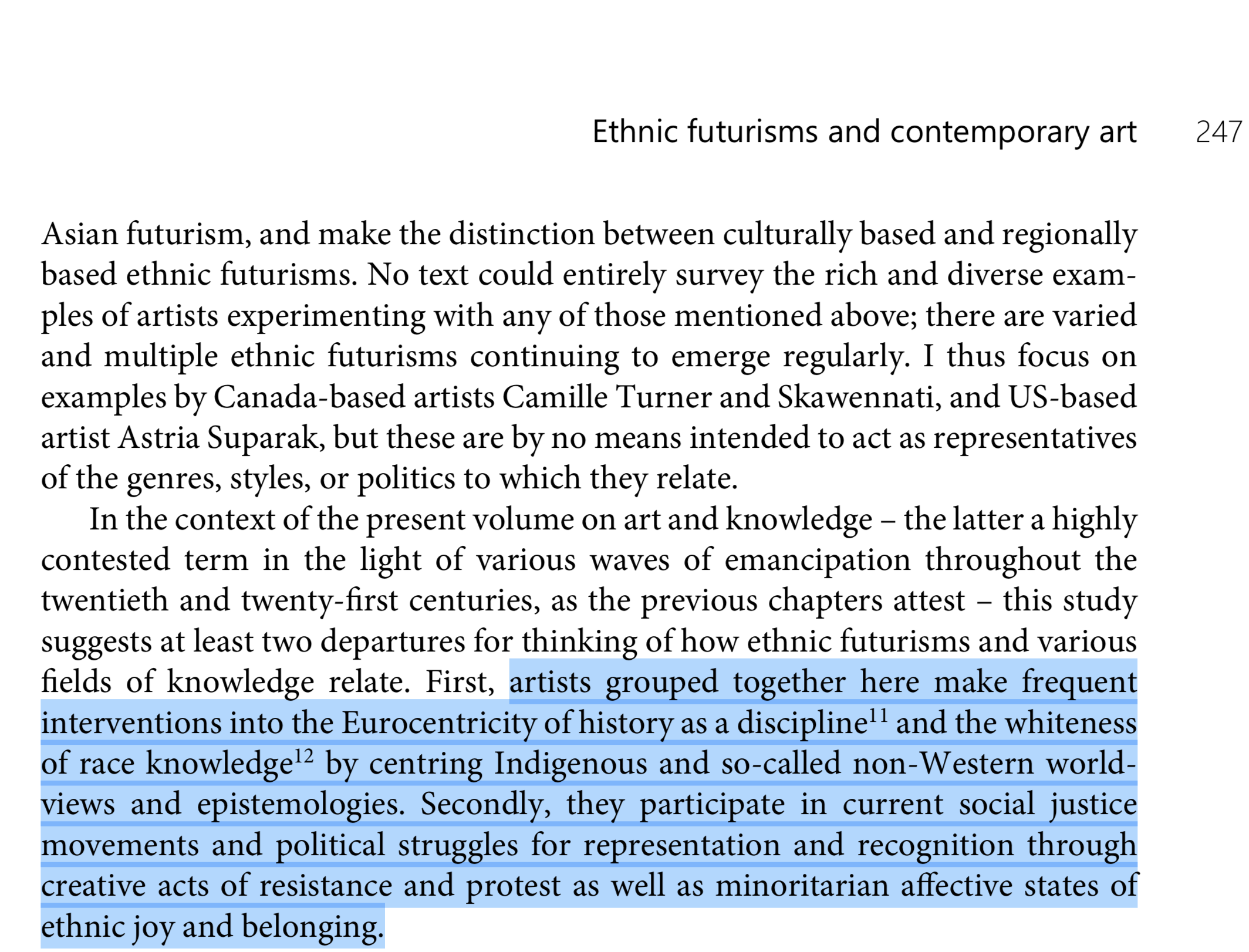
“In the context of the present volume on art and knowledge – the latter a highly contested term in the light of various waves of emancipation throughout the twentieth and twenty-first centuries, as the previous chapters attest – this study suggests at least two departures for thinking of how ethnic futurisms and various fields of knowledge relate. First, artists grouped together here make frequent interventions into the Eurocentricity of history as a discipline and the whiteness of race knowledge by centring Indigenous and so-called non-Western worldviews and epistemologies. Secondly, they participate in current social justice movements and political struggles for representation and recognition through creative acts of resistance and protest as well as minoritarian affective states of ethnic joy and belonging. […]
“Ethnic futurisms’ explorations at the intersections of critical race, ethnic, and diaspora studies and speculative arts and science fiction has had an enormous impact, not only on an aesthetic level in theory and practice but also on larger theorisations of contemporary art and culture in relation to intersectionality studies, social justice studies, and technological advancements of the digital age. Last but not least, these ideas and practices in turn contribute to public debates ranging from migration and human rights, xenophobia, and anti-racism in the arts and society to race-based surveillance, algorithmic politics, and reparative futures across all sectors.”
EXCERPT FROM THE “ASIAN FUTURES” SECTION:
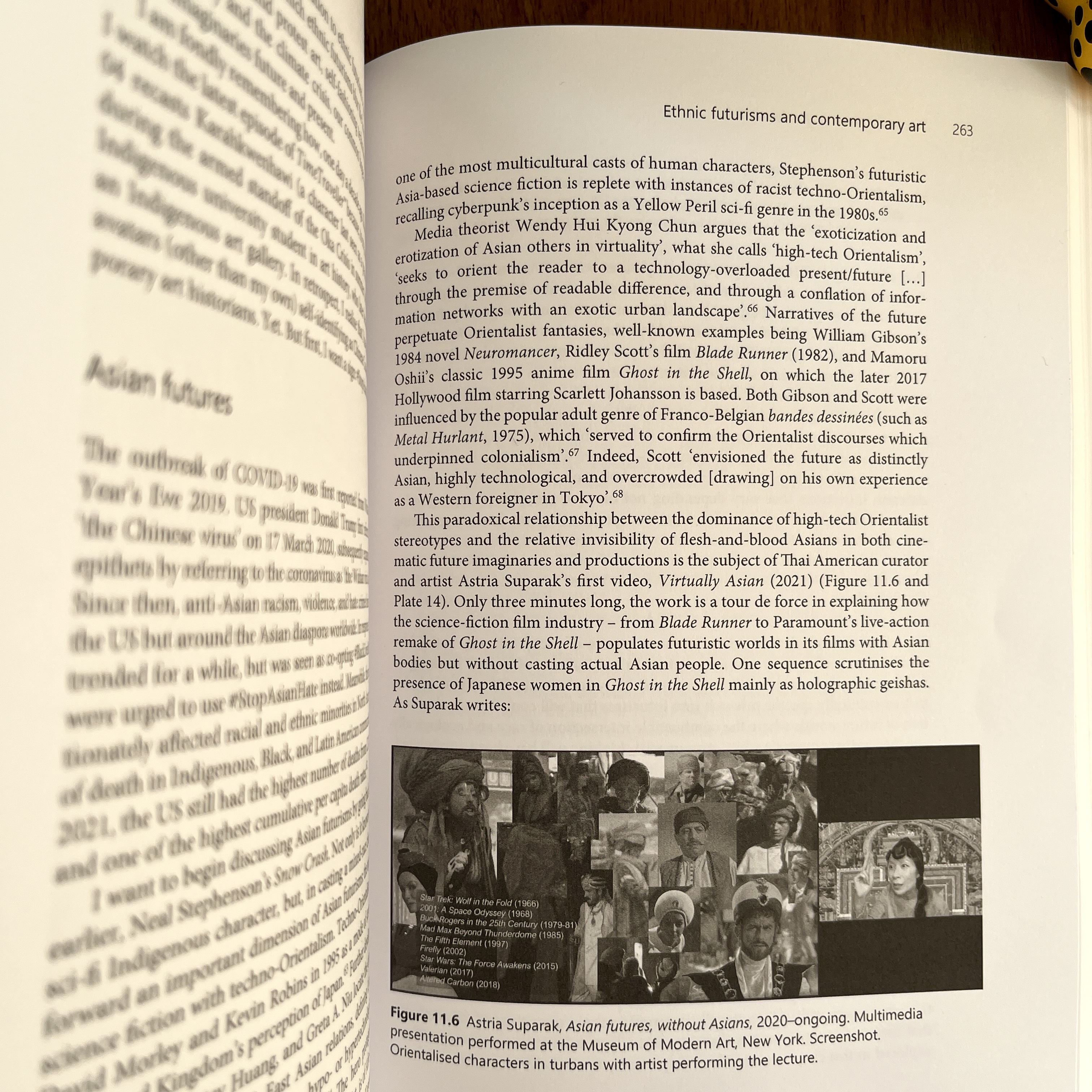
“This paradoxical relationship between the dominance of high-tech Orientalist stereotypes and the relative invisibility of flesh-and-blood Asians in both cinematic future imaginaries and productions is the subject of Thai American curator and artist Astria Suparak’s first video, Virtually Asian (2021) (Figure 11.6 and Plate 14). Only three minutes long, the work is a tour de force in explaining how the science-fiction film industry – from Blade Runner to Paramount’s live-action remake of Ghost in the Shell – populates futuristic worlds in its films with Asian bodies but without casting actual Asian people. One sequence scrutinises the presence of Japanese women in Ghost in the Shell mainly as holographic geishas. As Suparak writes:
Asians are used as scenery in white-made media, as a shorthand to indicate a ‘multicultural’ or ‘foreign’ place. But foreign to whom? Asians have been on record as living here since at least the 1600s, before the US even existed […] In order to imagine the future, it’s important to reimagine the past more accurately.
Part of the larger multimedia project Asian futures, without Asians (2020–ongoing), Suparak’s supercut video essay of forty years of sci-fi film history undertakes a media archaeology on cyberpunk’s fetishistic urban ethnopornography. By interrogating accounts of the future imagined by others, Asian futures, without Asians excavates racist tropes and cultural clichés pre-existing in the symbolic systems within which mainstream science fiction operates.”
PUBLICATION DETAILS
Art and Knowledge After 1900: Interactions Between Modern Art and Thought
Edited by James Fox & Vid Simoniti
Publisher: Manchester University Press
Publish Date: December 2023
Pages: 352
ISBN: 978-1-5261-6427-8
https://manchesteruniversitypress.co.uk/9781526164261
CONTENTS
Introduction – James Fox and Vid Simoniti
1. Modern art and spiritual knowledge – Lucy Kent
2. Twentieth-century revolutions in art and science – Gavin Parkinson
3. Psychoanalysis and art: a new theory of objects – Margaret Iversen
4. Before the visual turn: twentieth-century historians and the uses of art – Tom Stammers
5. Knowledge, truth, history: contemporary art and the problem of art-historical periodisation – Peter Osborne
6. Art / Economics – Allan Antliff
7. Art and cybernetics: a new ontology for art – Mara Polgovsky Ezcurra
8. Art into society: organised labour, workplace sociology, and artmaking in 1970s Britain – Catherine Spencer
9. Knowledge, nation, and colour in documentary photography – Julian Stallabrass
10. Art and biotechnology: on the limits and potential of interdisciplinary arts – Vid Simoniti
11. Ethnic futurisms and contemporary art – Alice Ming Wai Jim
12. The politics and aesthetics of climate emergency – T. J. Demos
13. Art and witnessing: the poetics and politics of testifying to environmental violence – Shela Sheikh
Index

RELATED WORKS
- Virtually Asian video
- Asian futures, without Asians performance
- Review of Virtually Asian in Media-N Journal
 Astria Suparak