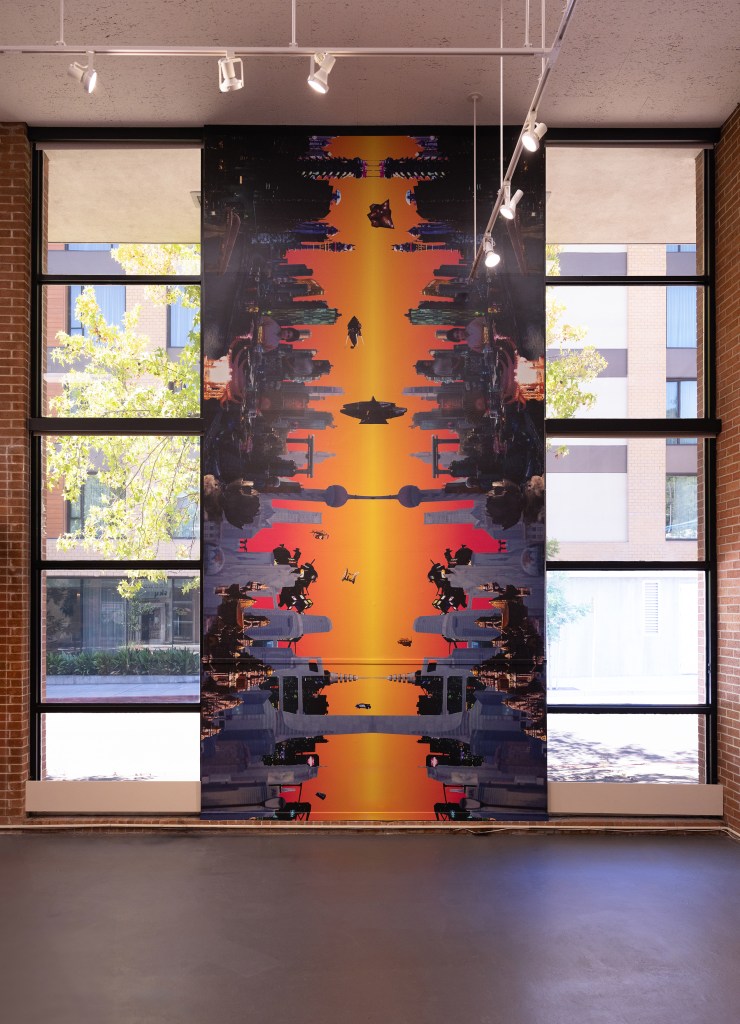

“Finite Horizon”
Astria Suparak
Installation (digital collage on vinyl, video), 32′ wide x 11′ high (9750 x 3400mm) dimensions variable
2023|2025
Originally commissioned by To Your Eternity: The 4th Future of Today Biennial, Today Art Museum, Beijing, China
https://bit.ly/finitehorizon
- Description
- Exhibitions
- Press
- From the series Asian Futures
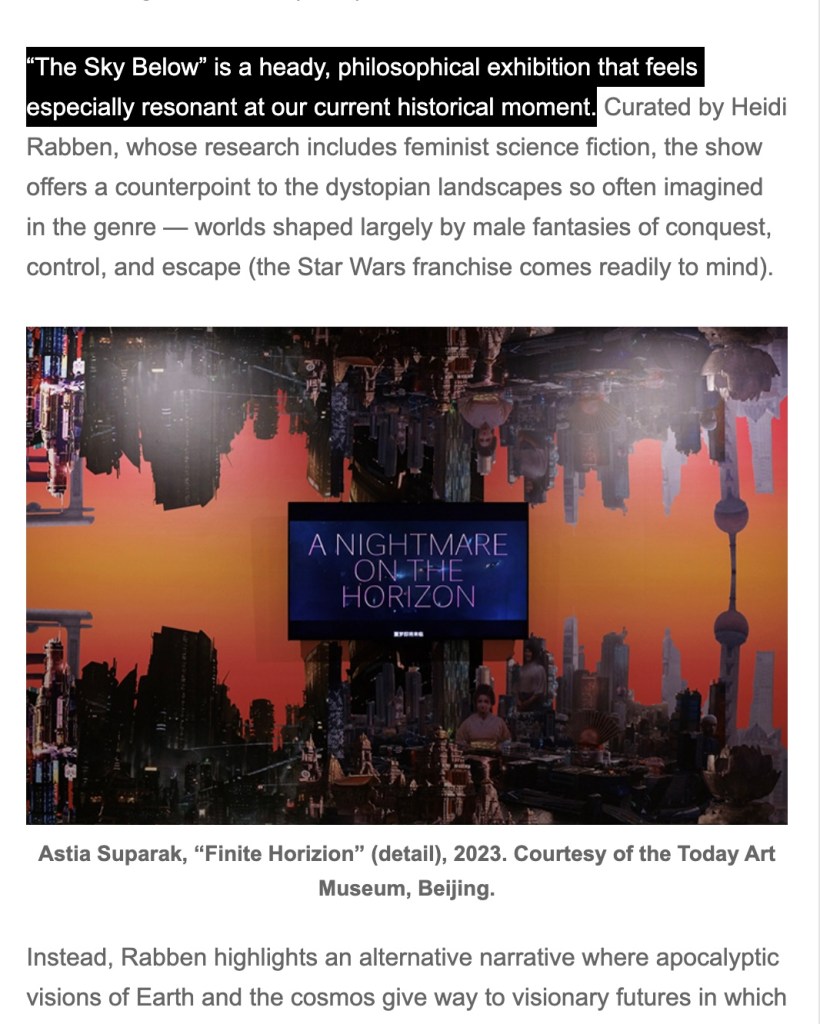
Finite Horizon is an amalgamated skyline of Asian futures imagined by white filmmakers. Evoking matte paintings — the old-school, practical special effects for portraying scenic landscapes in filmmaking, the installation foregrounds what is typically relegated to the background. Sourced from primarily 21st century sci-fi movies and television shows, including an early example of techno-orientalism (1936’s Flash Gordon), these movies depict a vice-ridden, dangerous world overtly marked by elements of East, Southeast, and South Asian architecture.
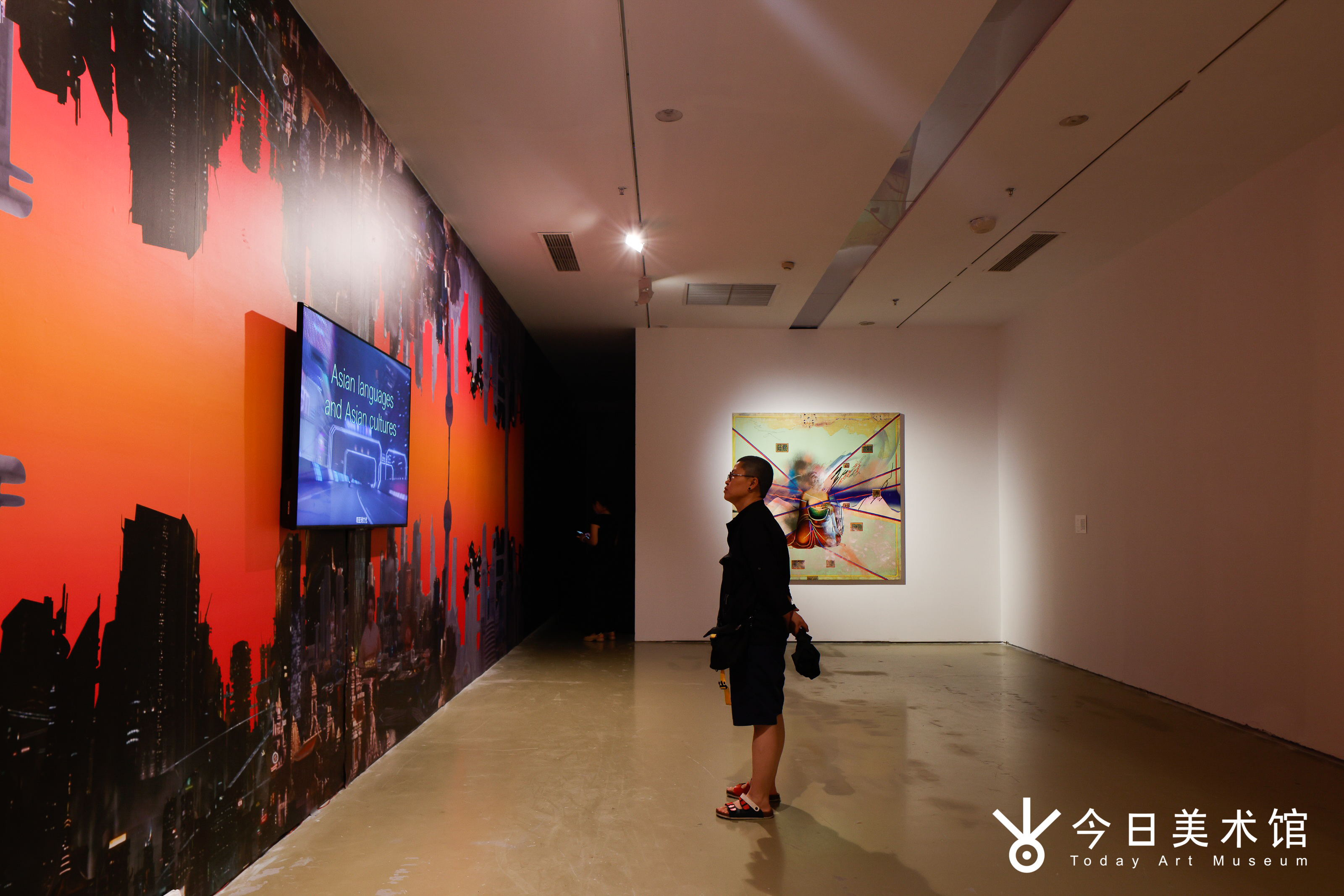
Embedded within Finite Horizon is Astria Suparak’s video, On the Neon Horizon. This essay film takes one of the world-building tics of white science fiction — gratuitous signage in Asian languages — to consider its utopian potential and dystopian applications. Fantastical mise en scène, breathtaking B-roll footage, and special effects deliriums from four decades of mainstream sci-fi by white American, Australian, Canadian, European, and New Zealander filmmakers craft an insidiously Asian futurescape — sometimes achieved by simply shooting in a present-day Asian country or a North American Chinatown. In aggregate, these productions inextricably tether non-white cultures to criminality and contagion, portraying Asian cultures and people as existential threats to white Western ideas of freedom. Prominent signage in Chinese and Japanese (stand-ins for some of America and Canada’s oldest scapegoats), as well as in Arabic, Hindi, Korean, and Thai, from more than a dozen futuristic movies and TV shows, provide copious examples of the racism embedded in and promoted by Hollywood.
Source imagery for Finite Horizon: Altered Carbon (2018), Buck Rogers in the 25th Century (1979-1981), Cloud Atlas (2012), Firefly (2002), Flash Gordon (1936), Ghost in the Shell (2017), Looper (2012), Mortal Engines (2018), Ready Player One (2018), Serenity (2005), Speed Racer (2008), Star Wars: The Force Awakens (2015), Stargate SG-1 (1997-2007), The Fifth Element (1997), The Mandalorian (2019), X-Men: Days of Future Past (2014).


EXHIBITIONS
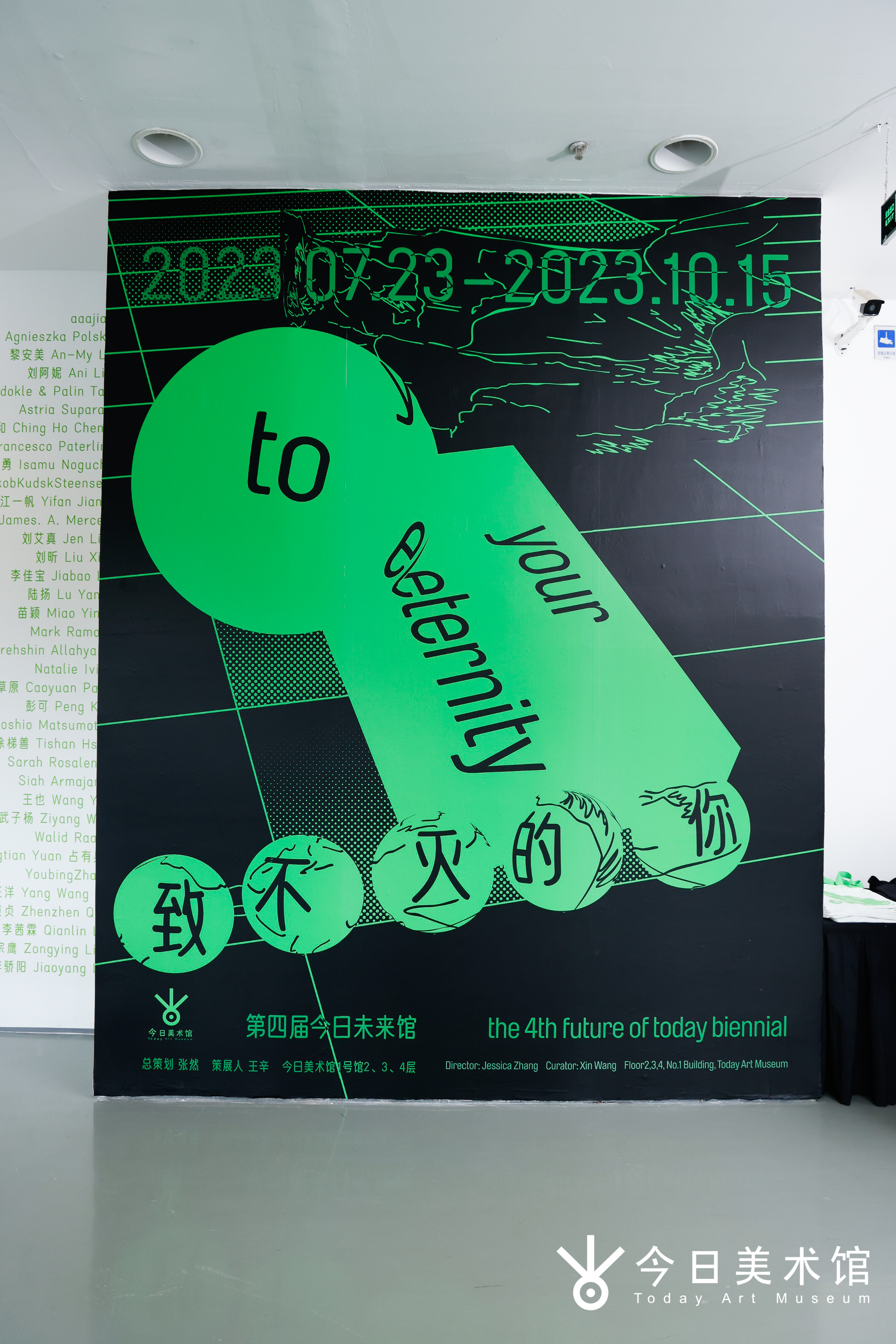




To Your Eternity: The 4th Future of Today Biennial
Today Art Museum, 32 Baiziwan Rd, Shuangjing, Chaoyang, 100022 Beijing, China
July 23–October 15, 2023
To Your Eternity, the fourth installment of the Today Art Museum’s art and technology themed biennial, zooms ever slightly away from an obsession with the now and the next, but revels in unlikely, luminous juxtapositions across geography and time […]
The exhibition takes its title and spirit from the 2021 anime To Your Eternity. Created by Yoshitoki Ōima, the story follows an amorphous alien entity as it approximates various forms of inorganic, plant, animal, and ultimately human lives through inhabiting their life cycles. This trans-species metamorphosis is spurred by the death of the previous host, expanding the definition of “intelligence” to also encompass feelings, embodied experiences, and situated knowledge against a grander scale of time. The exhibition similarly hopes to immerse visitors in an exhilarating range of artistic and philosophical perspectives on what technology means for our imagination, heart, and livelihood beyond media novelty or gadgetry. To Your Eternity features an unusual range of media: VR experiences, AI and algorithm-based art, games, video, lecture performance, sculpture, drawing, wallpaper, photography, tapestry, lacquer, mural, and monument. By inserting crucial art historical examples from the mid-20th century into the mix of more recent work, the exhibition invites ponderings on longer throughlines in historical conditionings of our current technological and existential crisis that never truly went away.
Special commissions from artists Tishan Hsu, Morehshin Allahyari, and Astria Suparak. Public programs include lectures and workshops with artists Li Jiabao, Liu Xin, and zzyw, as well as a book launch with NYU Shanghai for Machine Decision Is Not Final: China and the History and Future of Artificial Intelligence (Urbanomic, 2023).
Artists: aaajiao, Morehshin Allahyari, Siah Armajani, Ching Ho Cheng, Tishan Hsu, Natalie Ivis, Jiang Yifan, An-My Lê, Li Jiabao, Ani Liu, Jen Liu, Xin Liu, Lu Yang, Toshio Matsumoto, Miao Ying, James J. A. Mercer, Isamu Noguchi, Pan Caoyuan, Francesco Paterlini, Peng Ke, Agnieszka Polska, Walid Raad, Mark Ramos, Sarah Rosalena, Jakob Kudsk Steensen, Astria Suparak, Pelin Tan + Anton Vidokle, Wang Ye, Wu Ziyang, Chris Zhongtian Yuan, Zhan Youbing, zzyw (Yang Wang + Zhenzhen Qi) with Jiaoyang Li, Qianlin Li, and Zongying Liu.
Curator: Xin Wang
Director: Jessica Zhang
Curatorial team: Yan Yan, Xin Zhan, Jinger Xu, Kewei Xiong, Tianrun Zhao
Visual design: Pianpian He, Max Harvey
Exhibition design: Yiran Mu, Nianlai Zhong (advisor)
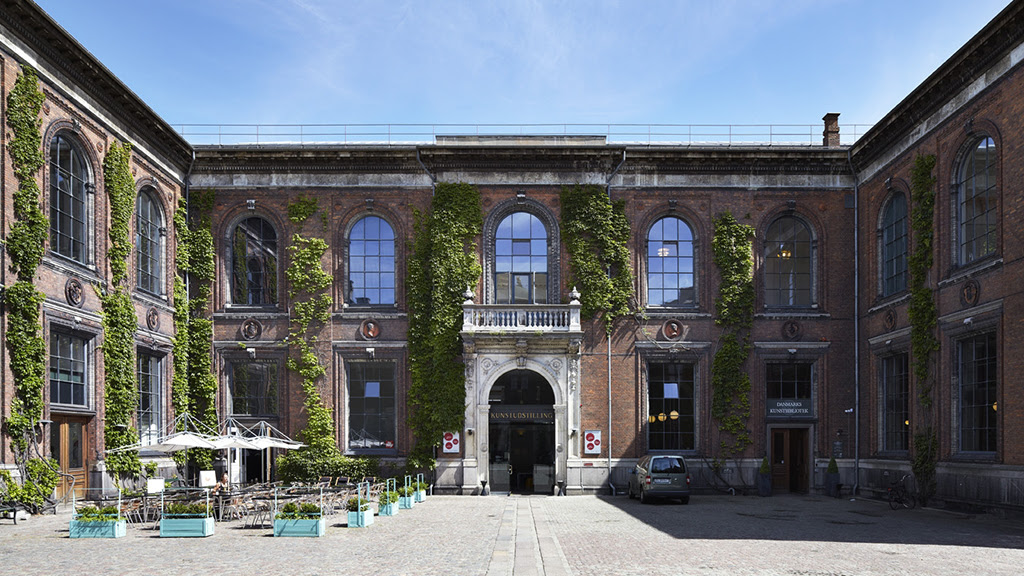
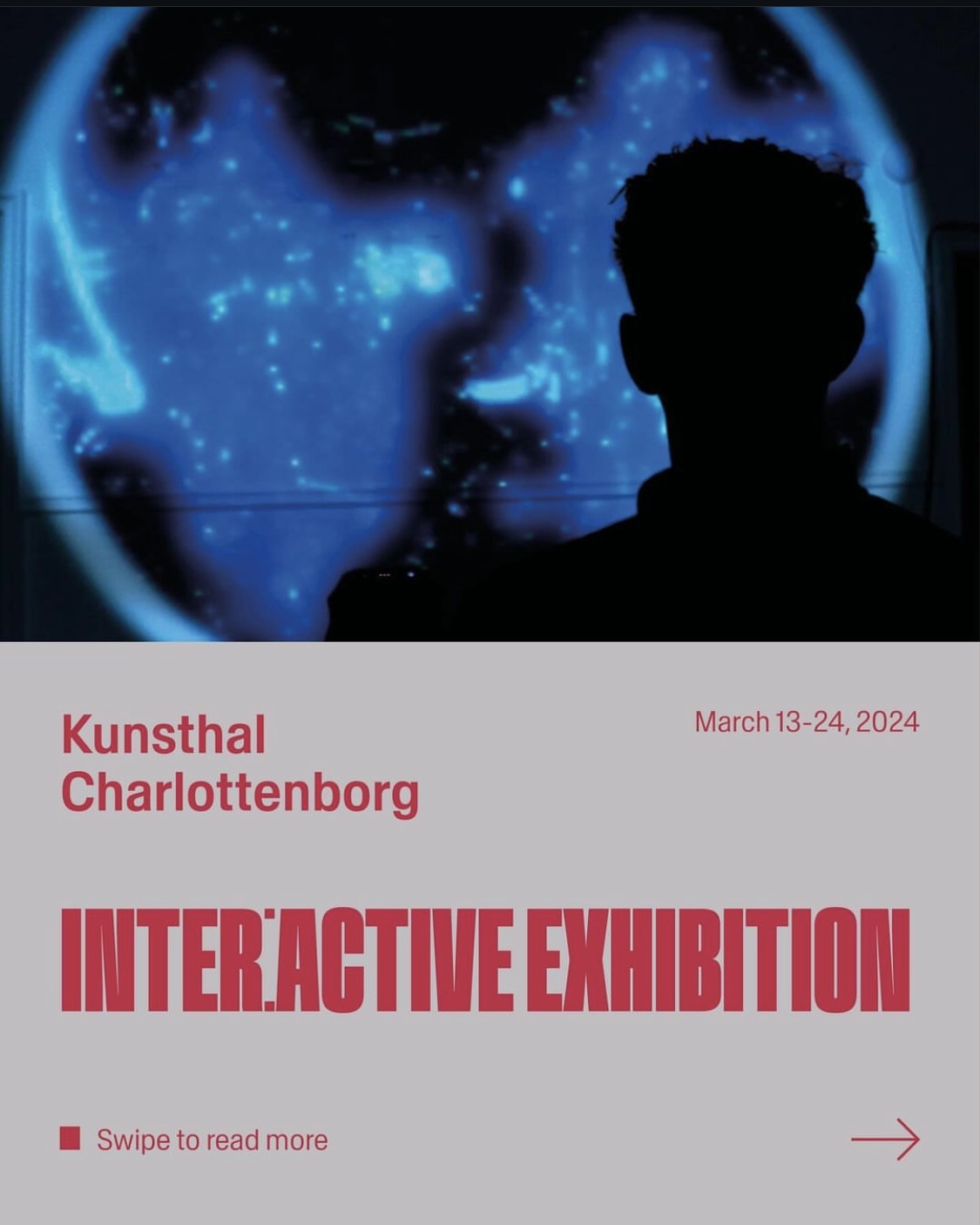

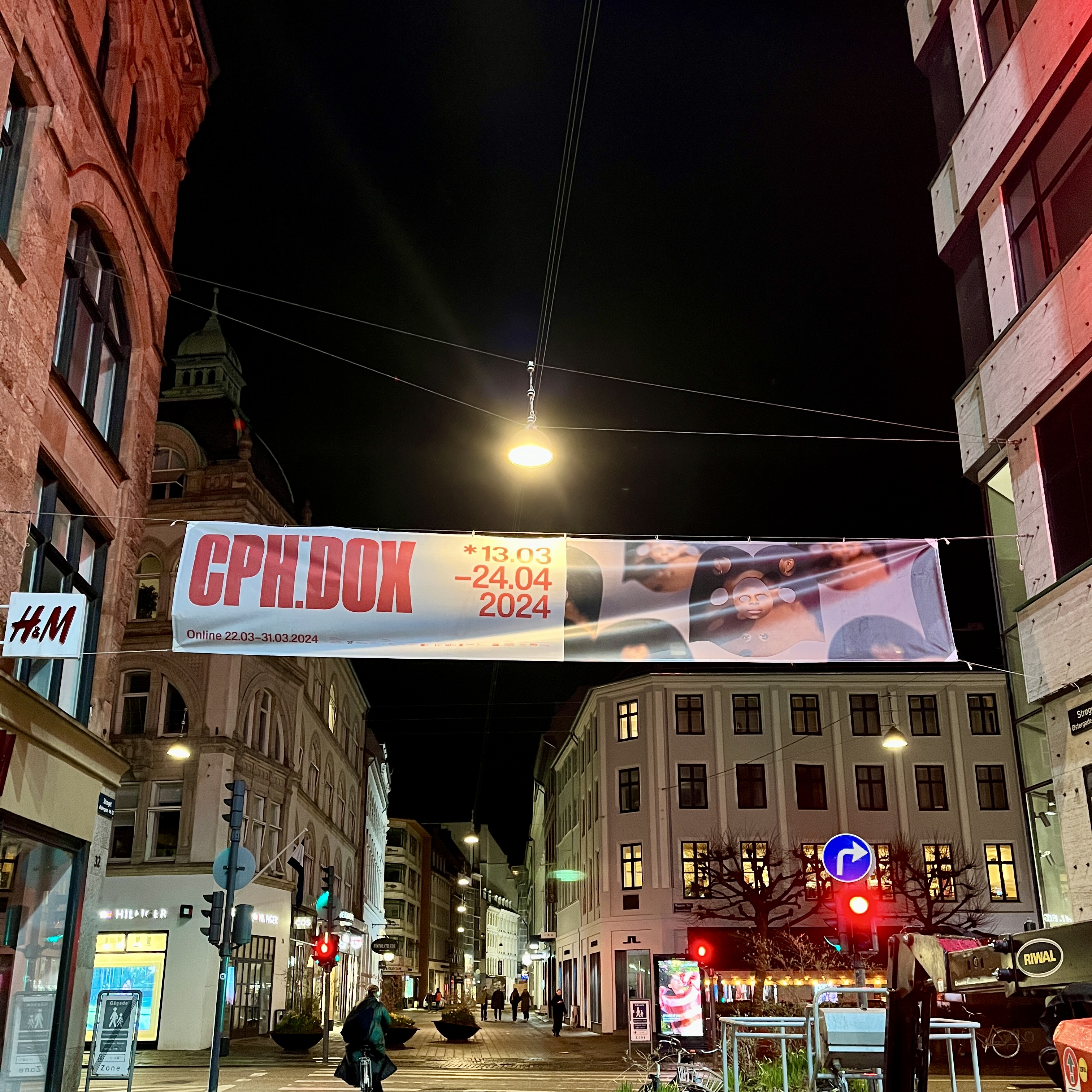
Who Do You Think You Are?: CPH:DOX Inter:Active exhibition
Kunsthalen Charlottenborg, Copenhagen, Denmark
March 13–24, 2024
An exploration of our changing relationships to our bodies. Through various media (games, immersive, interactive installations, video art, textiles, and AI), the presented artists examine shifts in how we relate to to our physical selves, our minds, society, and nature, to ask, is there any such thing as normal? How can we overcome perceived limitations? And what happens when we merge with the digital?
Curator: Mark Atkin


The Sky Below
Marin MOCA, San Rafael, CA
July 19–October 4, 2025
Set in the San Francisco Bay Area, The Sky Below brings together nine local artists who draw on feminist science and speculative fiction to imagine alternative futures. Inspired by authors like Ursula K. LeGuin, Octavia Butler, and NK Jemisin, the exhibition reclaims sci-fi tropes as tools for resistance and transformation. These works root futuristic visions in embodied experience, memory, and ecology. Blending craft traditions with new media, The Sky Below offers a grounded, expansive take on what lies ahead.
Curator: Heidi Rabben
Artists: Sofía Cordova, Solée Darrell, Julia Goodman, Maria Guzman Capron, Ranu Mukherjee, Genevieve Quick, Rel Robinson, and Astria Suparak



PRESS
V MAGAZINE CHINA, “Astria Suparak: The Asian future in Hollywood science fiction films,” Sept. 2023
This issue of V ART records Thai-American artist Astria Suparak’s long-term research project “Asian futures, without Asians.” She uses precise language like a scalpel cutting through the “human beings” that Hollywood science fiction films and television are keen to depict. The utopian illusion of a “community of shared future” points directly to the hidden ills in it — the superficial yearning and deep fear for foreign Asia.
In an in-depth conversation with V, Astria admitted that what she discussed was not just the appropriation of style: “It’s not just Asian objects, fashion, and architecture that are commonly appropriated and misused by white people, but also Asian skills, knowledge, philosophies, and religions. These rich and complex traditions are treated like discrete objects to pick apart and mix with other cultures, regardless of their meanings, histories, and origins.”
ARTFORUM, “To Your Eternity,” Today Art Museum 今日美术馆, Ekalan Hou, November 2023
In 1947, following the nuclear atrocities of World War II, Isamu Noguchi proposed a monument for a posthuman world. Sculpture to Be Seen from Mars is an abstract rendering of a human face (with a nose measuring one mile) that is visible only from outer space. Reproduced on a two-story-high panel in the atrium of Today Art Museum, Noguchi’s Sculpture embodies the balance that “To Your Eternity,” an art-and-technology-themed biennial curated by Xin Wang, strikes between the romance of synthetic appendages––an antenna stretched toward the cosmos, waiting for a signal––and the capitalist extraction, labor exploitation, and political subjugation that are often technology’s precondition and purpose. Rather than rehearse the tiresome drama pitching humanism against technological singularity, the biennial’s thirty artists understand artmaking, too, as a technical activity––one that stretches as far back as the days of stone carvings and lacquer work and creates glitches in structures of power as much as it is implicated in them. […]
The works in “To Your Eternity” show technology as a means of ecstatic communion with a great outside and as a condition of human fungibility, a mode of political control with pockets of concealment from mass surveillance: informer and witness, android dream and wish machine.
ARTREVIEW, “Sense of Reality,” Yao Boan, September 2023
[From online translation]
“I encountered Astria Suparak’s “On the Neon Horizon” ( 2023) and ” ASIAN FUTURES, WITHOUT ASIANS” (2022-2023) … The former is a false Asian future scenario created by white-dominated mainstream science fiction films for half a century. The latter is a comprehensive examination of the appropriation of Asian culture by the above-mentioned American science fiction films from seven aspects, including art, architecture and design, through performances and lectures. And whitewashed footage. […] Familiar Asian elements are reduced to an apocalyptic setting, and the artist’s job is to question where justice lies in that world.[…] The exhibition gave me a feeling of walking into the future calmly, but this is obviously contrary to common sense. At a time when technology is gradually controlling reality, how can I feel optimistic about the future? Back to the exhibition title “To the Immortal You”: the title comes from the Japanese anime of the same name. The story describes an object with an immortal body that can reproduce other existences, and gradually becomes “life” through encounters and separations with different species and people. This constantly migrating life technology may be one of the reasons why this exhibition is able to include so many works. By showing different dimensions of the technological world and even alternative assemblies of different works, the exhibition demystifies technology and liberates the audience here and now from the historical view of the science fiction apocalypse.”
KQED, “In ‘The Sky Below,’ Artists Depict Futures Worth Sticking Around For,” Sarah Hotchkiss, July 23, 2025
If some of the world’s richest men had their way, we’d think the future was all shiny silver surfaces and rockets blasting off to space. It’s a difficult vision to buck, especially when so much media bolsters it: movies keep putting ordinary men into space suits and tasking them with saving our dying planet. (Starring Ryan Gosling, out next March!)
But there’s another mode of science fiction, one that has distinctly West Coast roots. This strain of speculation looks inward and down — to the earth — for a more promising future. It’s this approach, put forth by sci-fi authors like Ursula K. Le Guin and Octavia Butler, that ties together the works in The Sky Below, a group show curated by Heidi Rabben for the Marin Museum of Contemporary Art. […]
The speculative futures depicted here are colorful, in more ways than one. Astria Suparak’s video On the Neon Horizon continues the artist’s investigation into mainstream white filmmakers’ depictions of “Asian futures, without Asians.” Here, we get an eight-minute supercut of Asian languages and cultures flattened into dangerous, crowded and miasmic backgrounds, again and again. Clips from the 1930s to the 2010s show this is neither a new, nor a diminishing trend. […]
In addition to swirls of color, satisfying textures and deeply researched narrative threads, The Sky Below boasts a reading room, complete with a vending machine from the Oakland bookstore Sistah Scifi. Each artist has recommended at least one work of science or speculative fiction, and Rabben and Mukherjee will both lead reading group meetings in August.
The futures imagined in this show — rooted in beauty, craft, handmade materials, care for land and people — are far more appealing (to me, at least) than the sterile, space-bound one I grew up believing in. It may take longer to see such visions enter our mainstream media, but until then, there’s a heck of a reading list to start with.
SQUARE CYLINDER, “The Sky Below,” Terri Cohn, Sept. 2025
“The Sky Below” is a heady, philosophical exhibition that feels especially resonant at our current historical moment. Curated by Heidi Rabben, whose research includes feminist science fiction, the show offers a counterpoint to the dystopian landscapes so often imagined in the genre — worlds shaped largely by male fantasies of conquest, control, and escape (the Star Wars franchise comes readily to mind).
Instead, Rabben highlights an alternative narrative where apocalyptic visions of Earth and the cosmos give way to visionary futures in which societies and technologies challenge entrenched patriarchal structures. These speculative worlds, emphasizing interconnection, transformation, and resilience, draw on the legacy of such writers as Mary Shelley, Ursula K. Le Guin, and Octavia Butler. Echoing these writers, the eight participating Bay Area artists — Maria Guzmán Capron, Astria Suparak, Genevieve Quick, Ranu Mukherjee, Sofía Córdova, Rel Robinson, Solee Durell, and Julia Goodman — reimagine history and technology through feminist and ecological lenses. Together, they suggest that the infinite potential so often projected into the cosmos may, in fact, be found beneath our feet and within the subconscious.
Guzmán Capron’s textile sculptures merge human, animal, and celestial forms, dissolving boundaries between material and speculative identities. Suparak’s video and digital collages expose exclusionary tropes in mainstream science fiction, particularly concerning power and the portrayal of Asian cultures as exotic or threatening, and reclaim them through feminist critique. By contrast, Quick casts herself as a time traveler or alien observer in works that recast space exploration as a metaphor for cultural displacement and survival. Her interactive “Hi. This is Mom and Dad” (2019–2024), in which faux scholar’s space rocks light up to play voicemail messages from her parents, draws us into a touching personal orbit. […]
The Spanish painter Remedios Varo’s “The Sky Below” (1958) (also known as “Papilla Estelar (Star Porridge)”) provides a powerful historical precedent. In this work, a woman grinds “star stuff” to feed a caged moon. It’s a haunting metaphor for alienation and fortitude that informs the exhibition’s central proposition: that even in confinement or adversity, imagination fuels transformation.
Like Varo’s painting, most works here remind us that whether gazing outward to the cosmos or inward to the psyche, resilience and creativity remain at the heart of human survival. These artists insist that hope and creativity are not distant stars, but enduring human capacities.
ARTNET, “When technology and art have ’emotions’, what kind of philosophical thinking can be triggered?,” Li Jingyue, August 28, 2023
(Online translation from Chinese) “The “To the Immortal You – The 4th Today’s Future Museum” currently on display at Today Art Museum is an unexpected exhibition about art and technology. Although the audience can wear VR and go on a visual fantasy journey, the exhibition is still like a multiverse, all-encompassing. […]
Everything is about technology and the future, but nothing is cliché. In “To the Immortal You”, it seems that the definitions of technology, intelligence and art can become emotional and philosophical, and the time scale of discussion can not only exist in the future, but also the past and present, or even the present. Make a connection. “Asian futures, without Asians” is reminiscent of the way Hollywood is currently failing the Chinese market. No matter how brilliant those Asian movies are, Asians will feel that they have nothing to do with them […]
As of today, the exhibition has transcended the seemingly opposing themes of art and technology, and the present and the future. Surface-level thinking, trying to further reveal those seemingly impossible juxtapositions across regions and time from an international perspective and art historical research perspective. The title and theme of the exhibition comes from the 2021 anime “To the Immortal You,” which tells the story of an amorphous alien entity that forms various forms of inorganic matter, plants, and animals by inhabiting the life cycles of different species. The stories of animals and their incarnations as humans echo the different forms and themes of the exhibited works. By inserting important art history cases from the mid-20th century into the current artistic creation context, the curator invites the audience to have more in-depth humanistic thinking based on the technological means we currently have and the changes in the world we are facing.”
RELATED WORKS
- On the Neon Horizon video
- Aloha, Boys installation
- Tropical Fruit in European Still Lifes slide show
- Asian Futures multipart research series, which includes videos, installations, collages, essays, publications, and other projects
- Check out the posts tagged #scifi
 Astria Suparak