“HELMET TO HELMET”
Astria Suparak and Caroline Washington
Collage, 8 x 10 inches
2021
Commissioned by Seen journal (BlackStar Festival)
https://bit.ly/helmet-to-helmet
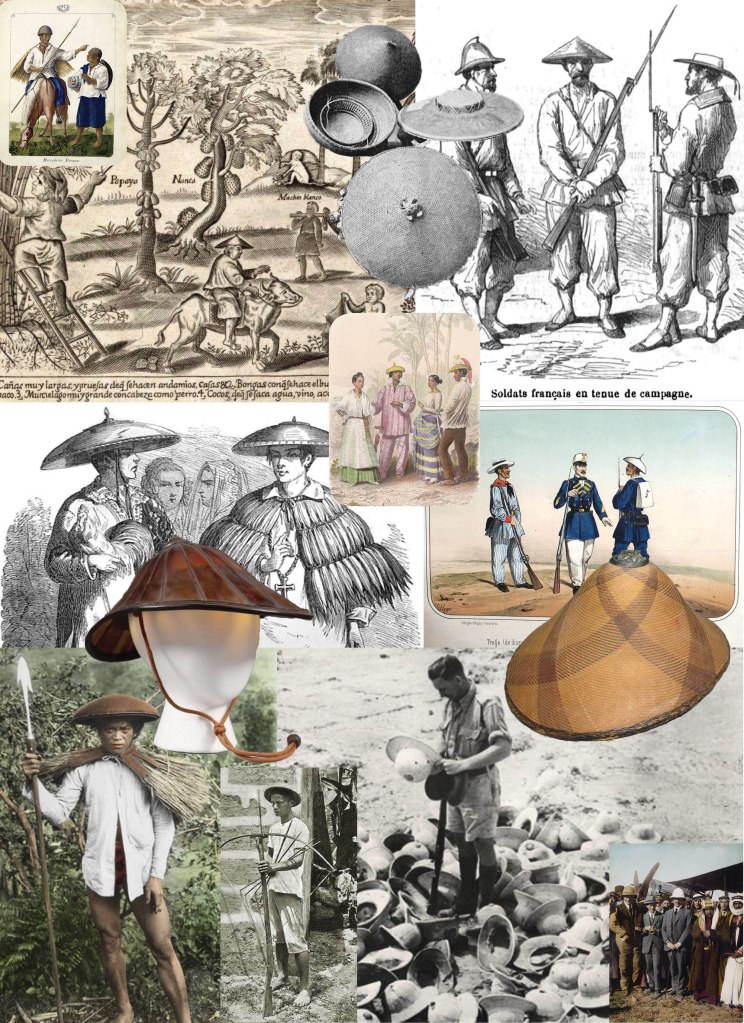
A collage of the Philippine salakót (roughly translates from Tagalog to “native helmet”). Embedded within the work is a timeline of how the ancient Asian technology was worn in the early 1700s by the people of the Philippine islands, then by Filipinos and Spaniards serving in the occupying Spanish army, and eventually adapted into the pith helmet. “So prolifically deployed by every white colonial power, the Asian-descended pith helmet became a symbol of colonialism itself” (Suparak).
The collage is composed of imagery from historical illustrations, photographs, prints, and artifacts from the early 1700s to the 20th century.
This collage was created to accompany Astria Suparak's essay "SEEDY SPACE PORTS AND COLONY PLANETS: Asian Conical Hats in Cinematic Dystopias," and is part of her ongoing research project, Asian futures, without Asians.
SOURCE IMAGERY
1. José Honorato Lozano, Mercaders Ilocanos (Ilocano Merchants), 1847, from Vistas de las islas Filipinas y trajes de sus habitantes, via Biblioteca Digital Hispánica.
2. Various Philippine animals and plants, detail from Carta Hydrographica y Chorographica de las Islas Filipinas (1734) by Pedro Murillo Velarde, Nicolás de la Cruz Bagay, Francisco Suarez, via Wikimedia Commons.
3. Salakots and women’s hats, from The Inhabitants of the Philippines (1900) by Frederic H. Sawyer, via Wikimedia Commons.
4. French soldiers in Indochina circa 1861, from the French publication L’Illustration, via militarysunhelmets.com.
5. Working-class Tagalog attire from the Spanish colonial era, with barong tagalog, esclavina (rain capes), and salakot, from Aventures d’un Gentilhomme Breton aux iles Philippines by Paul de la Gironiere (1855) by Paul de la Gironiere, via Wikimedia Commons.
6. Philippoteaux (artist) and Pierre (engraver), Oceanie: Habitants de Manille, Malais de I’lle Luçon, 1859, published by Dufour, Mulat, and Boulanger, via correosfilipinas-blog.tumblr.com.
7. Trage de Diario Sargento 2º de Gala, from Album de la Infanteria Española: desde sus primitivos tiempos hasta el día (1861) by Serafín María de Sotto, 3rd Count of Clonard, via Wikimedia Commons.
8. Filipino salakot made of tortoiseshell, made before 1899, courtesy of the Natural History Museum of Los Angeles County.
9. Tinggian rain cape (plaited straw) from the Philippines. Photo by Dean C. Worcester, from The National Geographic Magazine, 27 November 1913.

10. Sandatahan with crossbow, northern Luzon, 1898, via 1898miniaturas.com.
11. A British soldier picks a sun helmet from a pile left behind by Italian troops in the Western desert. June 1941. Crown Copyright provisions, via Wikimedia Commons.
12. Late-nineteenth century salakot from the Philippines, via militarysunhelmets.com.
13. On the Aerodrome at Amman. Col. Laurence [T.E. Lawrence, a.k.a. Lawrence of Arabia], Sir Herbert Samuel, Amir Abdullah, April 1921. Photograph by unnamed American Colony Jerusalem Photo Dept., from American Colony Jerusalem Collection, via Wikimedia Commons.
PUBLICATIONS
“SEEDY SPACE PORTS AND COLONY PLANETS: Asian Conical Hats in Cinematic Dystopias,” Astria Suparak, SEEN Journal, 2021
“We, the Aliens of the Future,” Astria Suparak, Stephanie Syjuco: The Unruly Archive (Santa Fe: Radius Books, 2024)
RELATED WORKS
- SEEDY SPACE PORTS AND COLONY PLANETS: Asian Conical Hats in Cinematic Dystopias visual essay
- Tang Rainbow installation
- Asian futures, without Asians performance
- White Robot Tears installation
- From the series, Asian futures, without Asians.
 Astria Suparak