- Short & Long bios
- Name pronunciation & Pronoun
- Contact & Social Media info
- CV
- Press
“Astria Suparak’s research-based multi-media practice exposes society’s latent biases […] with a refined logic that leverages our popular culture media landscape into an urgent questioning of the status quo.”
— Joseph Becker, Curator of Architecture & Design at SFMOMA and Artadia Award juror
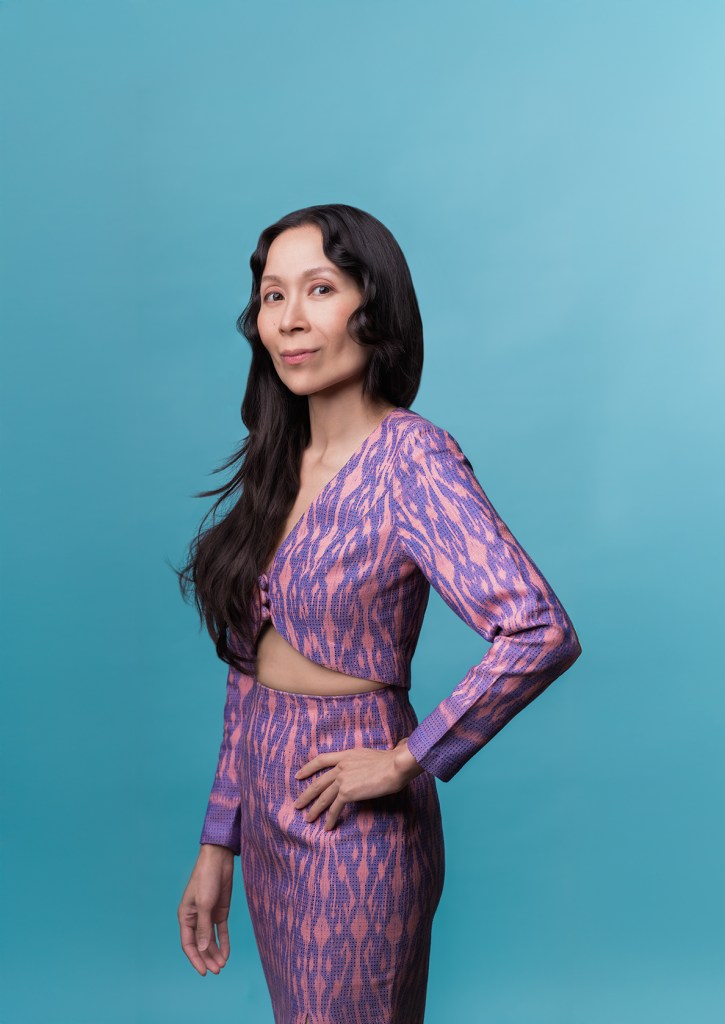
Astria Suparak’s multidisciplinary practice addresses how institutionalized racism, classism, and colonialism are embedded in popular culture, such as in science-fiction movies, rock music, memes, and sports.
Using creative and scholarly modes, Suparak’s projects chronicle subcultures and omitted perspectives. Her series Asian Futures is an incisive taxonomy of white Western film tropes, tracing their references and precursors through histories of architecture, fashion, religion, and science; the Asian futures, without Asians multimedia performance was described as “cathartic, brilliant” (Variable West) and “a compelling yet brutally honest exploration.” (The Michigan Daily). Suparak’s Tropicsss series proposes possible, expanded affinities and solidarities across geographies and national borders. Her Sports series playfully challenges the assumption that the worlds of sports, art, and politics are mutually exclusive.
In the past four years, Suparak’s installations, videos, and performances have been presented at the Museum of Modern Art, New York; the Institute of Contemporary Art, Los Angeles; the Walker Art Center, Minneapolis; and ArtScience Museum, Singapore.
She has curated exhibitions, screenings, and performances that are “visually and conceptually stunning” (Hyperallergic) with “savvy political consciousness,” for institutions and festivals including the Liverpool Biennial; Museo Rufino Tamayo, Mexico City; MoMA PS1 and The Kitchen, New York; Carnegie Museum of Art, Pittsburgh; and Expo Chicago, as well as for unconventional spaces such as roller-skating rinks, sports bars, and rock clubs.
A recipient of the 2022 San Francisco Bay Area Artadia Award, Suparak lives and works in Oakland, California.
LONG BIO below.
INFO
Pronunciation: “AH-stree-uh SOOper-ack” (“AH” like the “a” in apple)
Pronoun: She
Contact: astria.suparak (at) gmail.com
Social Media: @AstriaSuparak on Instagram, Facebook, Twitter/X; @astriasuparak1 on YouTube
Location: San Francisco Bay Area, California, USA
Press photo: Email request for a higher resolution photo.
LONG BIO (~600 words)
Astria Suparak’s cross-disciplinary practice often addresses complex and urgent issues, and has been widely acclaimed for its high level concepts made accessible through a popular culture lens. A recipient of the 2022 San Francisco Bay Area Artadia Award, she lives and works in Oakland, California.
Her materials are sourced from museums, libraries, oral histories, news stories, social media, and popular culture. Highlighted creative projects include her series Asian Futures, an incisive taxonomy of white Western film tropes that traces their references and precursors through histories of architecture, fashion, religion, and science; the Asian futures, without Asians multimedia performance was described as “cathartic, brilliant” (Variable West) and “a compelling yet brutally honest exploration.” (The Michigan Daily). Suparak’s Tropicsss series proposes possible, expanded affinities and solidarities across geographies and national borders. Her Sports series playfully challenges the assumption that the worlds of sports, art, and politics are mutually exclusive.
Highlighted curatorial projects include Alien She, a traveling group exhibition on the impact of the global punk feminist movement Riot Grrrl; Whatever It Takes: Steelers Fan Collections, Rituals, and Obsessions, an exhibit that reframed sports fanaticism as a significant form of cultural production; and the Sports issue of INCITE Journal of Experimental Media, which was accompanied by a series of exhibitions, screenings, dialogues, and artist projects.
Described as prescient and “visually and conceptually stunning,” Suparak’s work has garnered critical praise from The New York Times, Artforum, Art In America, Hyperallergic, The Washington Post, Fast Company, The Hollywood Reporter, The Los Angeles Times, and The San Francisco Chronicle for its innovative approaches, “savvy political consciousness,” unique contribution to local and larger cultural spheres, and ability to bridge diverse audiences.
Using creative and scholarly modes, Suparak’s projects chronicle subcultures and omitted perspectives. In the past five years, Suparak’s projects have been exhibited and performed at the Museum of Modern Art and the Ford Foundation Gallery in New York; the Institute of Contemporary Art, Los Angeles; the Walker Art Center, Minneapolis; Spike Island, Bristol, UK; the Future of Today Biennial, Today Art Museum, Beijing; ArtScience Museum, Singapore; the Wattis Institute for Contemporary Arts, San Francisco; and as part of the For Freedoms billboard series. Her artwork has been published in Art and Knowledge After 1900: Interactions Between Modern Art and Thought (Manchester University Press, 2023), BlackStar Festival’s Seen journal, and the anthology Why are they so afraid of the lotus? (The Wattis and Sternberg Press). Her writing has appeared in Art21 Magazine, The Walker Magazine, The Getty blog, Queer Threads: Crafting Identity and Community, and The Museum Is Not Enough.
Suparak has curated exhibitions, film screenings, performances, discussions, and live music events for art institutions and festivals across ten countries, including the Liverpool Biennial; Museo Rufino Tamayo, Mexico City; MoMA PS1, The Kitchen, and Eyebeam in New York; the Walker Art Center, Minneapolis; Carnegie Museum of Art, Pittsburgh; and Expo Chicago, as well as for unconventional spaces such as roller-skating rinks, ferry boats, sports bars, and rock clubs. Her curatorial practice has explored science, political and community activism, sports, and feminism, among other topics.
Suparak previously served as the director and curator of the contemporary galleries at Carnegie Mellon and Syracuse University, and of the Pratt Institute Film Series. Beyond a robust curatorial practice, she’s worked in every aspect of arts administration from fundraising to marketing to management. Suparak has taught in the Fine Arts and Curatorial Practice graduate programs at the California College of the Arts and in the Museum Studies Program at the University of San Francisco. She has advised various art organizations and served on numerous juries, boards, and panels, including Creative Capital, the Alpert Awards, Headlands Center for the Arts, the Mike Kelley Foundation, and Brooklyn Museum.
Astria Suparak (Αστρια ศุภรักษ์) studied studio art and art history at Pratt Institute.
 Astria Suparak